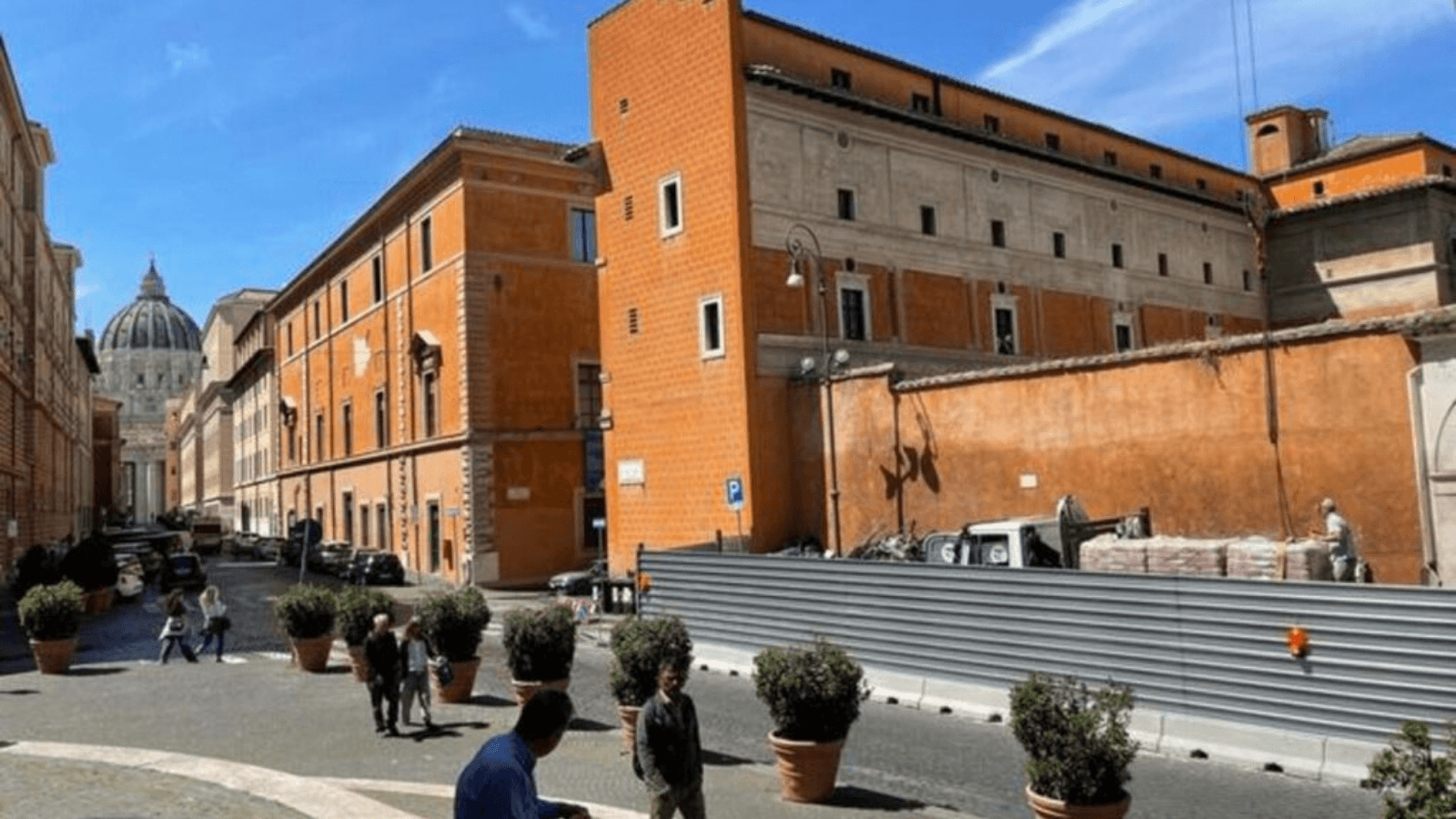
More than a thousand years ago, an English traveler arriving in Rome could reach the area beside the Vatican and St Peter’s and find a community where people from Anglo-Saxon England were not simply passing through.
Recent excavations beneath the Palazzo della Rovere have added unusually vivid evidence to that picture. Archaeologists identified twenty Anglo-Saxon coins alongside traces of leatherworking, boneworking and metalworking, suggesting that the district connected with the Schola Saxonum functioned as more than a temporary refuge for pilgrims.
The finds point instead to a settled, working community whose residents may have stayed in Rome for long periods and maintained close economic ties with their homeland.
An English community beside St Peter’s
The Schola Saxonum stood near St Peter’s and the River Tiber, in an area that became one of medieval Rome’s most international quarters.
Despite its name, the institution was not a school in the modern sense. It served travelers and residents from Anglo-Saxon England, offering accommodation, religious support and practical assistance close to the city’s major Christian shrines.
Other foreign communities maintained similar institutions nearby, including Franks, Frisians and Lombards. Together, they created a landscape around St Peter’s shaped by migration, pilgrimage and long-distance connections.
The Saxon presence proved particularly durable. Even today, the name “Sassia” survives in the district near the Vatican, most famously in Santo Spirito in Sassia.
Written sources had long established that the community existed. What remained much harder to reconstruct was the daily life of the people who occupied it.
The coins people left behind
Excavations beneath the Palazzo della Rovere have now supplied evidence from that everyday world.
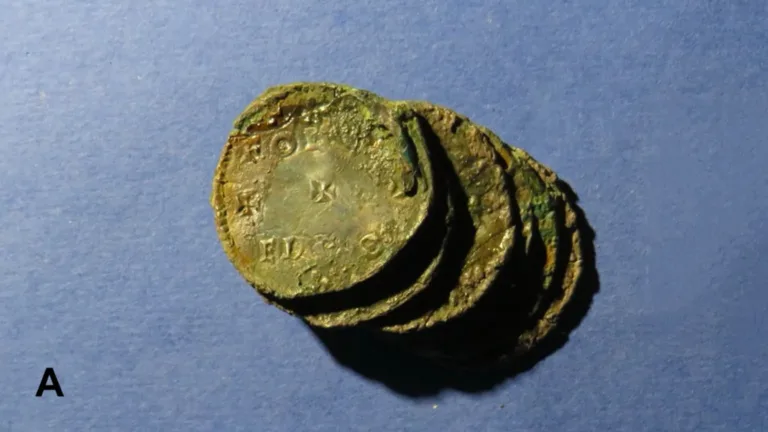
Researchers identified nineteen silver pennies and one halfpenny minted in Anglo-Saxon England during the reigns of Edward the Elder, Æthelstan and Eadred. The coins came from several regions, including London, Kent, East Anglia and the West Midlands.
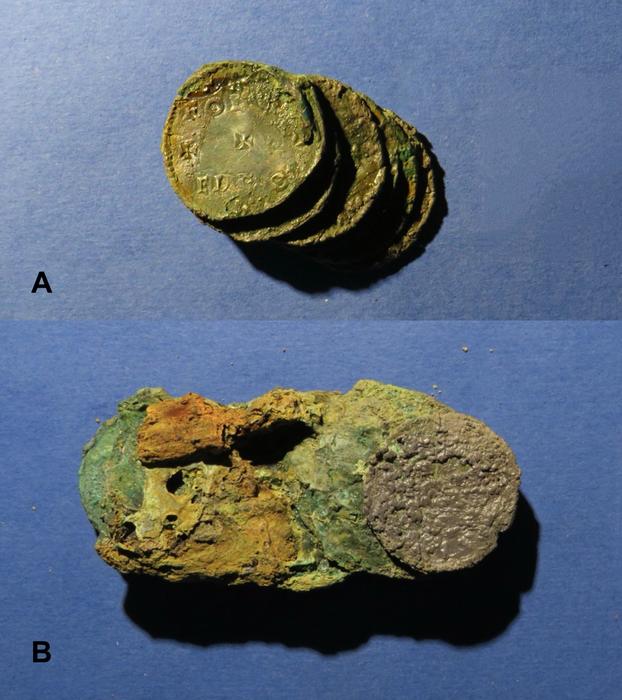
Fourteen were recovered from rubbish pits in two fused groups, while others appeared separately in the archaeological layers.
Their significance lies not only in where they were minted, but in the contexts in which they were found. These were not coins assembled as a formal hoard or deposited ceremonially. Their distribution instead suggests money that had moved through an inhabited and economically active neighborhood before being lost or discarded.
The halfpenny is particularly revealing. A small denomination fits naturally within a setting where people were making ordinary payments for goods and services rather than carrying money only for major transactions.
A neighborhood of workshops
The coins form only part of the picture. Across at least 3,000 square meters, archaeologists uncovered evidence connected with leatherworking, boneworking and metalworking. Those traces suggest that the district supported craft production as well as accommodation.
That changes how the Schola Saxonum can be imagined. Pilgrims arriving from England may have encountered people from home who were repairing equipment, making objects, selling goods or providing services rather than simply preparing for the return journey.
Historian Rory Naismith of the University of Cambridge has suggested that hundreds of people may have lived within the community on a permanent or semi-permanent basis.
Taken together, the archaeological evidence points toward something closer to an expatriate neighborhood than a simple pilgrims’ hostel: a small pocket of Anglo-Saxon society operating beside the Tiber.
Why Anglo-Saxon money was circulating in Rome
The presence of so many English coins raises an obvious question: how were they being used?
Foreign visitors normally had to deal with currency exchange, and papal coinage dominated much of Rome’s monetary system. Yet the Anglo-Saxon coins recovered from the site came from working and domestic contexts rather than from an obvious stock of silver intended for melting.
Italian and papal coins were also found, indicating that different currencies may have circulated side by side.
Naismith and historian Francesca Tinti have therefore considered whether the English community may have enjoyed some form of special monetary treatment. The idea remains a hypothesis, but written sources offer an intriguing parallel.
Asser, the biographer of Alfred the Great, recorded that Pope Marinus I released the Schola Saxonum from “every tribute and toll” in 883 after Alfred intervened on behalf of the English community.
That passage does not prove that Anglo-Saxon coins later held a formally protected status in Rome. It does, however, show that the community could receive exceptional privileges from the papacy, making the archaeological evidence for English money particularly significant.
Everyday lives behind royal connections
The relationship between Anglo-Saxon England and Rome is often told through kings, popes and missionaries.
Gregory the Great supported the mission that helped convert the Anglo-Saxons to Christianity in the late sixth century. English rulers later maintained close religious and diplomatic links with Rome, sending money, travelers and representatives south across Europe.
The discoveries beneath the Palazzo della Rovere shift attention away from those elite connections.
Here the evidence is smaller and more personal: lost coins, workshop debris and the traces of repeated daily activity. Together, they suggest that some English visitors did more than arrive, pray and leave.
Cover Image: Palazzo della Rovere near St Peter’s Basilica in Rome, where excavations uncovered evidence linked to the medieval Anglo-Saxon community of the Schola Saxonum. Credit: University of Cambridge.