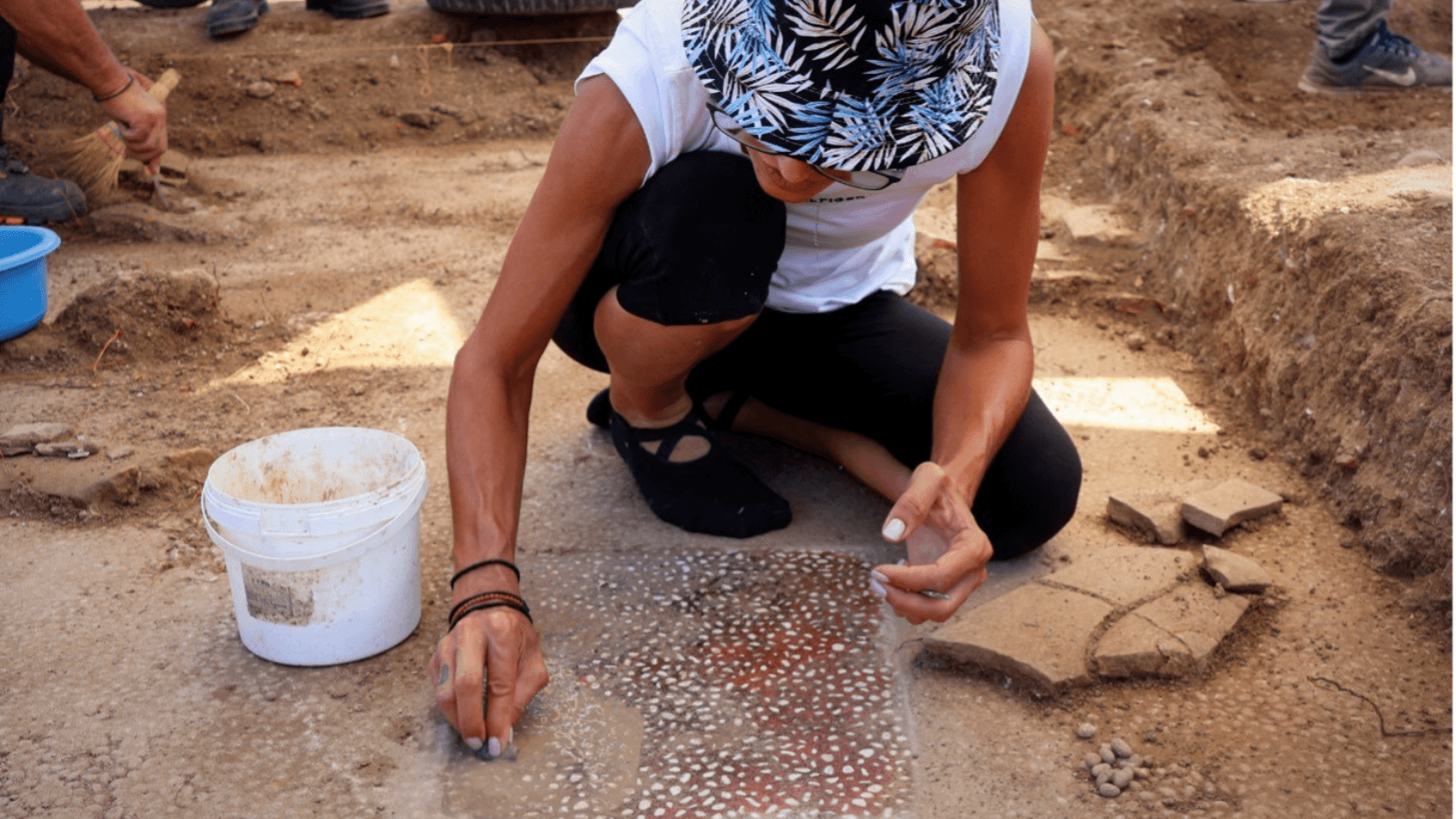
The school linked to Alexander the Great at ancient Mieza was not devoted to lectures and physical training alone. Archaeologists have also uncovered mosaic-floored rooms where members of Macedonia’s young elite appear to have reclined, dined and talked together.
Archaeologists excavating the Royal Gymnasium of Mieza in northern Greece have uncovered a large structure containing two banquet halls, each arranged for ten dining couches. The discovery opens an unusually intimate window onto the institution associated with Aristotle, the young Alexander the Great and the sons of Macedonia’s ruling elite.
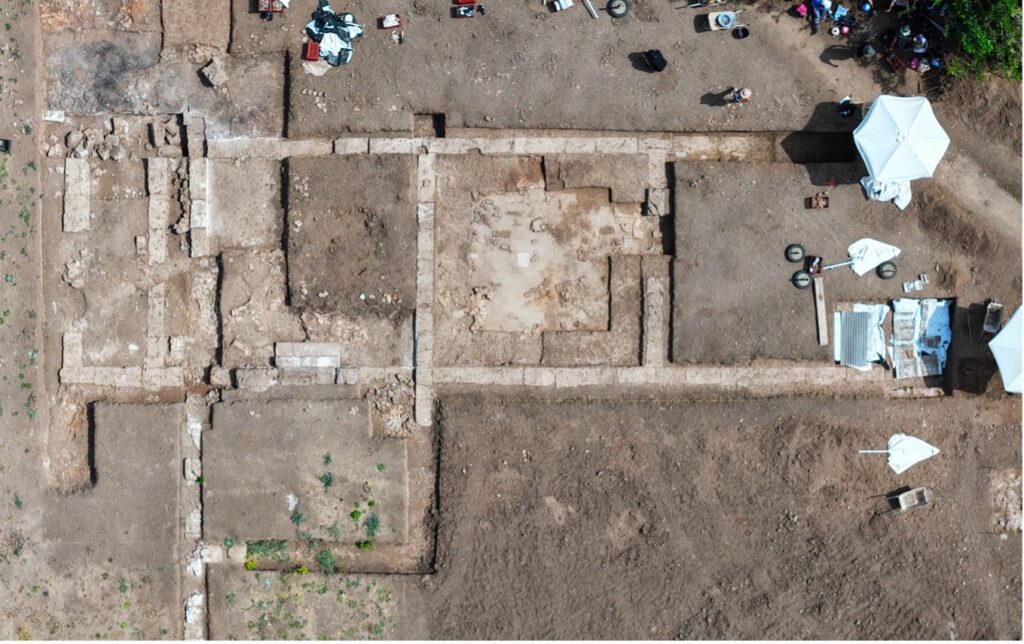
The newly investigated structure covers more than 160 square meters within a section identified as the “Teaching School.” According to Greece’s Ministry of Culture, it consists of a central vestibule flanked by two andrones—formal dining rooms traditionally used for male gatherings.
Both halls preserve mosaic floors and raised platforms on which dining couches once stood. With ten couches in each room, the two spaces could accommodate at least 20 diners at the same time.
A school that looked like a palace
These were not ordinary dining rooms added to a modest provincial school. The workmanship and construction techniques of their floors closely resemble those found at the royal palace of Aigai, the ceremonial center of the ancient Macedonian kingdom.
That architectural connection places the Mieza complex firmly within the world of Philip II, whose reign transformed Macedonia into the dominant power of the Greek world during the fourth century BCE.
The gymnasium dates to the middle of that century, when Alexander was still a prince. Archaeologists believe the growing body of evidence strengthens its identification as the royal institution where Aristotle taught Alexander and other young Macedonian nobles.
No inscription has yet emerged declaring that Aristotle lectured in one particular room. The identification instead rests on the complex’s date, monumental scale, royal architectural character and location within Mieza, which ancient tradition associates with the philosopher’s teaching.
The banquet rooms now add another layer to that picture. They suggest that education at Mieza extended beyond physical training and formal instruction into the social world of the symposium, where elite men ate, drank, debated and reinforced personal alliances.
For Alexander and his companions, such gatherings may have formed part of their preparation for court life and leadership. Some of the young men educated alongside him would later become commanders, officials and rulers across the territories conquered by the Macedonian army.
Lecture rooms, training grounds and a 200-meter portico
Systematic excavation of the site began in 2024 under the direction of honorary ephor of antiquities Dr. Angeliki Kottaridi. The research is being conducted through an agreement between Greece’s Ministry of Culture and the Municipality of Naousa.
The complex extends across approximately 30 stremmas, or 7.4 acres. Excavations have revealed portions of a palaestra, a stadium, roofed colonnades, lecture rooms and water-management installations, showing that the institution combined intellectual education with athletic training.
One of its most imposing features is the xystos, a covered portico about 200 meters long. Such spaces allowed athletes to continue exercising when weather conditions made outdoor training difficult, but the monumental scale of the structure at Mieza also reflects the status of the institution and the people educated there.
This year, archaeologists concentrated on the eastern side of the unified palaestra and teaching complex. Lecture rooms equipped with stone benches were identified in the same general area as the banquet halls, placing formal teaching and elite communal dining within a carefully planned architectural setting.
Four styluses, pottery, coins and architectural elements have also been recovered from the wider site. Although modest beside the monumental buildings, the styluses are evocative objects associated with writing and learning at an institution created for the education of young Macedonians.
Surviving a deliberate dismantling
Much of the Royal Gymnasium was systematically dismantled by the Romans after the defeat of the Macedonian pretender Andriscus at the Second Battle of Pydna in 148 BCE. Stone blocks and other reusable architectural materials were removed, leaving parts of the complex stripped to their foundations.
Yet substantial remains survived beneath destruction deposits and evidence of an extensive fire. Archaeologists have documented ancient floors, walls coated with exceptionally fine mortar and enough architectural material to begin reconstructing the appearance of the buildings.
Among the finds from the palaestra are sections of an Ionic frieze, an Ionic architectural support and a capital. A rare fragment of a corner Doric architrave from the peristyle could prove especially valuable in determining how the palaestra’s colonnades were arranged.
Together, the discoveries portray the Mieza gymnasium as a monumental royal foundation rather than a simple local training ground. Its close similarities to the palace at Aigai suggest that the visual language of royal architecture extended into the environment where Macedonia’s future leaders were educated.
The site has long been connected with one of history’s most famous teacher-and-student relationships. The newly uncovered dining rooms bring that association closer to daily life, revealing a place where lessons, exercise, meals and political relationships may all have formed part of the same education.
Excavations are continuing, and the identification of the complex remains an archaeological interpretation supported by accumulating evidence rather than a conclusion secured by a single inscription. Even so, the physical outline of the institution is becoming clearer: a vast royal school built for bodies and minds, but also for the shared table around which a generation of Macedonian leaders may have learned how power worked.
Cover Image: An archaeologist uncovers part of a mosaic floor inside the Royal Gymnasium complex at ancient Mieza in northern Greece. Credit: Hellenic Ministry of Culture