
Hidden deep within the rugged canyons and rainforests of Isalo National Park, the archaeological site of Teniky has long been regarded as one of Madagascar’s most perplexing enigmas. Carved sandstone niches, dry-stone walls, and its extreme isolation have puzzled researchers for decades. For years, the dominant explanation linked the site to shipwrecked Portuguese sailors of the 16th century. A new academic study now directly challenges this long-standing interpretation.
A Settlement Older Than European Contact
According to reporting in Iran Times, Teniky may predate European activity in the Indian Ocean by several centuries. The study proposes that the site was founded between the 10th and 12th centuries, not by accidental castaways, but by Zoroastrian communities fleeing persecution in Persia. This reframes Teniky as a purposefully chosen religious refuge, rather than a survival camp created by chance.
Rock-Cut Niches and a Distinct Persian Signature
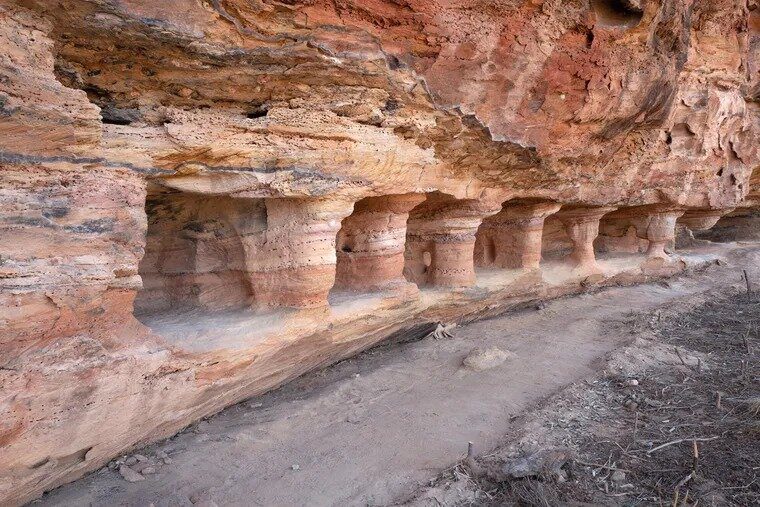
The most visually striking element of Teniky is the series of carefully carved rock niches embedded in the sandstone cliffs. These features closely parallel funerary niches used in Zoroastrian ritual landscapes of the Fars region in Iran. In Zoroastrian belief, burying the dead was forbidden, as it polluted the sacred elements of earth and water. Bodies were exposed, and only the cleaned bones were later placed in rock-cut chambers.
What makes Teniky exceptional is that this architectural tradition has no known parallels in Madagascar or East Africa, while it is well documented in Persian contexts.
Radiocarbon Evidence Strengthens the Argument
Scientific analysis adds further weight to the hypothesis. Carbon-14 dating of charcoal samples recovered from the site confirms occupation centuries before Portuguese explorers reached the region. This timeline aligns closely with the period following the Arab conquest of Persia, when Zoroastrian populations increasingly faced political and religious pressure. Medieval Islamic geographical sources referring to Madagascar as “Wakwak” indicate that the island was known within early maritime knowledge systems, making a long-distance Persian voyage historically plausible.
Unresolved Questions in an Isolated Landscape
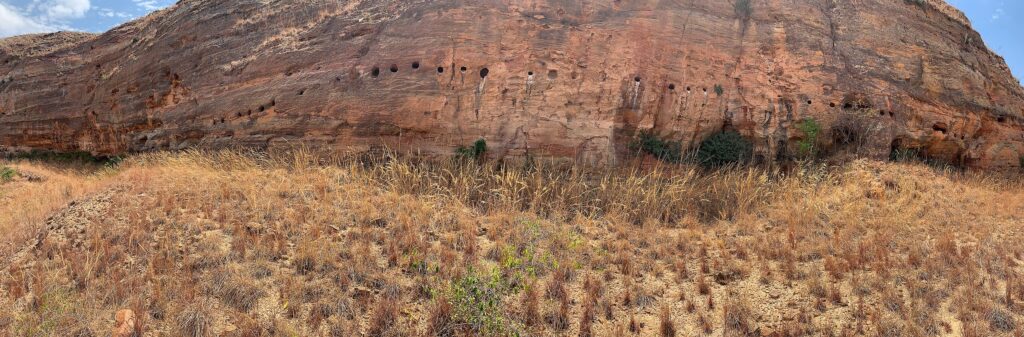
Despite the compelling evidence, Teniky remains deeply enigmatic. No human remains have been identified within the niches—an absence researchers suggest may result from later ritual removal by subsequent groups. The site’s location, more than a hundred miles from the coast, raises further questions about why such a remote interior setting was chosen and how the settlement sustained itself. Local fauna, including river eels, wild boar, and lemurs, may have played a role in subsistence. Meanwhile, the presence of defensive dry-stone walls suggests that the community perceived a need for protection, although the nature of any threat remains unknown.
A Discovery with Far-Reaching Implications
If confirmed, Teniky would represent one of the most unexpected examples of early transoceanic religious migration. Such a finding would significantly alter current understanding of Madagascar’s early human history and the wider Indian Ocean cultural network. Rather than a relic of European misadventure, Teniky may stand as a silent testament to a medieval Persian community, whose members undertook an extraordinary journey in search of spiritual survival and sanctuary.
Source / Reference
Guido Schreurs et al., Teniky: enigmatic architecture at an archaeological site in southern Madagascar, Azania: Archaeological Research in Africa (2024).
DOI: 10.1080/0067270X.2024.2380619