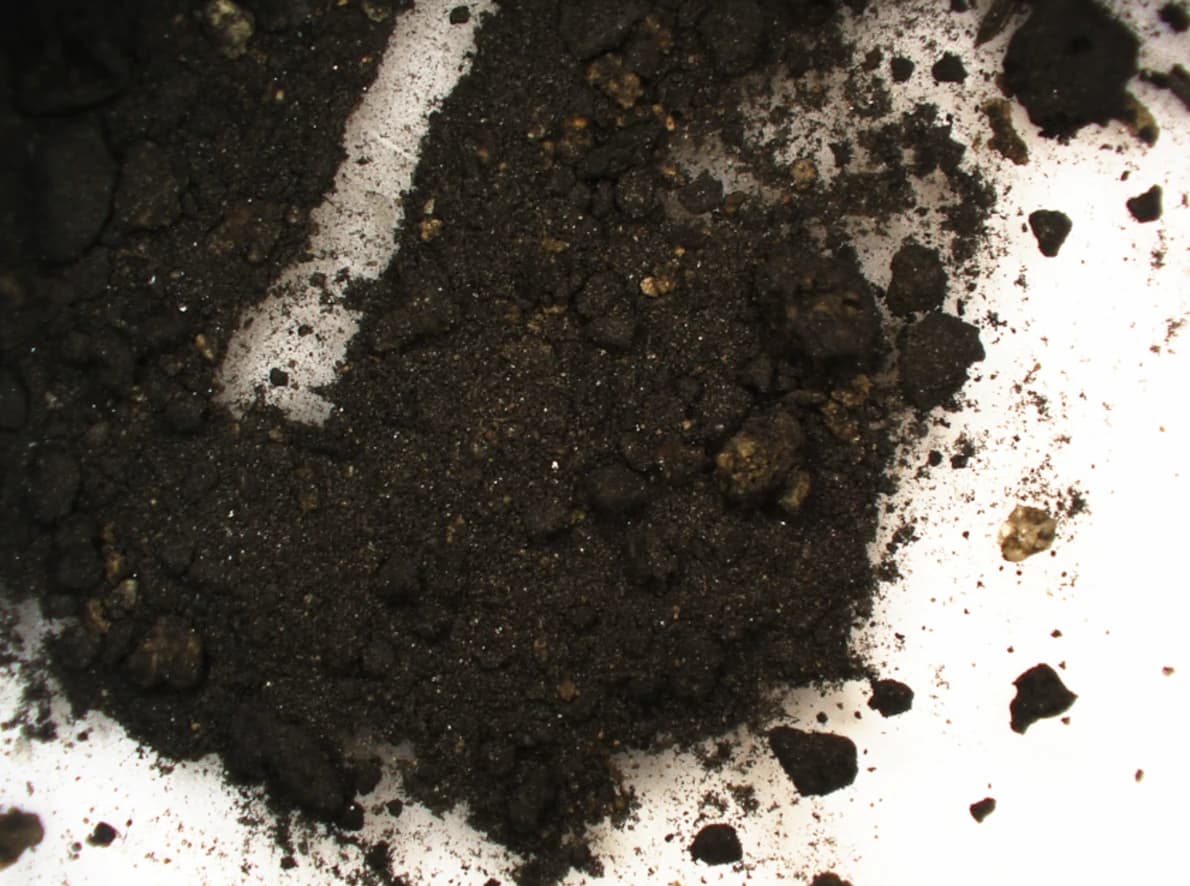
It began with a small bronze cylinder nobody expected to matter. But the inkwell recently re-examined in Conimbriga—one of the best-preserved Roman cities in Portugal—has turned out to be one of the most disruptive finds in the study of ancient writing. Inside the vessel, sealed for nearly two millennia, researchers identified the chemical traces of an ink far more advanced than anything previously confirmed in the western provinces of the Roman Empire.
A Modest Object with Unusual Consequences
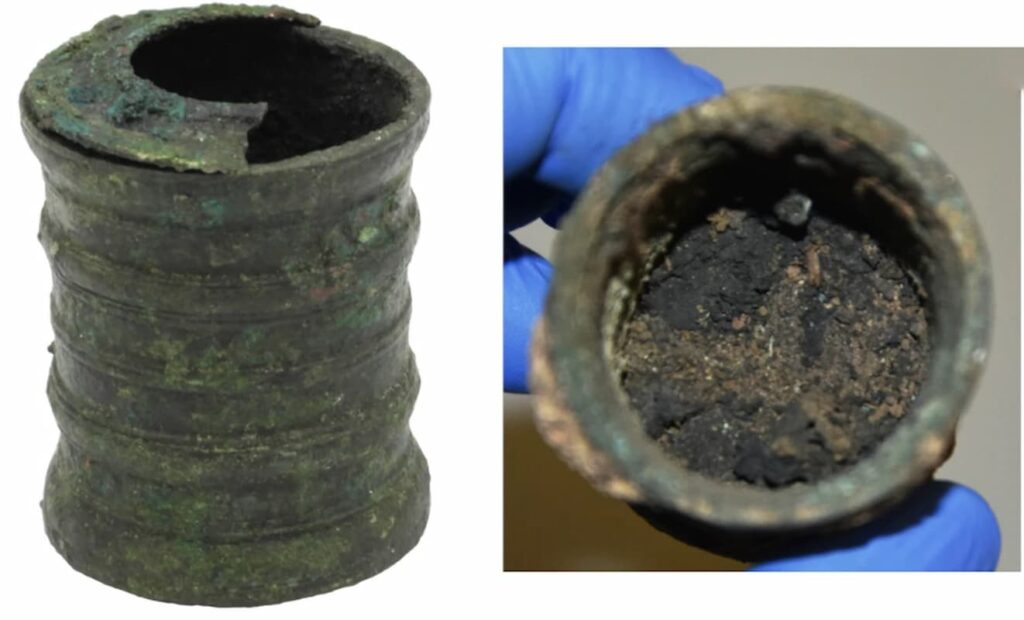
The object itself is unremarkable at first glance: a 94-gram Biebrich-type bronze inkwell, originally crafted in the early 1st century CE. Typologically, these inkwells are linked to northern Italy and the Rhine frontier—contexts dominated by engineers, surveyors, and military scribes. Finding one in Lusitania already signaled mobility. Discovering that it contains the earliest known archaeological proof of a mixed-ink recipe pushes the implications much further.
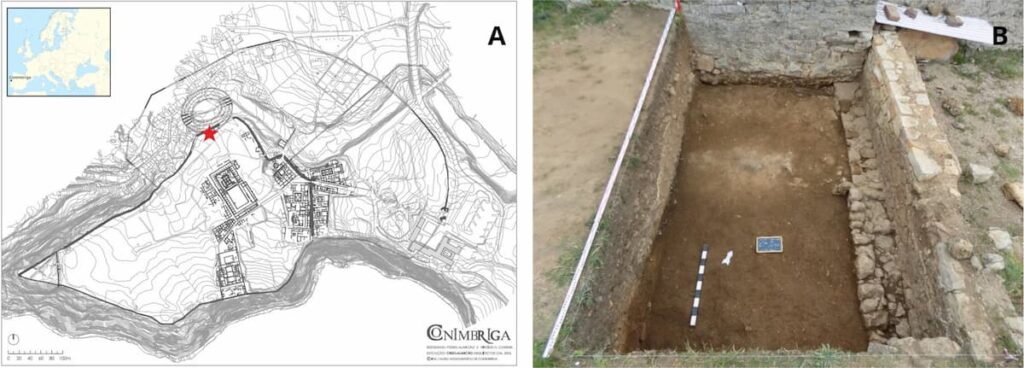
The inkwell was recovered from construction layers tied to the demolition of Conimbriga’s amphitheater, suggesting it slipped from the kit of a literate official—possibly someone overseeing fortification works. The stratigraphy dates its final deposition to the 3rd–4th century CE, but the inkwell itself was clearly older, likely carried for decades before being lost.
Inside the Ink: A Recipe No One Expected
Most Roman inks were simple carbon suspensions that rarely survive. But this inkwell protected a compact, sealed residue that allowed scientists to deploy high-resolution pyrolysis-GC/MS, NMR, XRF, and chromatographic analysis—revealing a formulation far more sophisticated than conventional Roman carbon ink.
The chemical profile shows a hybrid mixture consisting of:
- Carbon soot from resin-rich conifer wood
- Bone black derived from calcined animal bone
- Iron-gall components, far earlier than expected in the western provinces
- Beeswax used as a thickener and cohesive agent
- Animal-based binders improving flow, viscosity, and long-term adhesion
This is not experimental guesswork—it’s a direct molecular fingerprint.
Why This Matters: A Technological Leap in Roman Literacy
Each ingredient served a targeted function. Carbon provided the base black, bone black enriched opacity, iron-gall elements increased permanence, and the wax–fat binders created a protective finish that rendered the script resistant to moisture, abrasion, and oxidation. In effect, Roman scribes in Lusitania were applying a proto–oil-based ink centuries before such formulas are traditionally recorded.
The study also indicates that a volatile diluent—similar to turpentine—was likely added during preparation, evaporating after application and leaving behind a glossy, hardened writing surface. This parallels what is known from Vindolanda’s tablets, but the Conimbriga example predates them and shows a different chemical signature.
What It Reveals About Knowledge Networks
The presence of such an advanced ink in western Iberia is not a trivial detail. It signals:
- Highly mobile specialists (surveyors, engineers, administrators).
- Rapid transfer of technical knowledge across the Empire.
- Provincial access to specialist pigments and refined metalwork.
- A literate bureaucracy that relied on durable, transport-resistant writing materials.
Conimbriga has already produced styluses, wax tablets, and counting tools. This inkwell completes the picture: literacy here was supported by a fully developed technological ecosystem—not the simplified version often assumed for provincial towns.
Rewriting the Timeline of Roman Ink Technology
Scholars may now need to reconsider the evolution of Mediterranean writing technologies. Mixed inks have long been cited in texts but almost never confirmed archaeologically. This discovery pushes back their adoption and expands their geographical range. It shows that innovation did not flow only from Rome outward; provincial communities were also sites of adaptation, hybridization, and creative problem-solving.
Conclusion — What Survived in the Bronze Cylinder
For two thousand years, the inkwell sat quietly beneath layers of stone and debris. Its contents, however, speak loudly: about mobility, technological competence, and the administrative machinery that held an empire together. It is a rare case where chemistry gives voice to a forgotten scribe—someone whose ordinary daily work has suddenly become a landmark in the history of writing.
Oliveira, C., Bottaini, C., Kaal, J. et al. Tracing literacy in Roman Conimbriga: insights from the metallurgy and ink of a Biebrich inkwell. Archaeol Anthropol Sci 17, 216 (2025). doi.org/10.1007/s12520-025-02330-3
Cover Image Credit: Residues extracted from the inkwell’s interior and analyzed using advanced laboratory techniques. C. Oliveira et al., 2025.