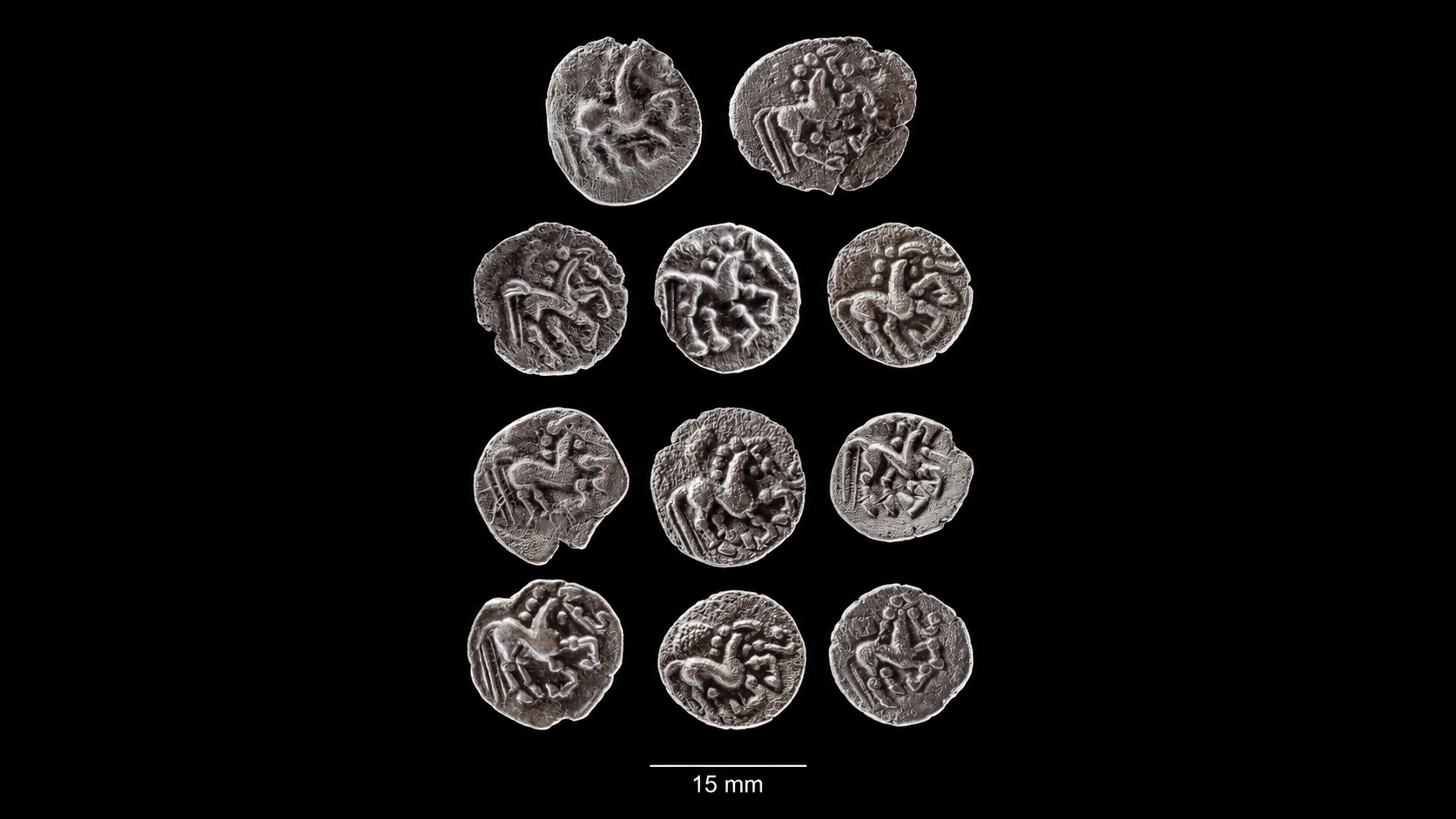
Eleven small silver coins discovered beneath a former sports field in central Germany have been identified as the largest Celtic hoard of its kind ever recorded in Thuringia. Although centuries of farming had pulled the coins away from their original hiding place, archaeologists were able to show that they once formed a single deposit.
The coins were found at Singen, a village near Stadtilm in the Ilm district, where the former playing field is being cleared for a new fire station. All 11 are silver quinarii dating to the first century BC, when Celtic communities occupied and traded across parts of what is now central Germany.
A treasure disturbed by the plough
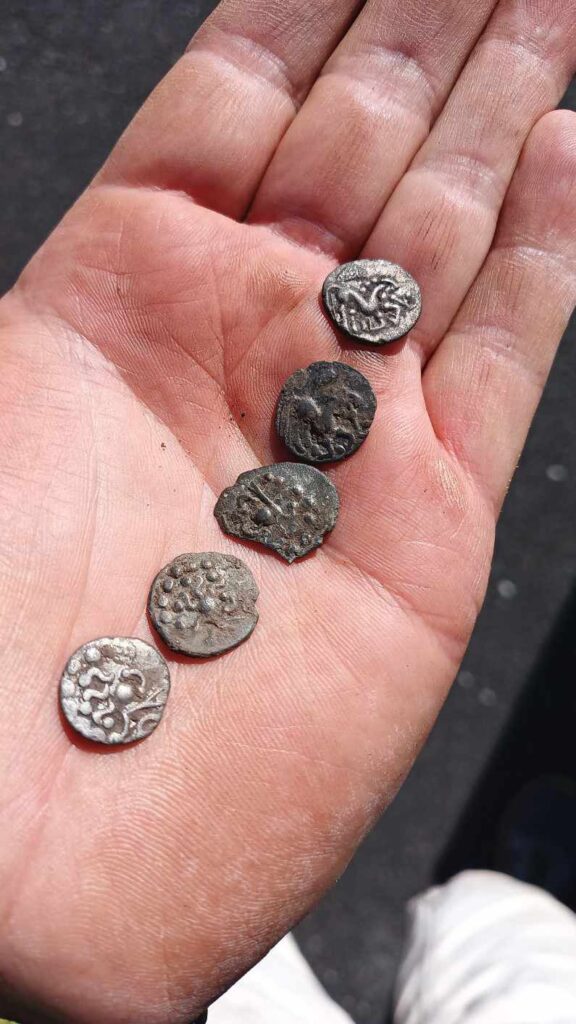
The first coins appeared during archaeological monitoring of construction work in July and August 2025. Their discovery prompted a more focused investigation in August 2026, when archaeologists returned to examine the surrounding ground and determine whether the pieces belonged together.
They found that the coins had been dispersed across a narrow strip measuring approximately 5.8 by 1.5 meters. The pattern was consistent with repeated ploughing, which had gradually dragged the objects away from the place where they were originally buried.
No fragments of pottery or a metal container were recovered beside them. Archaeologists therefore suspect that the silver may have been placed in a small pouch or another container made from an organic material that later decomposed.
The scattered condition could easily have made the coins appear to be unrelated losses. Careful recording of their positions, however, allowed the excavation team to reconstruct the deposit and identify the coins as a single hoard.
Eleven coins transform the regional record
All 11 coins belong to a group known as Prague-type quinarii. Only about 80 examples of this coin type had previously been documented across Thuringia, making the Singen group unusually important despite its modest size.
The hoard represents more than one-tenth of the known Prague-type quinarii from the entire state. Andreas Hummel, regional officer at the Thuringian State Office for Heritage Management and Archaeology (TLDA), described it as the most extensive Celtic hoard of this period yet discovered in Thuringia.
The coins are thought to have been minted during the first century BC, possibly at a workshop in the Gotha region northwest of Singen. Further study may help refine their dating and determine where they were produced.
Archaeologists have not established why the coins were buried or whether their owner ever returned for them. With no surviving container or associated objects, the circumstances behind the deposit remain unknown.
A clue to Celtic movement through Thuringia

Singen lies between the proposed production area around Gotha and several important Celtic sites farther south. Among them is the Steinsburg near Römhild, a fortified settlement and major center of craft activity during the Iron Age.
The location gives the hoard significance beyond the coins themselves. It provides another point from which researchers can examine how silver, manufactured goods and people moved between settlements in Iron Age Thuringia.
Other objects found during the work show that the site continued to attract activity long after the Celtic period. Archaeologists also recovered a Roman denarius dating to AD 164–169, an early medieval glass bead, a silver coin from the 16th century and a Prussian uniform button from the 19th or early 20th century. These later objects were documented separately and are not considered part of the Celtic deposit.
Although ploughing had moved the coins from their original position, their distribution preserved enough evidence for archaeologists to recognize them as a single deposit. The discovery now offers one of the clearest indications yet of how Celtic silver circulated through Iron Age Thuringia.
Cover Image: The 11 Celtic silver quinarii discovered at Singen, shown with stylized horse motifs. Credit: H. Arnold / TLDA, Weimar.