
Pompeii’s Lost Ceiling Reveals Dionysus and Ariadne Above an Ancient Banquet Hall

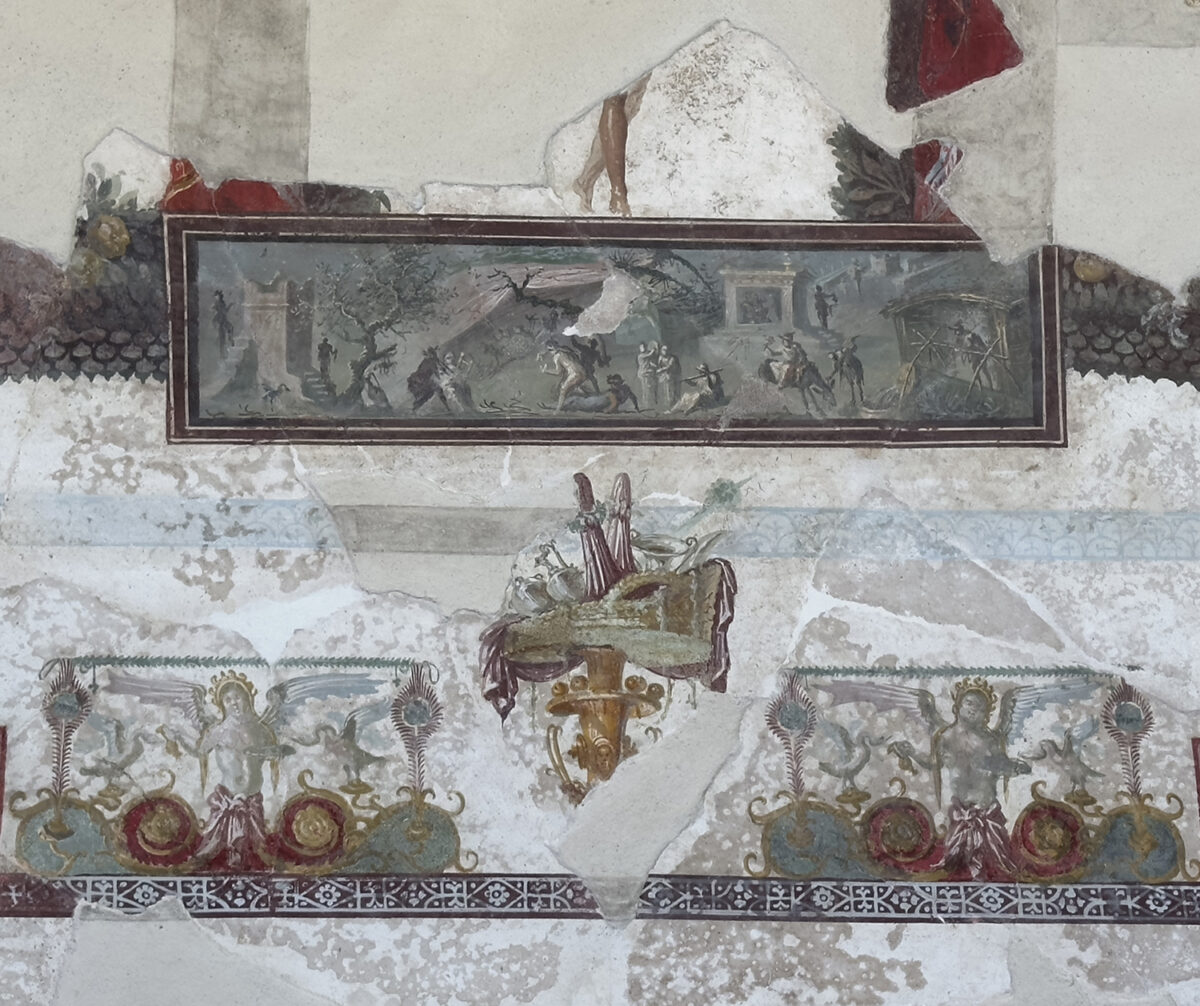
A richly painted ceiling that once covered an upstairs banquet hall in Pompeii has been partially reconstructed from hundreds of fragments recovered beneath the room’s collapse. The restored section, from the House with the Bakery in Regio IX, reveals an elaborate mythological composition centred on the sacred union of Dionysus and Ariadne. Conservators have so far reassembled more than a quarter of the original vaulted ceiling, while additional pieces may still be identified during continuing excavations. The fragments were found where the upper floor of the house had fallen, allowing archaeologists to determine which room they originally decorated. Their positions were documented during excavation, and researchers began identifying connections between the pieces before conservation work formally started. Dionysus and Ariadne at the Centre The reconstructed decoration was arranged around a large central panel surrounded by architectural frames, floral garlands, winged figures, personifications of the seasons and other ornamental motifs. Although much of the main scene remains missing, comparisons with similar Roman artworks have helped specialists identify its subject. Dionysus is shown reclining on a chariot opposite Ariadne, who appears to be playing a harp. A winged Eros accompanies her with another stringed instrument, while two centaurs depicted as musicians pull the chariot. The scene represents the hierogamy, or sacred marriage, of Dionysus and Ariadne. References to the Dionysian world continue across the rest of the ceiling through theatrical masks, ritual vessels, drinking equipment and garlands filled with fruit and flowers. Such imagery would have been especially suited to a banquet room, where wine, music and performance formed part of Roman social life. Guests dining in the upstairs hall would have looked up at a composition celebrating Dionysus, the god associated with wine, theatre and ecstatic ritual. A Reconstruction Designed to Grow One of the most unusual aspects of the project is the support created for the surviving fragments. Instead of mounting the paintings on a conventional flat panel, conservators developed a curved structure that reproduces the shape of the original vault. Its exact form could only be established gradually as more fragments were joined together. The modular support also allows new pieces to be added without dismantling the existing reconstruction. This was necessary because other fragments linked to the ceiling remain in storage, while additional sections could emerge as archaeological work continues inside the house. Only pieces whose original positions could be established with sufficient confidence were included. Uncertain areas were left incomplete rather than being filled with hypothetical reconstructions. Pompeii Archaeological Park Director Gabriel Zuchtriegel said the project demonstrated how archaeological conservation could also become an opportunity for research and international collaboration. The ceiling adds to a series of recent discoveries connected with Dionysus in Regio IX. Between 2024 and 2025, excavations at the nearby House of the Thiasus uncovered a monumental painted procession associated with the god. Together, the two discoveries show how Dionysian mythology shaped some of Pompeii’s most richly decorated domestic interiors. In the House with the Bakery, however, the ancient image is still incomplete—and may continue to expand as more pieces of the collapsed ceiling are recovered and identified.

A richly painted ceiling depicting Dionysus and Ariadne, once suspended above an upstairs banquet hall in Pompeii, has been partially reconstructed from hundreds of fragments recovered beneath the room’s collapse.

The restored section comes from the House with the Bakery in Regio IX. Conservators have so far reassembled more than a quarter of the original vaulted ceiling, while further pieces may still be identified as excavations continue.

The fragments were found where the upper floor of the house had fallen, allowing archaeologists to determine which room they originally decorated. Their positions were documented during excavation, and researchers began identifying connections between the pieces before conservation work formally started.
Pompeii’s Lost Ceiling Reveals Dionysus and Ariadne Above an Ancient Banquet Hall
Credit: Pompeii Archaeological Park

Dionysus and Ariadne at the Centre

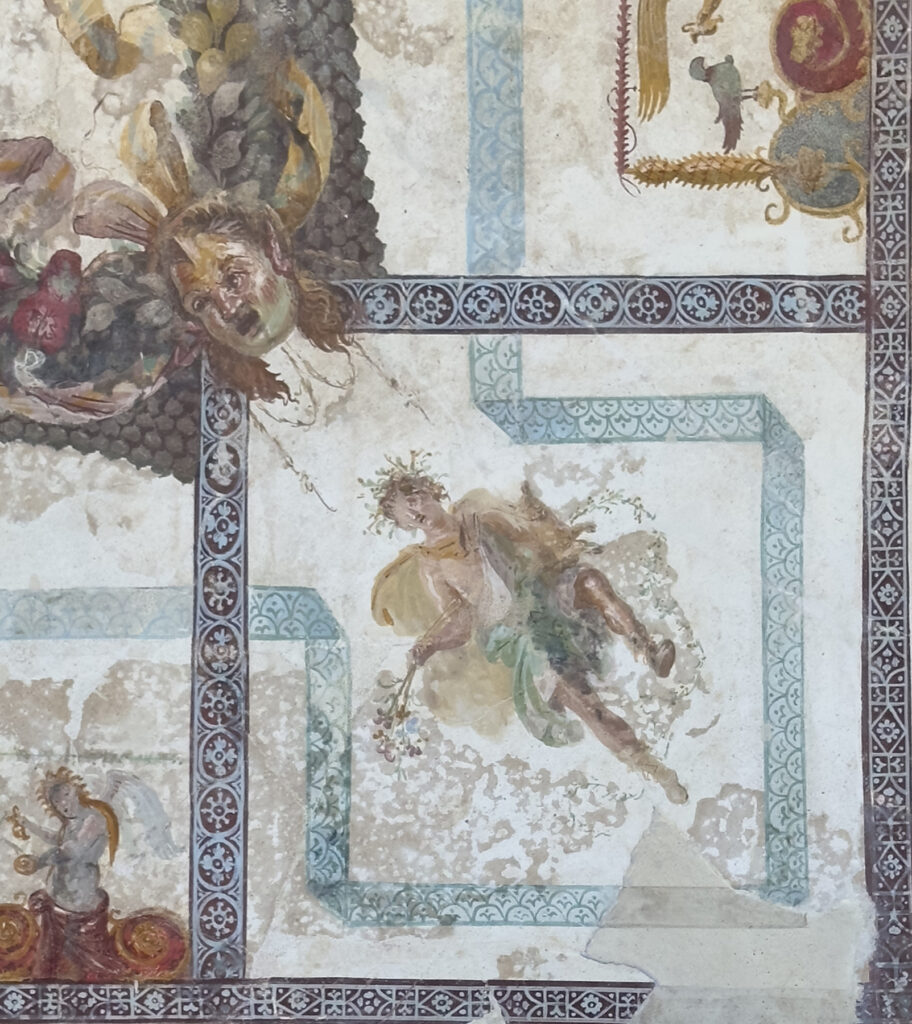
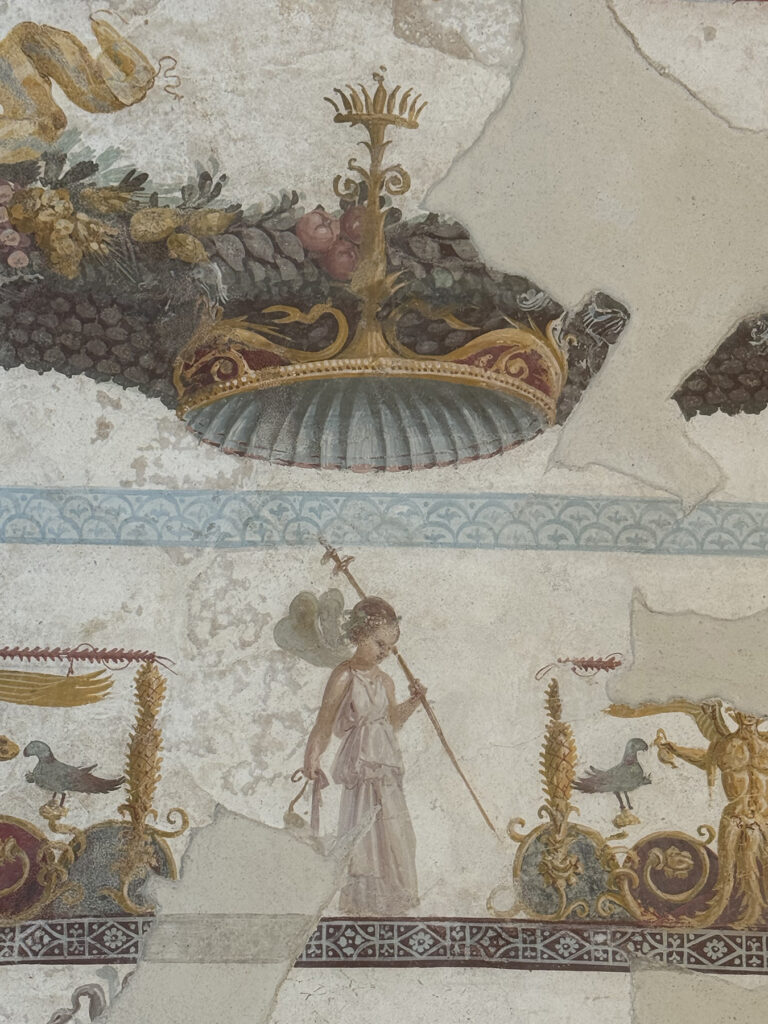
The reconstructed decoration was arranged around a large central panel surrounded by architectural frames, floral garlands, winged figures, personifications of the seasons and other ornamental motifs.

Although much of the main scene remains missing, comparisons with similar Roman artworks have helped specialists identify its subject.

Dionysus is shown reclining on a chariot opposite Ariadne, who appears to be playing a harp. A winged Eros accompanies her with another stringed instrument, while two centaurs depicted as musicians pull the chariot.
Credit: Pompeii Archaeological Park

The scene represents the hierogamy, or sacred marriage, of Dionysus and Ariadne. References to the Dionysian world continue across the rest of the ceiling through theatrical masks, ritual vessels, drinking equipment and garlands filled with fruit and flowers.

Such imagery would have been especially suited to a banquet room, where wine, music and performance formed part of Roman social life. Guests dining in the upstairs hall would have looked up at a composition celebrating Dionysus, the god associated with wine, theatre and ecstatic ritual.

A Reconstruction Designed to Grow

One of the most unusual aspects of the project is the support created for the surviving fragments.

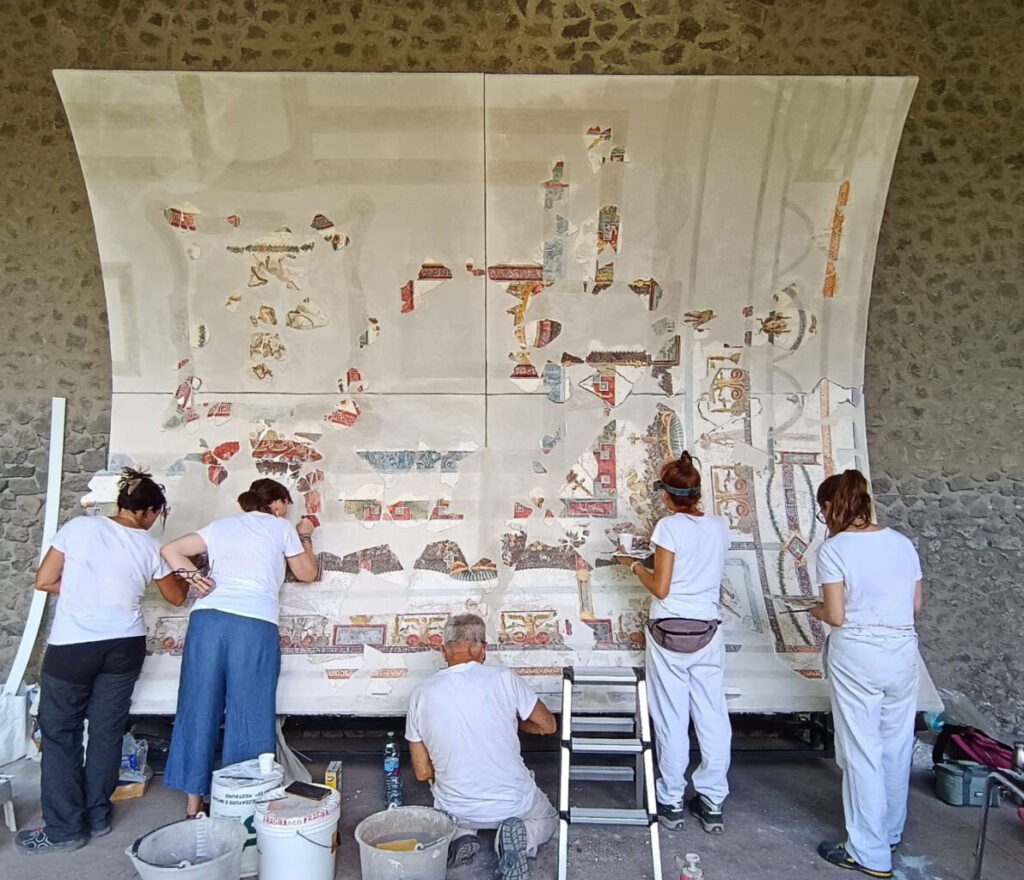
Instead of mounting the paintings on a conventional flat panel, conservators developed a curved structure that reproduces the shape of the original vault. Its exact form could only be established gradually as more fragments were joined together.
A richly painted ceiling that once covered an upstairs banquet hall in Pompeii has been partially reconstructed from hundreds of fragments recovered beneath the room’s collapse. The restored section, from the House with the Bakery in Regio IX, reveals an elaborate mythological composition centred on the sacred union of Dionysus and Ariadne. Conservators have so far reassembled more than a quarter of the original vaulted ceiling, while additional pieces may still be identified during continuing excavations. The fragments were found where the upper floor of the house had fallen, allowing archaeologists to determine which room they originally decorated. Their positions were documented during excavation, and researchers began identifying connections between the pieces before conservation work formally started. Dionysus and Ariadne at the Centre The reconstructed decoration was arranged around a large central panel surrounded by architectural frames, floral garlands, winged figures, personifications of the seasons and other ornamental motifs. Although much of the main scene remains missing, comparisons with similar Roman artworks have helped specialists identify its subject. Dionysus is shown reclining on a chariot opposite Ariadne, who appears to be playing a harp. A winged Eros accompanies her with another stringed instrument, while two centaurs depicted as musicians pull the chariot. The scene represents the hierogamy, or sacred marriage, of Dionysus and Ariadne. References to the Dionysian world continue across the rest of the ceiling through theatrical masks, ritual vessels, drinking equipment and garlands filled with fruit and flowers. Such imagery would have been especially suited to a banquet room, where wine, music and performance formed part of Roman social life. Guests dining in the upstairs hall would have looked up at a composition celebrating Dionysus, the god associated with wine, theatre and ecstatic ritual. A Reconstruction Designed to Grow One of the most unusual aspects of the project is the support created for the surviving fragments. Instead of mounting the paintings on a conventional flat panel, conservators developed a curved structure that reproduces the shape of the original vault. Its exact form could only be established gradually as more fragments were joined together. The modular support also allows new pieces to be added without dismantling the existing reconstruction. This was necessary because other fragments linked to the ceiling remain in storage, while additional sections could emerge as archaeological work continues inside the house. Only pieces whose original positions could be established with sufficient confidence were included. Uncertain areas were left incomplete rather than being filled with hypothetical reconstructions. Pompeii Archaeological Park Director Gabriel Zuchtriegel said the project demonstrated how archaeological conservation could also become an opportunity for research and international collaboration. The ceiling adds to a series of recent discoveries connected with Dionysus in Regio IX. Between 2024 and 2025, excavations at the nearby House of the Thiasus uncovered a monumental painted procession associated with the god. Together, the two discoveries show how Dionysian mythology shaped some of Pompeii’s most richly decorated domestic interiors. In the House with the Bakery, however, the ancient image is still incomplete—and may continue to expand as more pieces of the collapsed ceiling are recovered and identified.
Credit: Pompeii Archaeological Park

The modular support also allows new pieces to be added without dismantling the existing reconstruction. This was necessary because other fragments linked to the ceiling remain in storage, while additional sections could emerge as archaeological work continues inside the house.

Only pieces whose original positions could be established with sufficient confidence were included. Uncertain areas were left incomplete rather than being filled with hypothetical reconstructions.

Pompeii Archaeological Park Director Gabriel Zuchtriegel said the project demonstrated how archaeological conservation could also become an opportunity for research and international collaboration.

The ceiling adds to a series of recent discoveries connected with Dionysus in Regio IX. Between 2024 and 2025, excavations at the nearby House of the Thiasus uncovered a monumental painted procession associated with the god.

Together, the two discoveries show how Dionysian mythology shaped some of Pompeii’s most richly decorated domestic interiors. In the House with the Bakery, however, the ancient image is still incomplete—and may continue to expand as more pieces of the collapsed ceiling are recovered and identified.