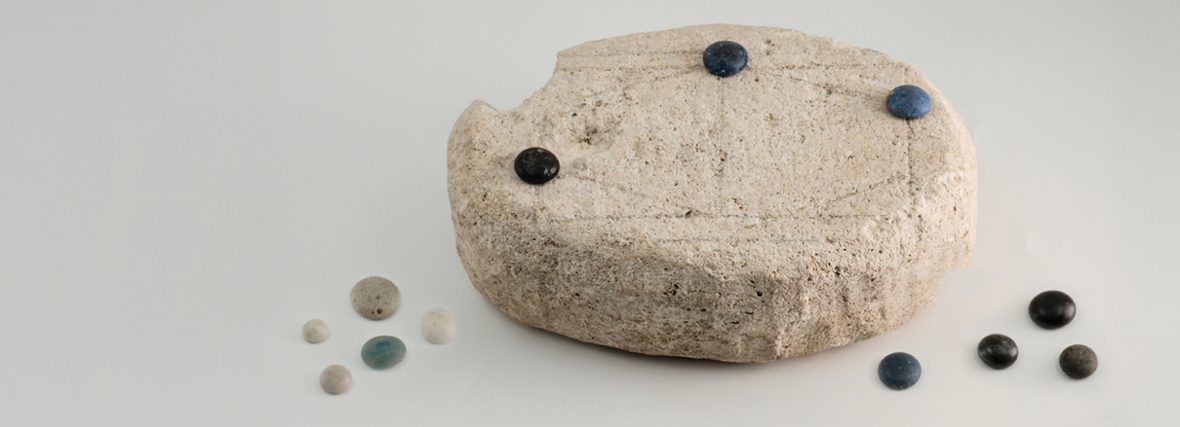
For more than a century, a carved limestone slab from the Dutch city of Heerlen sat quietly in a museum collection.
Now, artificial intelligence has revealed that it was not decoration.
It was a game.
Researchers have reconstructed the rules of an unknown Roman-period board game carved into stone nearly 1,700 years ago — and the discovery pushes the history of strategic “blocking” games back several centuries earlier than previously believed.
A Stone from Roman Coriovallum
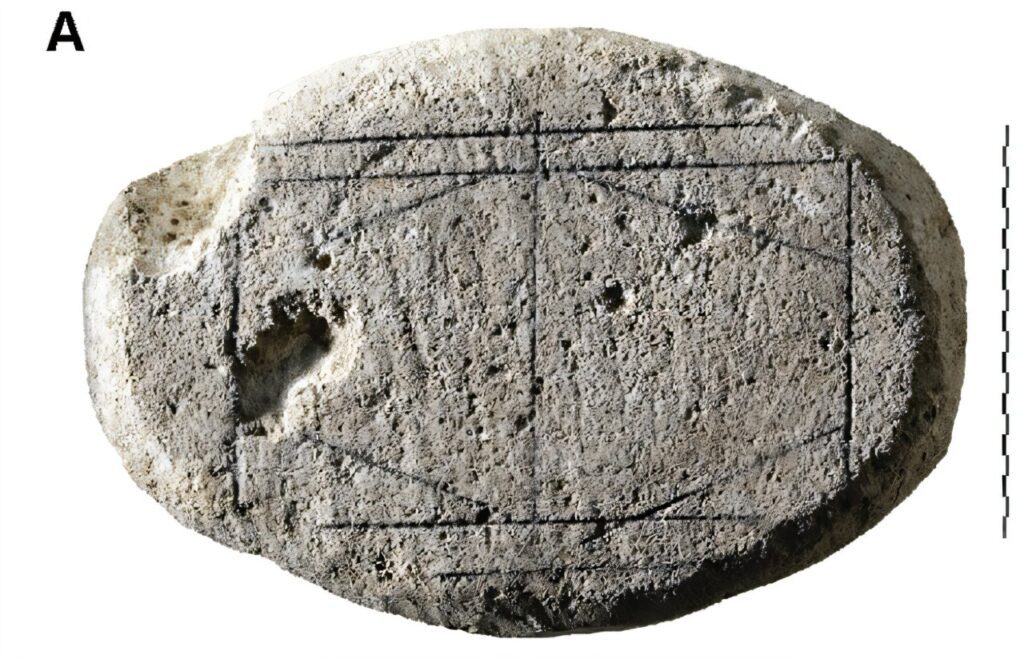
The object was originally unearthed in Heerlen in the late 19th or early 20th century. In Roman times, the city was known as Coriovallum, an important settlement in the province of Germania Inferior.
The limestone slab, measuring just 21 by 14.5 centimeters, is now housed at the Roman Museum (formerly the Thermenmuseum).
When archaeologist Walter Crist, a specialist in ancient board games, encountered the stone in 2020, he immediately suspected it had been used for play.
The carved surface features a rectangular layout with four diagonal lines intersecting a central straight line — a pattern unfamiliar from any known Roman game.
“I didn’t recognize the design from other ancient games,” Crist noted, but the wear patterns suggested repeated movement across the lines.
Microscopic Wear and 3D Scanning
Closer examination revealed something crucial.
Under the microscope, researchers observed subtle but consistent wear marks precisely along the carved lines — exactly where playing pieces would slide. Some grooves were fractions of a millimeter deeper than others, indicating repeated and intensive use.

A detailed 3D scan produced by a restoration studio in Heerlen clarified these traces further. The stone’s edges were neatly finished, confirming that this was not a construction fragment or unfinished material. It was a completed object.
Based on contextual analysis, the slab dates to approximately 300–500 CE — placing it firmly in the late Roman period.
AI Simulates the Game
To understand how the board functioned, researchers turned to AI.
The team — including scholars from the Netherlands, Belgium, and Australia — used the Ludii game system developed at Maastricht University. Two AI agents played thousands of simulated matches using rule sets derived from documented ancient European board games.
The results were striking.
The wear patterns matched most closely with so-called “blocking games” — strategy games in which players attempt to immobilize their opponent rather than capture pieces.
Until now, this category of game was only securely documented from the medieval period onward.
The Heerlen stone suggests that such tactical play existed several centuries earlier.
Rewriting the History of Strategy Games
The findings were published in the journal Antiquity, marking the first time AI-driven simulated gameplay has been systematically combined with archaeological wear analysis to identify an ancient board game.
If the interpretation is correct, it changes more than the history of one artifact.
It shifts the timeline of strategic game development in Europe.
Blocking mechanics — central to many later medieval and early modern board games — may have already been part of Roman recreational culture.
A New Tool for Archaeology
Beyond the specific discovery, the study demonstrates a methodological breakthrough.
By merging microscopic wear analysis, 3D digital modeling, and AI simulation, archaeologists now have a new way to identify ambiguous carved surfaces that might otherwise be dismissed as decorative or functional marks.
“This research provides archaeologists with additional tools to identify games from ancient cultures,” Crist emphasized.
And perhaps more importantly, it reminds us that strategy, competition, and abstract thinking were embedded in everyday Roman life — even in a modest provincial town far from Rome itself.
W. Crist et al, Ludus Coriovalli: Using artificial intelligence-driven simulations to identify rules for an ancient board game. Antiquity (2026). DOI: 10.15184/aqy.2025.10264.