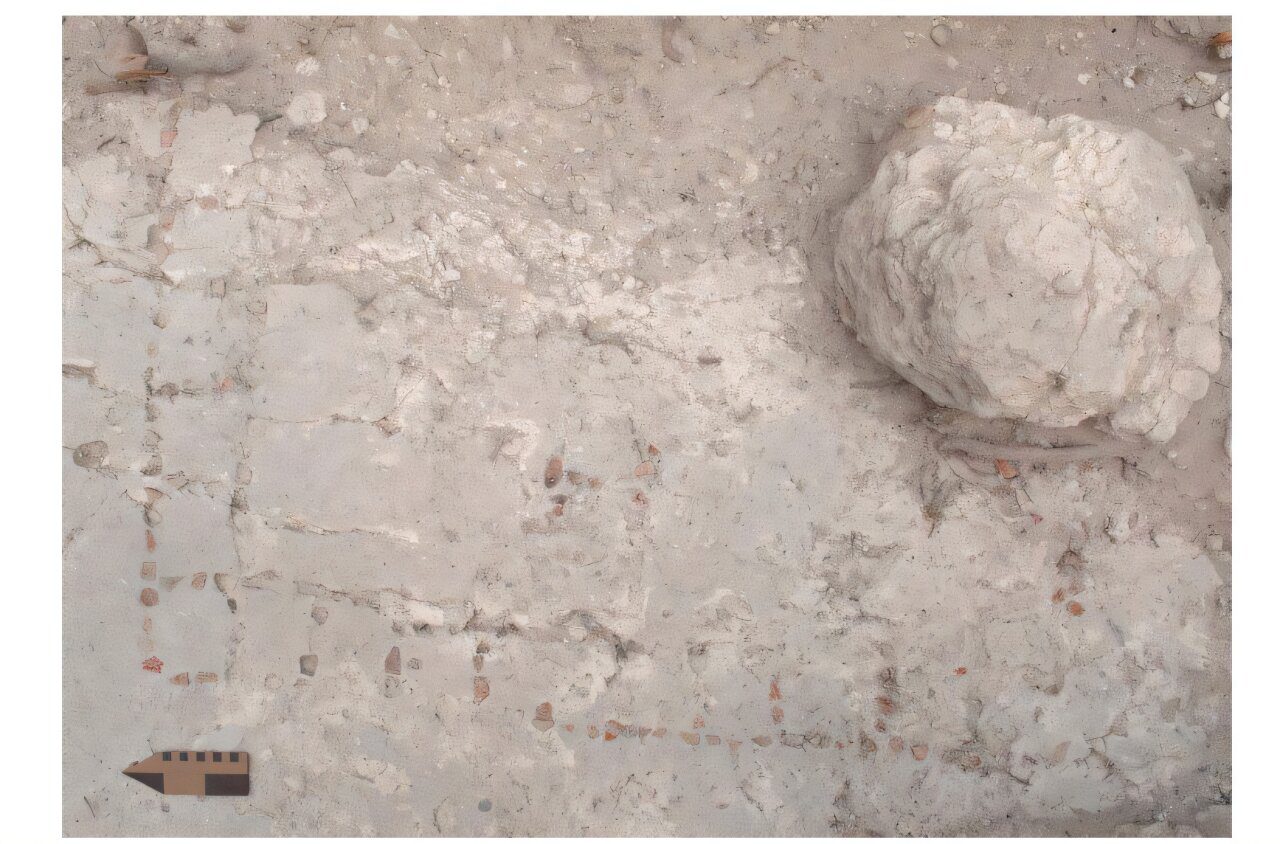
Deep beneath a modest mound in the ancient Maya capital of Naachtun, archaeologists have uncovered a discovery that challenges long-held assumptions about how the Maya played, gathered, and designed their living spaces. Hidden within the plaster of a Classic-period floor lay a meticulously crafted patolli board, not scratched into the surface—as is typical across Mesoamerica—but built directly into the architecture using hundreds of carefully selected ceramic tesserae.
The find is unlike anything previously reported in the Maya world. And its implications extend far beyond the game itself.
The Only Known Maya Game Board Constructed as a Mosaic
Across Maya cities, patolli boards usually appear as quick, lightly incised designs on floors and benches—additions whose exact dates are difficult to determine.
Naachtun’s board breaks this pattern entirely.
Researchers found the grid outlined with nearly 500 sherds, each pressed into fresh mortar during the laying of Floor 1 in Structure 6L-19. The technique resembles a floor mosaic, a method virtually undocumented in Maya architecture.
This means the board was not a casual pastime etched after construction.
It was designed as part of the building itself, planned at the blueprint stage, and likely intended to be used for a long time.
A Unique Find in a Powerful Maya Household
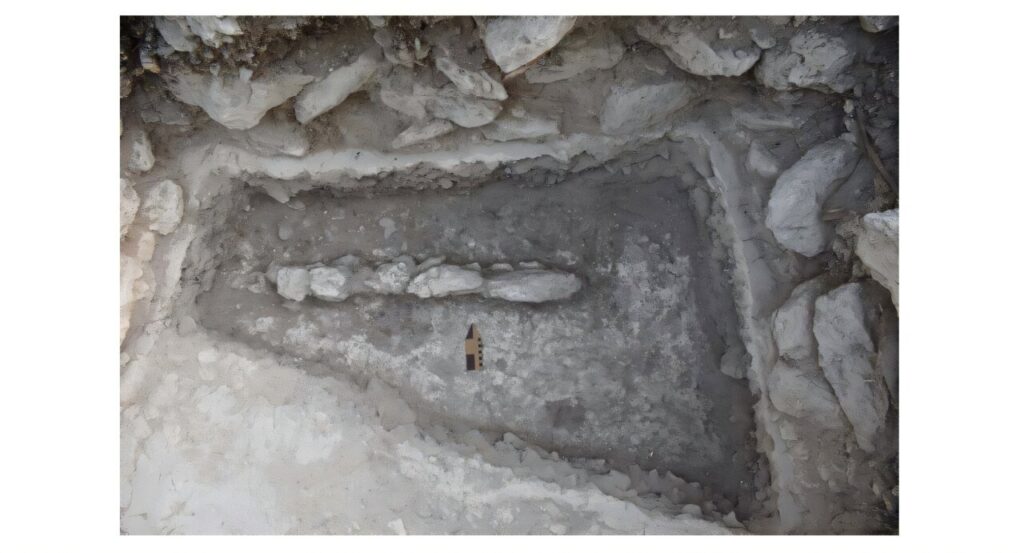
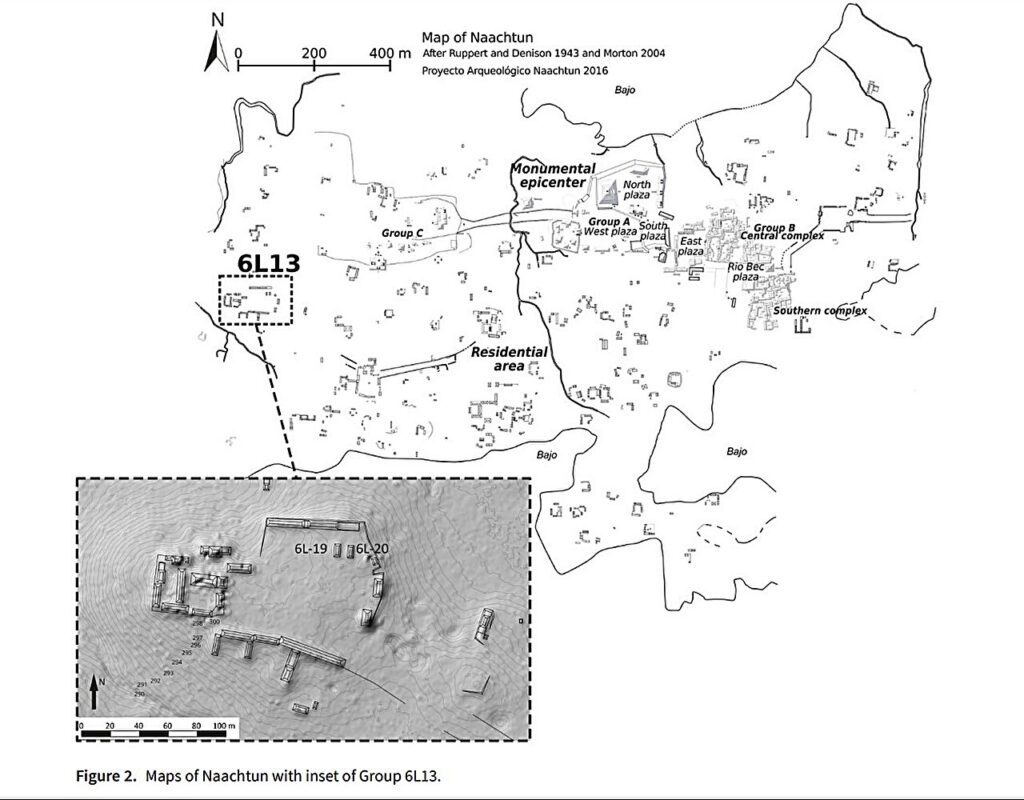
The board lies inside Residential Group 6L-13, one of Naachtun’s largest elite compounds, known for its vaulted structures, Teotihuacan-related ceramics, and long occupation sequence from the Late Preclassic to the Terminal Classic.
When excavations opened a trench across Structures 6L-19 and 6L-20, archaeologists expected architectural clarification—not a game surface embedded in the floor. Only later construction partially covered the mosaic, indicating it was part of an earlier, open or semi-open space.
This unusual placement reinforces that the board belonged to the compound’s life during an Early Classic phase, a period when the inhabitants of Group 6L-13 held significant political and economic power.
Reconstructing the Board: Hundreds of Sherds, One Coherent Design
Although part of the mosaic was damaged by later construction, enough survives to reconstruct the layout:
- Dimensions: approx. 110 × 78 cm
- Configuration: a rectangular Type II patolli board with a central cross
- Estimated tesserae: ~478 ceramic sherds
- Sherd attributes: standardized size, predominantly red/orange hues
- Ceramic typology: largely Early Classic (AD 300–550)
The sherds were not broken intentionally; their varied wear and typology indicate they were collected from domestic middens, then sorted by color and size. Red tones may have been chosen both for visibility and for their cosmological link to the Maya east.
This level of care suggests the board was intended as a durable, socially significant fixture—not an ephemeral scratch on a plaster floor.
A New Perspective on Maya Play, Ritual, and Social Life
Patolli—known across Mesoamerica as a game of chance, strategy, divination, or even communication with ancestors—has long been interpreted through the limitations of incised, hard-to-date boards.
The Naachtun mosaic changes the conversation.
Its architectural integration reveals:
1. Gaming was intentionally designed into elite residential spaces
Not an afterthought, but part of how people interacted, gathered, and displayed identity.
2. Patolli may have carried both ritual and communal functions
Durability implies repeated use, potentially blending entertainment with ceremonial or social cohesion.
3. The board offers rare chronological precision
Because it is tied to a specific construction phase, it anchors gaming practices within the Early–Late Classic transition.
4. Maya mosaic floors may have been more experimental than previously understood
This is the first documented example of a mosaic built directly into a floor, revealing architectural creativity normally unseen in the record.
Why This Discovery Matters
The Naachtun board is an archaeological breakthrough because it demonstrates that:
- Maya gaming was more structured and socially embedded than previously believed
- Architectural planning included dedicated play spaces
- The Early Classic may have hosted more institutionalized gaming traditions than later periods
As excavations continue, researchers hope to understand whether the surrounding structures once formed a sheltered pavilion or open plaza devoted to gatherings—and whether the board played a role in household identity, diplomacy, ritual practice, or elite interaction.
For now, the mosaic at Naachtun stands as a rare reminder that even games can leave enduring marks on the ancient built environment.
Cover Photo: Archaeologists working at Naachtun in Guatemala uncovered an exceptional patolli board formed by embedding hundreds of ceramic sherds into newly laid plaster. Image courtesy of Latin American Antiquity (2025), DOI: 10.1017/laq.2025.10125.