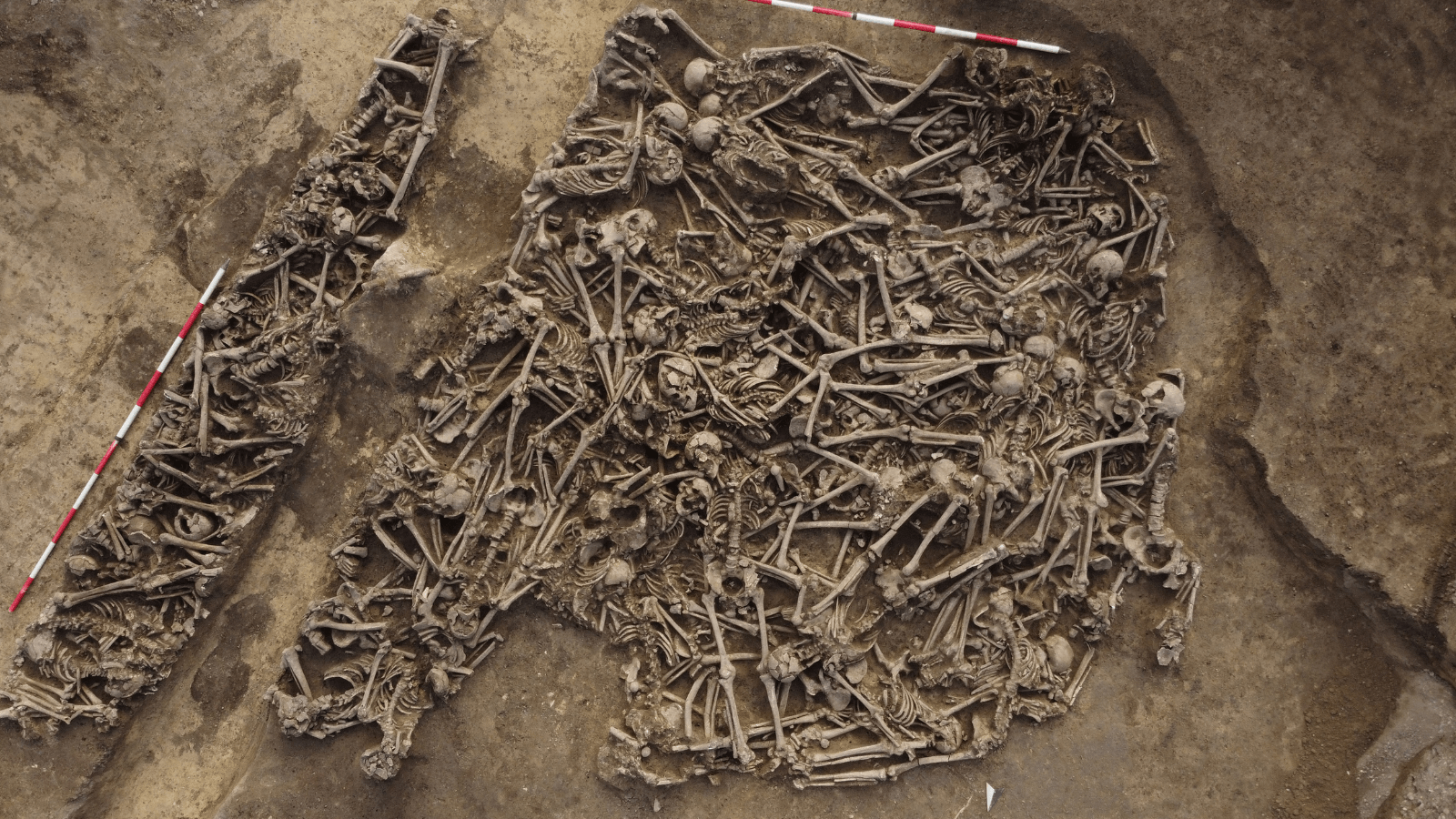
When the Vienna mass grave was uncovered beneath a soccer field in October 2024, the Roman period was not the initial interpretation.
Radiocarbon dating changed that picture, placing the burial between about AD 80 and 130. Now, a new analysis of the skeletons suggests that at least 129 young men were killed in a single episode of extreme violence — possibly an otherwise unknown military clash on the Roman frontier.
One of the most striking pieces of evidence was still lodged inside a victim: archaeologists recovered a lance head embedded in his pelvis. The finding is part of a wider pattern of projectile injuries concentrated around the pelvis and groin, potentially offering unusual evidence of how combatants targeted vulnerable parts of the body.
129 young men and evidence of mass violence
The grave contained the remains of at least 129 individuals packed together in a highly disorganized burial. Earlier excavation work also recovered dislocated bones that may represent additional people, leading archaeologists to suggest that the true number of dead could exceed 150.
The new bioarchaeological analysis indicates that all 129 identified individuals were males between approximately 18 and 35 years old. At least two-thirds showed evidence of violent trauma inflicted around the time of death, including injuries caused by sharp weapons, blunt force and projectiles.
Their demographic profile, injuries and hurried burial strongly point toward a mass-fatality event connected with organized violence. Bioarchaeologist Sheridan Strang of the archaeology firm Novetus has argued that the men were most likely soldiers who died during a battle or military campaign.
Strang presented the latest findings on August 6 at the 25th European Paleopathology Association meeting in Berlin. The research has not yet undergone peer review, and further analysis of the remains is continuing.
Why were so many struck in the pelvis?
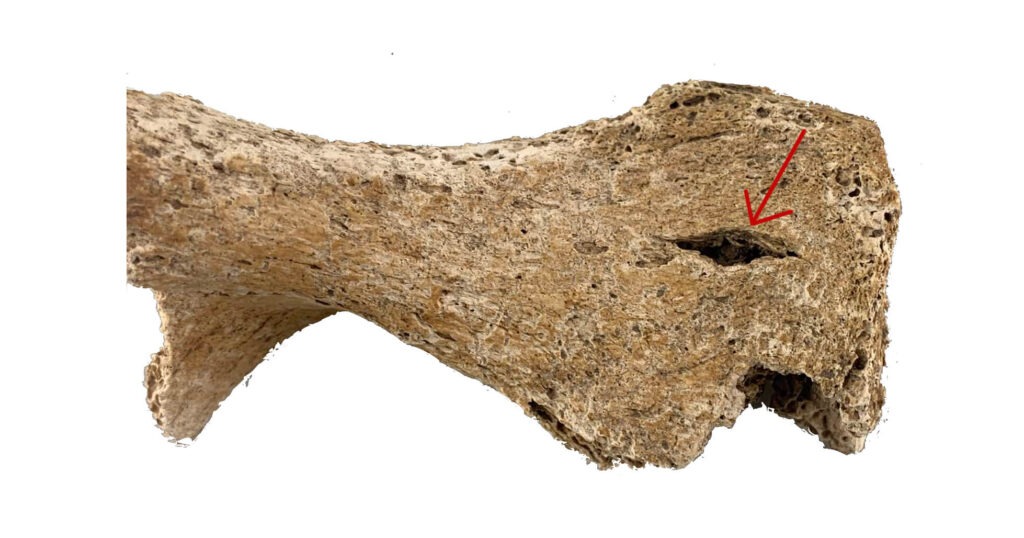
The location of the injuries may provide clues about how the confrontation unfolded.
Sharp-force trauma, consistent with weapons such as swords or daggers, appears across different parts of the skeletons, while blunt-force injuries are concentrated mainly on the skull. Projectile trauma follows a noticeably different pattern: many of those injuries occur around the pelvis and groin.
In one individual, a lance head remained inside the pelvis when the skeleton was excavated.
One proposed explanation is that attackers on foot were throwing lances at mounted opponents and aiming for gaps in their armor. The pelvis, groin and upper legs may have been comparatively exposed, making them effective targets for disabling a rider.
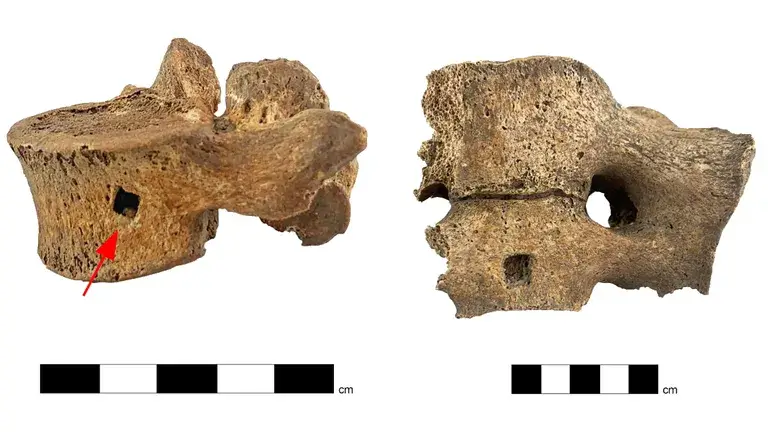
The scenario cannot yet be reconstructed with certainty, but the repeated concentration of projectile trauma in the same anatomical area suggests that the pattern may not have been accidental. Biological anthropologist Patrick Randolph-Quinney of Uppsala University, who was not involved in the research, noted that the injuries could reflect both limited protection in these areas and an understanding of where an opponent could be incapacitated.
A battle with no clear historical record
The dating places the mass grave at a crucial moment in the development of Roman Vienna. Vindobona became a major military center on the Danube frontier in the late first century AD, helping Rome control a border facing Germanic groups including the Marcomanni.
Yet no historical source or previous archaeological evidence records a battle at Hasenleitengasse during this period.
When the grave was publicly presented in 2025, Vienna city archaeologists suggested that one possible context could be Emperor Domitian’s Danube campaigns between AD 86 and 96. The radiocarbon dates are compatible with that period, but no evidence currently links the dead directly to those campaigns.
The later Marcomannic Wars, fought during the second century AD, are another well-known period of conflict around the Danube frontier, but their main phase falls later than the current dating range of the Hasenleitengasse burial.
Were the dead Roman soldiers?
DNA may eventually help answer another unresolved question: who were the men in the grave?
Preliminary DNA analysis of 25 skeletons confirmed that they were chromosomally male and revealed considerable diversity in ancestry. Some showed ancestry associated with the Italian peninsula and other parts of mainland Europe, while three had connections to the eastern Mediterranean and Levant.
Such diversity could be compatible with the Roman military, which drew personnel from across a vast geographic area. But the genetic evidence does not establish which side the men fought for.
Researchers have therefore left open the possibility that the grave contains Roman military personnel, Germanic combatants or even individuals from opposing forces buried together after the same confrontation.
Stable isotope analysis is expected to provide better evidence about where some of the men actually grew up, while further research will examine their health, diet and disease.
For now, the Hasenleitengasse grave preserves the physical evidence of an event that remains absent from surviving historical accounts: more than a hundred young men killed violently and buried together near the Roman frontier, leaving archaeologists to reconstruct a battle whose name, participants and circumstances have been lost.
Cover Image: The Roman-era mass grave uncovered beneath a soccer field in the Simmering district of Vienna, where archaeologists identified the remains of at least 129 young men killed in a violent event. Credit: A. Slonek / Novetus.