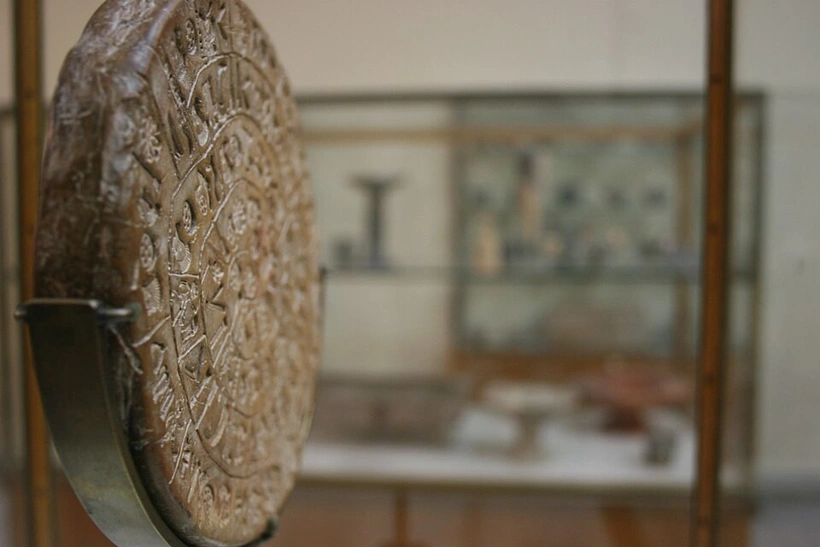
The Phaistos Disc, discovered on the Greek island of Crete more than a century ago, continues to resist every attempt to decipher its mysterious symbols.
Italian archaeologist Luigi Pernier found the Phaistos Disc on July 3, 1908, inside the Minoan palace of Phaistos. Generally dated to around 1700–1650 BC, the object is now approximately 3,700 years old.
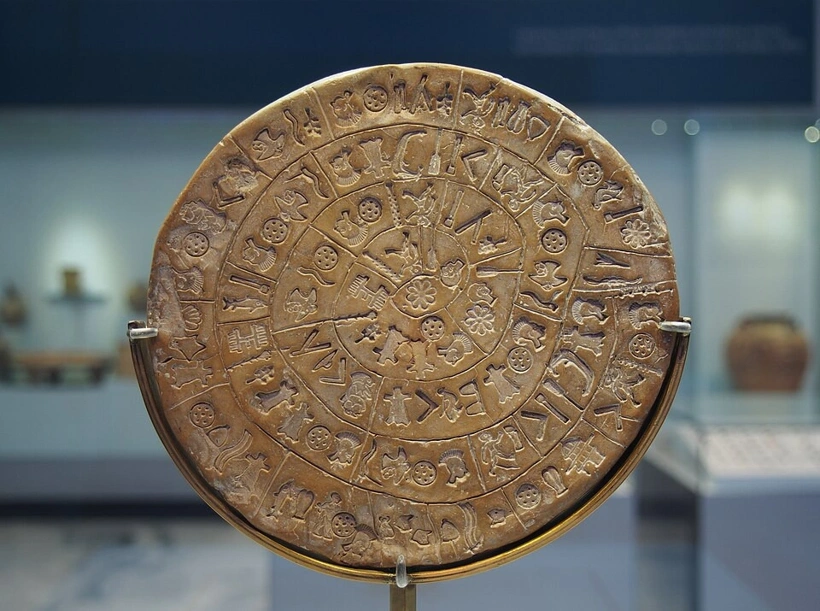
The disc measures about 16 centimetres across and is covered on both sides with symbols arranged in a spiral. Researchers have identified 45 different signs, repeated 241 times across the surface.
Some resemble human figures, birds, plants, tools and weapons. Their meaning, however, remains unknown.
Symbols pressed into wet clay
The signs were not carved individually. They were made by pressing prepared stamps into soft clay before the disc was fired.
This unusual technique has led to comparisons with printing, although the object was not a printing machine in the modern sense. Its maker simply reused the same stamps to repeat particular symbols.
The signs were divided into 61 groups by vertical lines, suggesting that they may represent words, syllables or structured sequences. The relatively small number of different symbols has led some specialists to classify the system as a possible syllabic script.

Why has it never been deciphered?
The main problem is that no second inscription written in the same system has been found.
There is no bilingual text connecting the symbols to a known language, and the disc is too short to reveal dependable grammatical patterns. Without comparable material, proposed translations cannot be tested.
Over the years, researchers have interpreted the disc as a prayer, religious hymn, calendar, ritual object, military message and ancient game. None of these explanations has gained general acceptance.
The disc’s authenticity has also been questioned. In 2008, art historian Jerome Eisenberg argued that it could have been created as a modern forgery.
Later archaeological comparisons weakened that claim. A complex “comb-like” motif found on the disc was also identified on pottery and a seal impression excavated at Phaistos decades after the disc’s discovery. Researchers argue that these parallels place the object firmly within the artistic and craft traditions of Minoan Crete.
The Phaistos Disc is now displayed at the Heraklion Archaeological Museum. After 118 years of study, its symbols remain unread and its original purpose is still unknown.