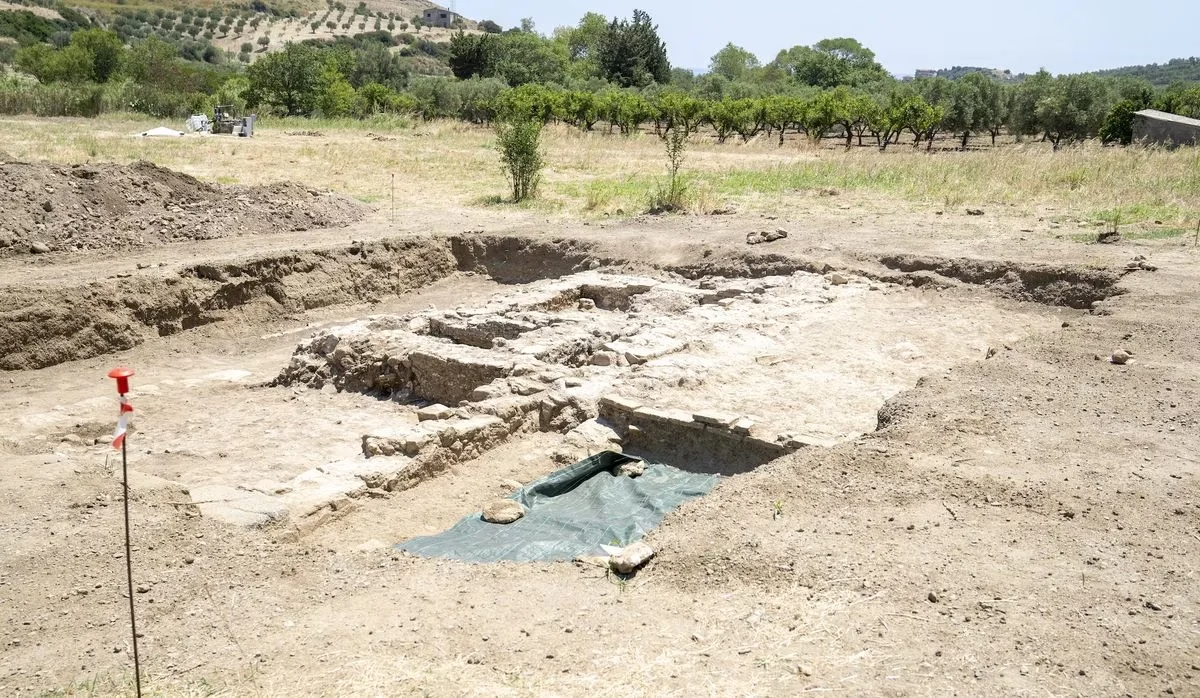
Archaeologists have uncovered the remains of a monumental Roman villa in the Ceraso area of Squillace, southern Italy, shedding new light on settlement patterns in the late antique period and potentially offering rare evidence linked to Saint Cassiodorus — a renowned sixth-century Christian scholar, politician, and monastic founder.
The excavation, led by the Pontifical Institute of Christian Archaeology under the Vivarium Project, reveals an exceptional site that may help connect the dots between Roman luxury estates and the early Christian intellectual movement in Calabria.
A Monumental Discovery in Southern Italy
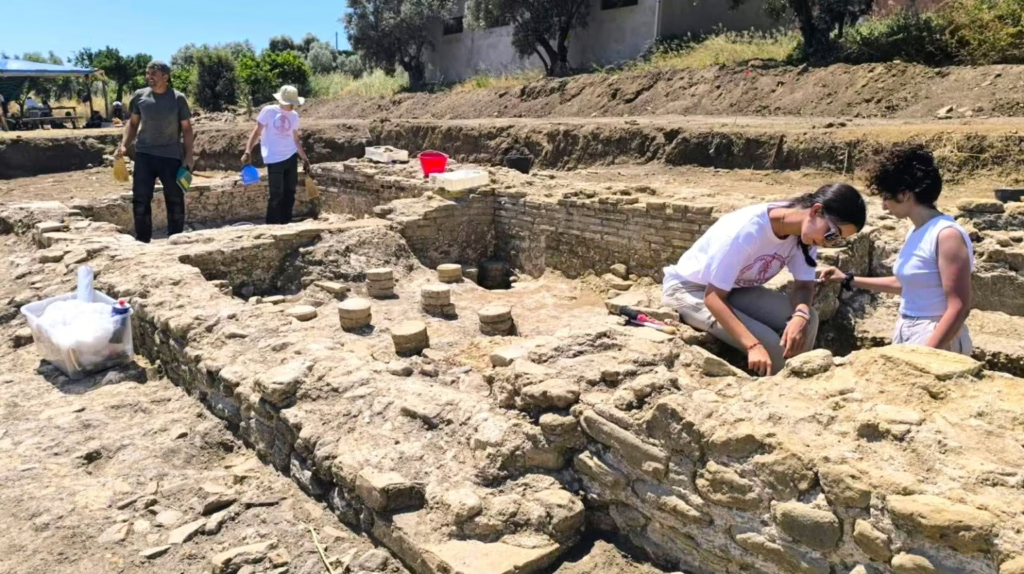
Researchers uncovered a sprawling rural complex featuring a 30-meter defensive wall, service rooms, and an elaborate bathhouse equipped with a praefurnium (furnace) and three thermal chambers. Archaeological evidence — including ceramic fragments, building materials, and decorative elements — dates the villa’s occupation from the 2nd to the 6th century AD.
Two distinct construction techniques are evident: opus incertum (irregular stones bonded with mortar) in the villa’s earliest phase, and opus testaceum (brick masonry) in the later bath complex. A hypocaust heating system — the ancient Roman forerunner to underfloor heating — ensured warm interiors during cooler months.
Professor Domenico Benoci, co-director of the dig, suggests the villa was likely built on terraced slopes overlooking a river, which supplied water to the baths. “The presence of North African pottery indicates strong trade links between Calabria, Sicily, and North Africa during this period,” he notes.
A Possible Link to Saint Cassiodorus
This archaeological zone lies close to Copanello di Stalettì, long suspected to be the site of the Vivarium — a monastery founded by Cassiodorus after retiring from political life in the Ostrogothic court around AD 544. The Vivarium became famous for preserving and copying both biblical and classical texts, making it one of the intellectual beacons of early medieval Europe.
The current excavation is part of a wider initiative to identify sites connected to Cassiodorus’ religious and cultural legacy. While the villa itself predates the monk’s lifetime, it may have been integrated into the monastic network, perhaps serving as an agricultural or residential hub.
The 1950s Sarcophagus Discovery
Adding weight to this theory is a significant find from the 1950s, when archaeologists discovered a marble sarcophagus in the nearby Church of San Martino. The sarcophagus bore Greco-Latin inscriptions alongside prayers from pilgrims invoking “Sanctus Senator” — a title believed by many scholars to refer directly to Saint Cassiodorus.
If confirmed, this could mean the area holds Cassiodorus’ actual burial place, elevating its importance not only for historians but also for Christian pilgrims worldwide. Archaeologists are now considering targeted excavations around San Martino to search for additional evidence.
Local Stewardship and Future Plans
The villa’s discovery was made possible thanks to the vigilance of the Lopez Pascali family, owners of the land, who reported findings during agricultural work. The site had not been registered as a late antique settlement before this intervention.
Future excavation phases aim to fully map the villa’s layout and explore its relationship to other ancient and early Christian sites in the region. The project also envisions creating a public archaeological park, with guided tours, educational programs, and digital reconstructions to bring Calabria’s layered history to life.
Bridging Rome’s Legacy and Christian Heritage
For archaeologists, the Ceraso villa encapsulates a pivotal transition in southern Italy’s history — from a region of Roman aristocratic estates to a landscape dotted with Christian monastic centers. The possibility that this single location connects both worlds makes it one of the most significant archaeological prospects in modern Calabrian research.
As excavations continue, the team hopes not only to understand the daily life of late Roman elites but also to illuminate the enduring influence of Saint Cassiodorus — a man who bridged the classical and Christian eras, ensuring that the treasures of both would survive for future generations.
Cover Image credit: View of the masonry structures uncovered during excavations in the Ceraso area, Squillace, Catanzaro. Sevesinop