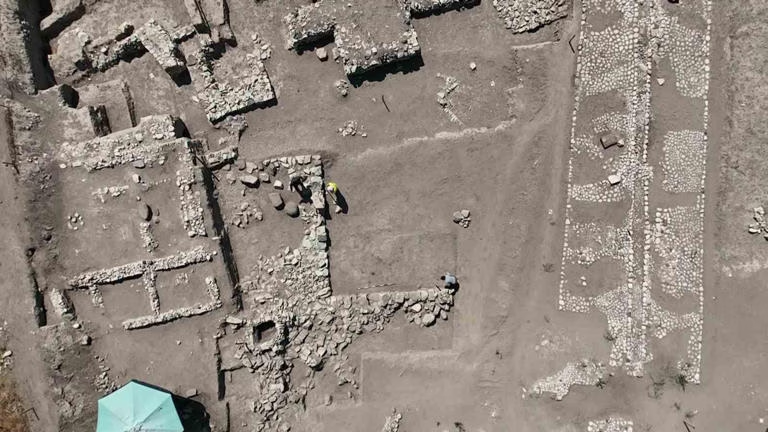
Archaeologists in northern Turkey have revealed the remains of a sanctuary unlike any other known in Central Anatolia—a 2,600-year-old temple dedicated to the goddess Kubaba, constructed from volcanic tuff and hidden from the pages of ancient history.
The site, Oluz Höyük, carries a human story stretching back 6,500 years. Yet its most astonishing revelation is this Iron Age cult complex, never once mentioned by the classical authors who often chronicled Anatolia’s past. “Herodotus is silent, Strabo is silent,” emphasized Prof. Dr. Şevket Dönmez, who has directed the excavations for nearly two decades. “And yet, here we stand before a monumental sacred system that defies the written record.”
A Monumental Cult Center
Within the Iron Age strata, archaeologists uncovered altars, a sacred chamber, and a symbolic stone embodying the goddess Kubaba—an ancient deity of fertility and sovereignty who was later absorbed into the pantheon of Phrygian and Hittite traditions. The scale of the sanctuary suggests elaborate ceremonies once unfolded on this plateau in Amasya, rituals still waiting to be decoded.
Stones from Fire and Earth
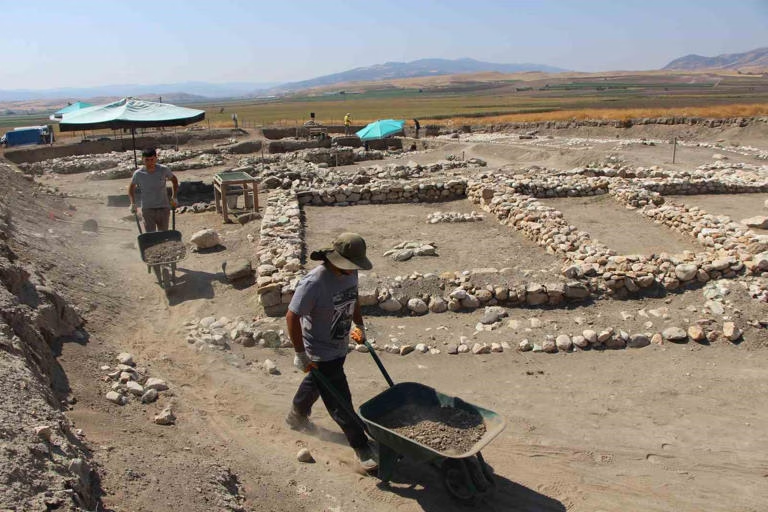
Scientific analysis traced the temple’s greenish tuff blocks to an ancient quarry at Doğantepe, 10 km from the site. “Their mineral structure is identical,” explained astrogeologist Dr. Ersin Kaygısız. “The stone was chosen not just for its striking color but because it could be shaped and carried with relative ease.” Nearly 90 percent of Oluz Höyük’s architecture relied on this same volcanic material, embedding the settlement’s identity in stone born of fire.
Beyond the Sources
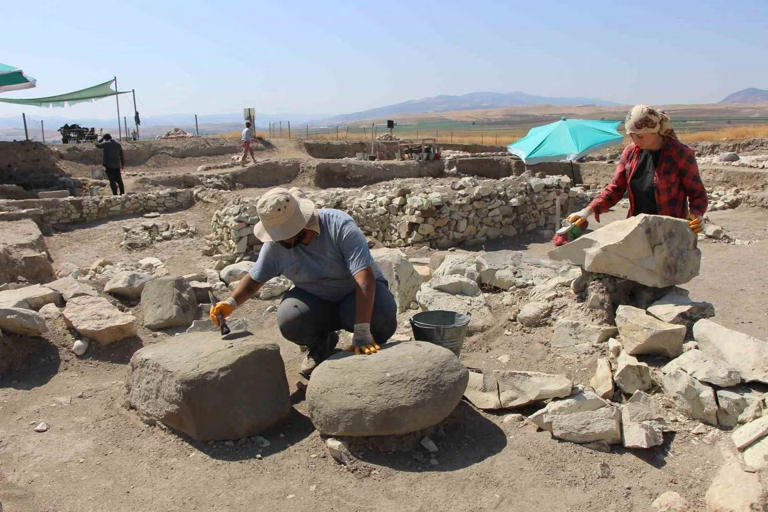
The project, carried out under the Turkish Ministry of Culture and Tourism’s Heritage for the Future initiative, underscores the gap between archaeology and ancient texts. The Oluz Höyük temple offers a rare glimpse into a religious tradition that escaped historical memory, a hidden chapter of Anatolia’s cultural heritage.