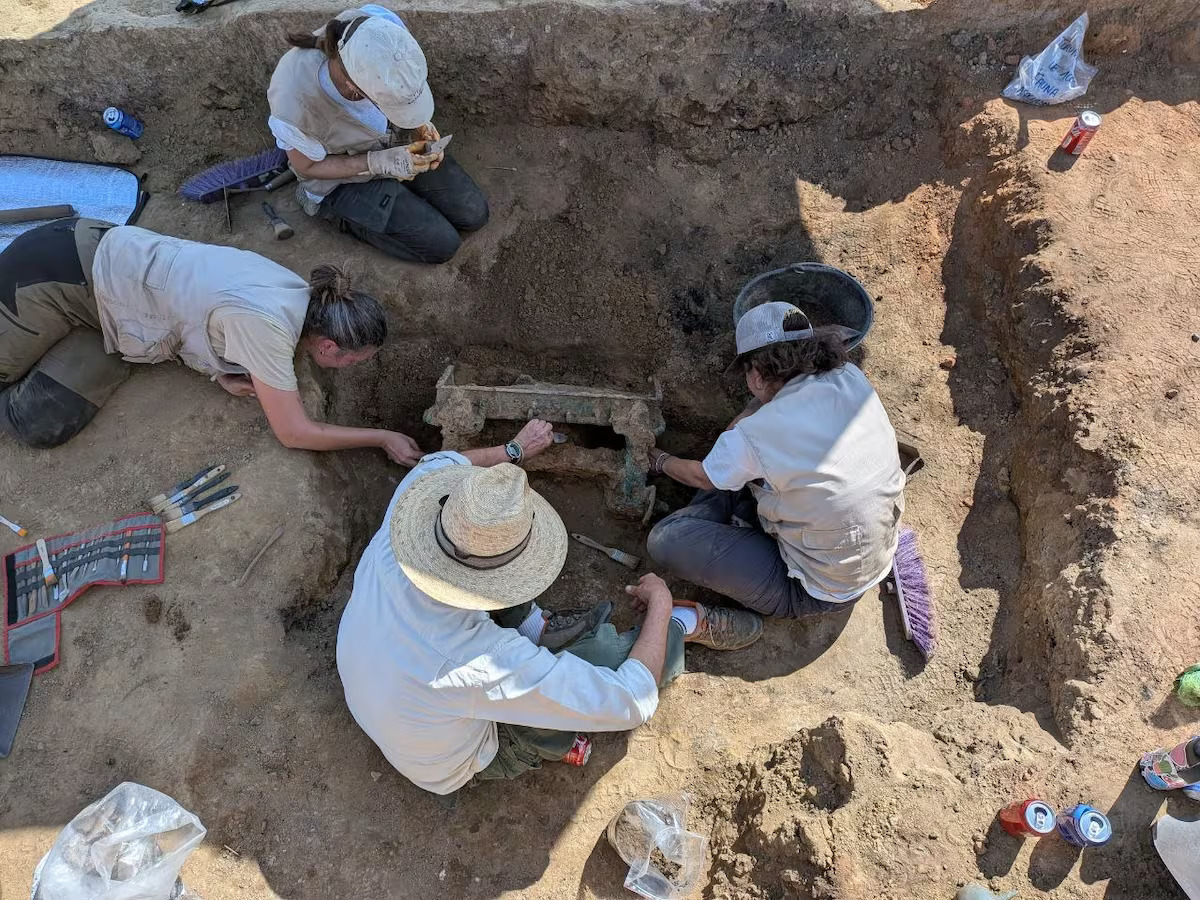
A small bronze cart, broken in half and buried for nearly 2,500 years, has become the latest surprise from Casas del Turuñuelo, the Tartessian site in southwestern Spain that keeps forcing archaeologists to rethink one of the Iberian Peninsula’s most elusive ancient cultures.
The object was found during the eighth excavation campaign at the site, near Guareña in Badajoz. It is not a toy, not a model of a practical vehicle, and not a loose decorative fitting. Researchers identify it as a votive or ceremonial cart, probably used in rituals inside the monumental building before the place was deliberately sealed and abandoned.
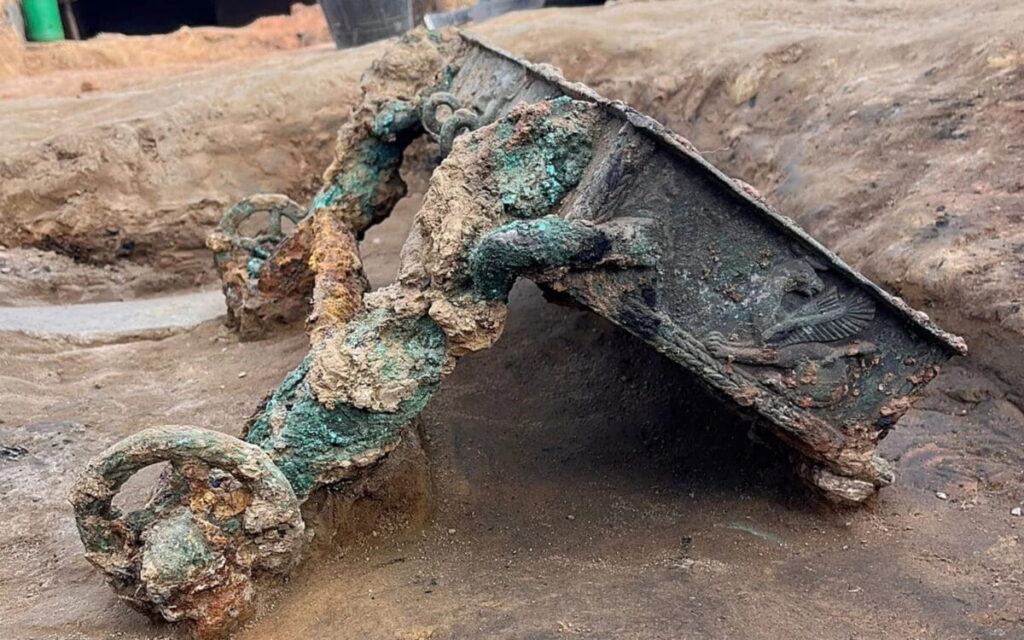
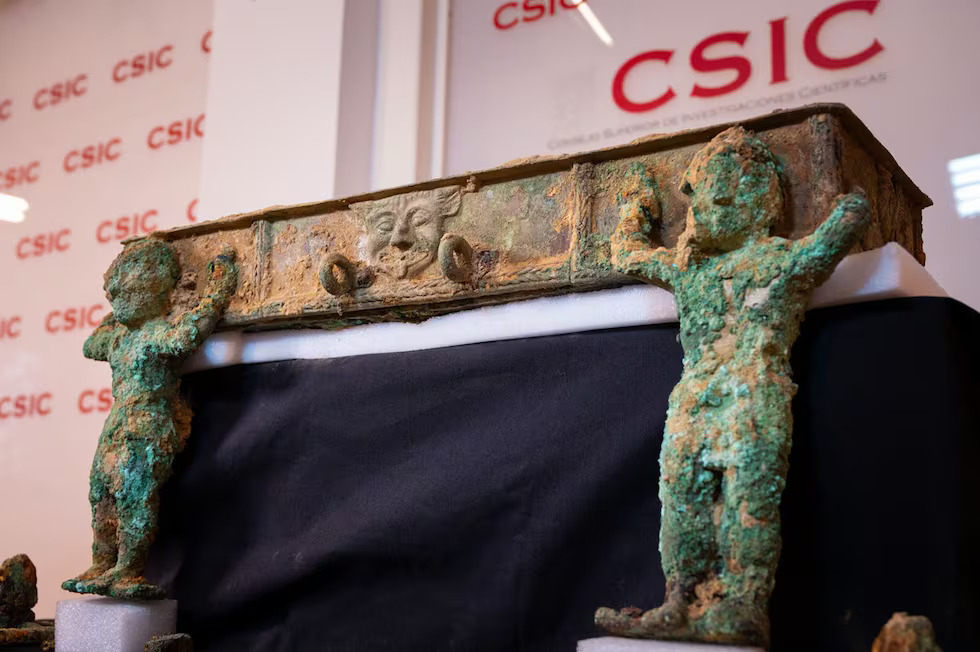
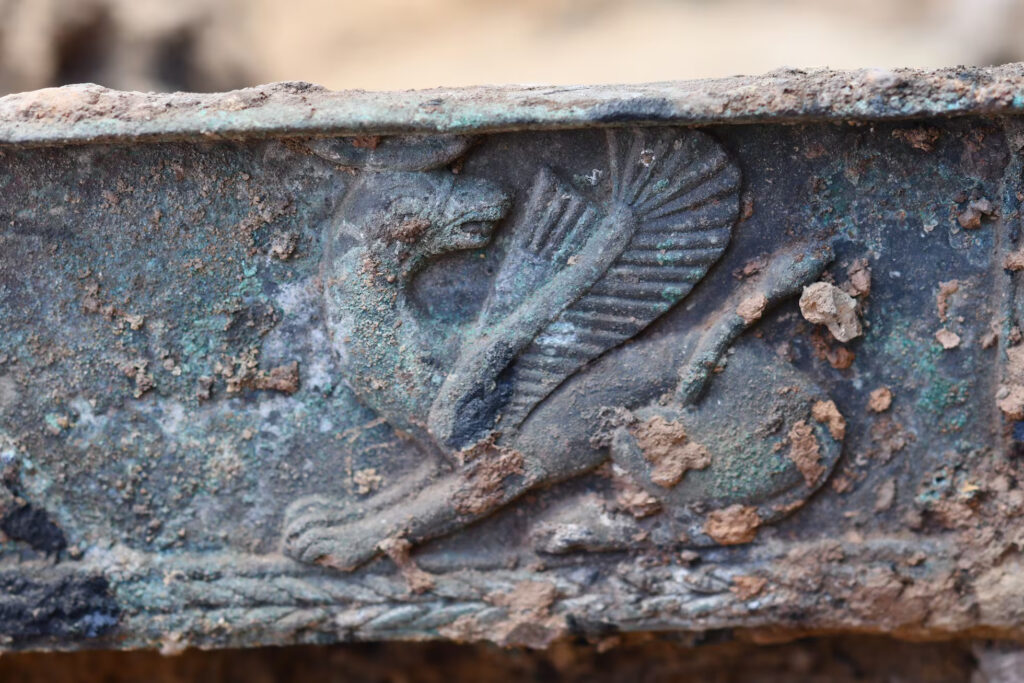
Only one half has been recovered so far. Even that fragment is enough to show why the find matters. The bronze cart preserves two wheels, part of its box and a dense mythological decoration that includes griffins, damaged supporting figures and a horned face identified as Achelous, the ancient river god known from Greek tradition.
If the identification is confirmed, it would be the first known representation of Achelous found in the Iberian Peninsula.
A rolling incense burner from Tartessos
The piece measures roughly 60 to 62 centimeters in length and about 47 centimeters in height. It was made in bronze, with iron elements in its axle system that allowed the wheels to turn.
The excavators think it may have held embers or aromatic resins such as myrrh or incense. Sebastián Celestino, codirector of the Construyendo Tarteso project, has compared its possible function to a “rolling botafumeiro,” a mobile incense burner used in ceremonies rather than a fixed ritual object.
That image is useful, but the cart is older, stranger and harder to classify. It was found in an elongated corridor on the upper floor, close to the building’s banquet area and near another altar. This was not a casual deposit. It belonged to the richer and more controlled part of the structure, where imported goods, ritual equipment and prestige objects have been appearing campaign after campaign.
Soon after its discovery in April, the cart was taken to the Secyr conservation and restoration laboratory at the Autonomous University of Madrid for stabilization and cleaning. Since then, the team has been looking for parallels. So far, the search has produced comparisons, but not a match.
Achelous, griffins and a damaged divine world
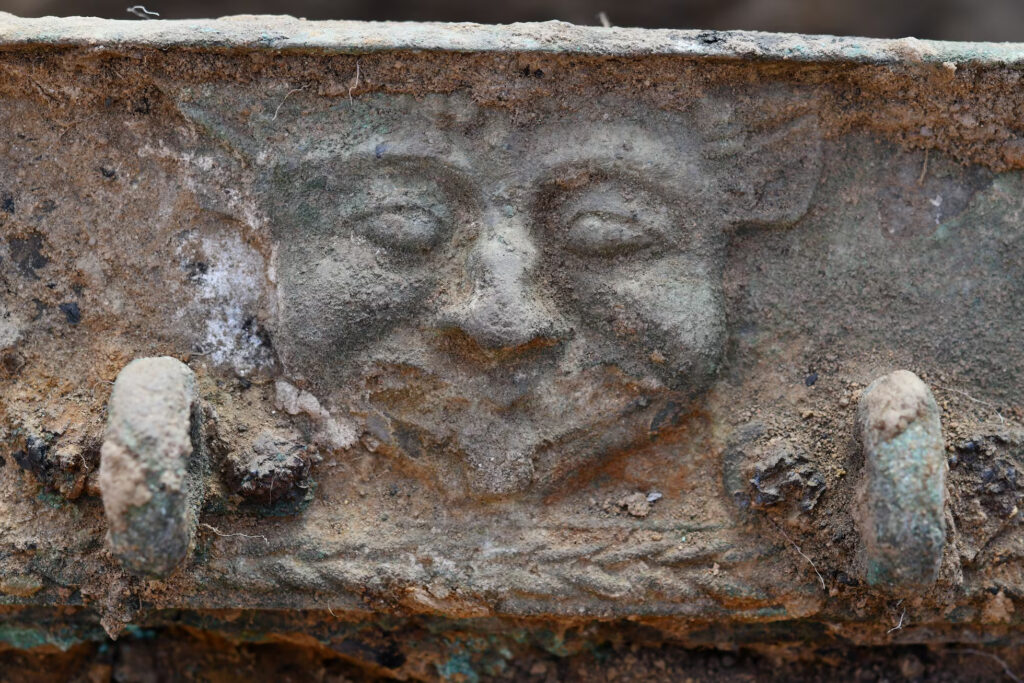
The front of the cart carries the most arresting image: a horned face identified as Achelous, the river god associated with water, fertility and power in the Greek world.
But the Turuñuelo figure is not straightforward. The face sticks out its tongue, a feature more familiar from gorgons such as Medusa than from standard Achelous imagery. Esther Rodríguez, codirector of the excavations, has noted that the image may combine a river divinity with darker, underworld associations.
That is exactly the kind of detail that makes the find important. It does not look like a simple imported symbol dropped untouched into Iberia. It may be a local or hybrid reading of Mediterranean religious imagery, used by people who understood the power of the image but adapted it to their own ritual language.
On the sides of the cart are griffins, the lion-and-eagle creatures that moved through ancient Mediterranean art from eastern and Greek traditions into local elite settings. Two male supporting figures, damaged by oxidation, appear to hold up the structure like atlantes. They are hollow-cast and still difficult to identify with certainty.
The missing half of the cart may still be somewhere inside the mound.
The “year of bronzes” at Turuñuelo
The bronze cart was not the only major find from the latest campaign. The excavation also produced two complete braziers, a large bronze cauldron, a patera and other bronze objects, including heavy handles made with molds.
One vessel, with handles ending in palmettes, has been linked to a podanipter, a Greek-style basin used for washing the feet. Researchers believe it may belong to the same ritual package as the marble altar column found in 2025, which came from Proconnesus, the island now known as Marmara in Türkiye.
That detail matters because it points to people who were not merely collecting foreign luxuries. Someone at Turuñuelo appears to have known how such objects worked.
The campaign also strengthened another pattern: imported materials. Archaeologists recovered an Egyptian alabastron from the fifth century B.C., similar to one found at Cancho Roano, along with a large collection of ivory fragments carved with plant, animal, combat and warrior scenes. These motifs open a wider Mediterranean field that includes Phoenician, Egyptian, Greek and possibly Etruscan currents.
The bronze itself is still under study. Isotope analyses may help determine its origin. For now, the team has not ruled out Greece, but the technique has led them to look closely at Etruria. Some ritual carts from that region share broad features, although none appears to match the Turuñuelo example.
An inland site with Mediterranean reach
Casas del Turuñuelo sits in the Vegas Altas del Guadiana, beside the Guadiana River and close to the mouth of the Búrdalo. The position gave the site access to fertile land, livestock routes and river transport.
That inland location is one reason the new find is so compelling. The bronze cart, Egyptian alabastron, Greek-style ritual vessels, ivories and imported ceramics all reached a place far from the great Mediterranean ports. Turuñuelo was not a provincial backwater receiving occasional exotic objects. It looks more like a node in a network where elite families, artisans and ritual specialists moved goods and ideas deep into the Iberian interior.
Tartessos itself has long sat between history and legend. Ancient writers associated the southwest of Iberia with wealth, metals and the famous ruler Argantonios. Modern archaeology has moved the discussion away from myth, but the basic question remains difficult: what exactly was Tartessos?
The old answer, a wealthy culture formed through contact between local Iberian communities and Phoenician settlers, is still broadly useful. Turuñuelo adds something less tidy. It shows a world that absorbed Mediterranean images and objects, then gave them new settings, new uses and perhaps new meanings.
A building closed by ritual destruction
The cart also belongs to one of the most unusual archaeological settings in western Europe.
Casas del Turuñuelo preserves a monumental two-story building, a rare survival in protohistoric architecture of the western Mediterranean. Its excavated spaces include Room H-100, a bull-hide-shaped altar, a lime bathtub or sarcophagus, a monumental staircase, banquet areas and a large lower courtyard.
That courtyard produced the site’s most famous deposit: a mass animal sacrifice dominated by horses. A peer-reviewed study of the remains examined 6,770 bones belonging to 52 animals, mostly adult equids, with smaller numbers of cattle, pigs and one dog. The evidence suggests repeated ritual activity over time, not a single accidental accumulation.
The final life of the building seems to have involved feasting, sacrifice, controlled destruction, fire and burial beneath clay. Objects were broken. Sculptures were damaged. The building was shut down in a way that looks deliberate rather than chaotic.
The bronze cart fits that final act. It was split in two, probably with a single blow, but not pulverized. Celestino has suggested that the people who broke it may have held back because of the divine image it carried.
That is an interpretation, not a certainty. But it is the kind of cautious reading the site now demands. Turuñuelo rarely gives simple answers.
The missing half still matters
What survives of the cart is enough to make it one of the most striking finds from the 2026 campaign. What does not survive may be just as important.
The other half could confirm the iconography, clarify the function and perhaps reveal whether the cart was imported, locally made or assembled through a mixture of techniques. It could also show whether the Achelous image was repeated, paired or opposed by another figure.
For now, the discovery leaves archaeologists with a rare object and a controlled uncertainty. The cart appears to be unique in the Iberian Peninsula. It may be linked to Etruscan craft traditions. It carries a river god with a gorgon-like tongue. It was found near a ritual space inside a building closed by sacrifice and fire.
At many sites, one of those details would be enough to carry the story. At Casas del Turuñuelo, they arrive together.