
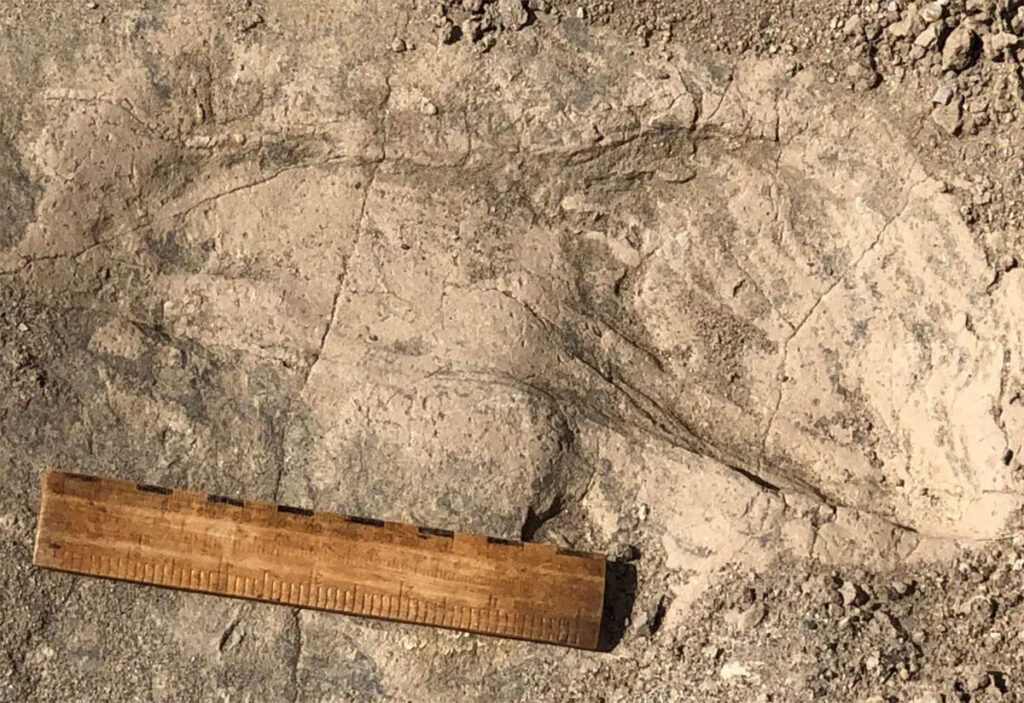
Several early hominins crossed the muddy edge of a lake in northern Kenya around 1.43 million years ago. Their footprints survived long after the water disappeared, preserving a brief scene of movement that bones alone could never record.
The tracks, uncovered at the GaJi10 site in East Turkana, suggest that some of these individuals were considerably larger than previously expected for Paranthropus boisei. They may also offer rare evidence that several large-bodied males occupied the same lakeshore at approximately the same time.
Yet the identity of the track makers remains unresolved. The anatomy of the impressions most closely resembles footprints attributed to P. boisei, while their exceptional size also makes Homo erectus a plausible candidate.
Published in Proceedings of the National Academy of Sciences, the study provides new evidence about Early Pleistocene body size, walking mechanics, habitat use and possible social behavior.
A Discovery Expanded Over Decades
GaJi10 was first discovered in 1978, when researchers documented hominin and hippopotamus tracks preserved in ancient sediments. Further excavations in 2016 and 2023 exposed many more impressions than were previously known.
Researchers have now identified 21 hominin footprints, including five continuous trackways. They provisionally represent eight individuals, although one person may conceivably have crossed the surface more than once.
Most of the tracks point west, while one trackway runs east. The pattern does not prove that all eight individuals moved together, but several appear to have crossed the surface within a relatively limited period.
This is what makes fossil footprints so valuable. A bone may become part of a deposit assembled over thousands of years. Tracks, by contrast, can preserve activity that took place within hours or days.
At GaJi10, they offer something close to a moment from life.
Feet That Moved Differently from Ours
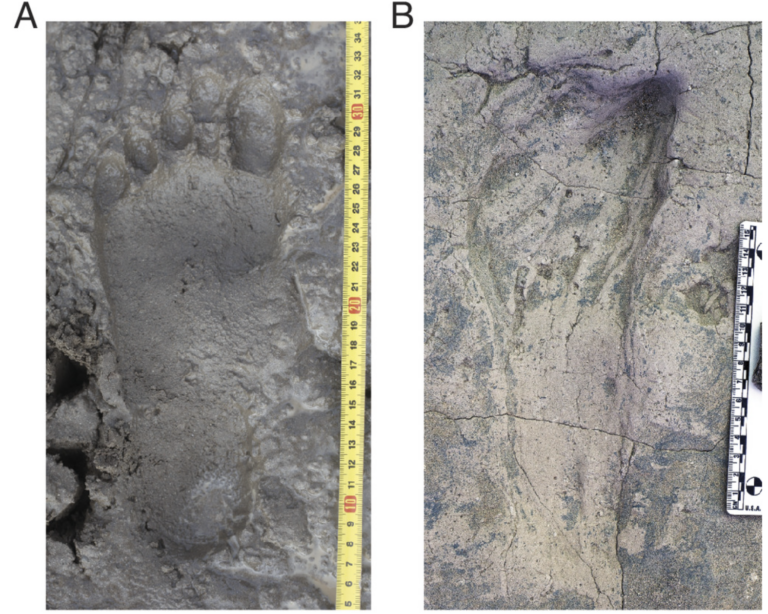
The GaJi10 footprints differ from modern human tracks in several important anatomical and biomechanical features.
Three-dimensional analysis indicates a flatter arch pattern and a heel-to-toe movement unlike that seen in living humans. The prints also show a more widely angled big toe, or hallux.
In one track, the hallux was separated from the rest of the foot by nearly 40 degrees. Another well-preserved impression, designated H9, had a hallux angle of approximately 25 degrees, compared with an angle near zero in a modern human footprint used for comparison.
These characteristics are similar to other East Turkana tracks previously attributed to Paranthropus boisei. They also resemble aspects of the 3.66-million-year-old Laetoli footprints generally associated with Australopithecus afarensis.
By contrast, East Turkana footprints attributed to Homo erectus show a more modern human-like arch and walking pattern.
The comparison suggests that the GaJi10 track makers walked upright but transferred their weight through the foot differently from modern humans.
Much Larger Than Expected
The size of the footprints produced the study’s most striking result.
Because the species responsible has not been conclusively identified, the researchers calculated body size using two different anatomical models.
If the footprints belonged to P. boisei, the seven measurable individuals may have stood between approximately 1.31 and 1.81 meters tall and weighed between 39.8 and 74.6 kilograms.
All seven height estimates exceed a previously published species average of about 1.31 meters. Four are also above the largest individual estimate derived from the comparative skeletal sample. Six of the seven estimated body masses exceed the highest published average used in the study.
These figures would significantly alter current reconstructions of P. boisei. The species is best known from skulls with broad faces, powerful jaws and enormous back teeth, but its postcranial skeleton remains poorly documented.
If GaJi10 was made by P. boisei, the species could grow substantially larger—and display much greater variation in body size—than its known bones have suggested.
Using Homo erectus proportions, the estimated heights range from approximately 1.55 to 1.81 meters. Those values would still represent relatively large individuals, but they fit more comfortably within the known range for H. erectus.
The tracks therefore present a puzzle: their internal anatomy favors P. boisei, but their dimensions look more familiar for Homo erectus.
Did Several Adult Males Walk Together?
Five of the larger individuals appear to have moved westward in similar directions, from shallower water toward a deeper part of the ancient lake margin.
If the prints belonged to P. boisei, their estimated sizes suggest that several of the track makers may have been adult males.
The evidence cannot establish a precise social organization. It does, however, indicate that multiple large-bodied individuals tolerated one another in the same place at approximately the same time. The researchers suggest that they may even have belonged to the same social group.
Such evidence is unusual in paleoanthropology. Skulls and limb bones can reveal anatomy, age and sometimes sex, but they rarely show how individuals were spatially related during daily activity.
Footprints can preserve that relationship directly.
A Busy Lakeshore Shared with Other Animals
The hominins were not alone at GaJi10.
The excavated surface also preserves 146 animal tracks attributed to hippopotamuses, bovids, birds and equids. The range of sizes suggests that several animal species visited the area.
The hominins probably walked through soft silt beneath approximately two to ten centimeters of shallow water. Fine sand then filled their impressions, protecting them before later sediments buried the surface.
A volcanic deposit around 40 centimeters above the tracks has been correlated with the Akait Tuff, dated to approximately 1.43 million years ago.
The ancient shoreline would have offered dependable water and access to wetland plants, shellfish, fish and other aquatic resources. Such environments may help explain why both P. boisei and Homo erectus repeatedly visited the same parts of East Turkana.
A Scene Preserved in Mud
The researchers consider Paranthropus boisei the best-supported identification, but they cannot exclude Homo erectus. A currently unrecognized species is also theoretically possible, though less likely given the extensive fossil record from this geological layer.
Whichever species made them, the GaJi10 tracks show that some Early Pleistocene hominins in northern Kenya were unusually large.
More importantly, they preserve movement rather than anatomy alone.
Several individuals crossed wet ground. One travelled in the opposite direction. Hippos and hoofed mammals passed nearby. For a brief interval, the lakeshore was alive with activity.
GaJi10 is therefore not simply another fossil locality. It is a fragment of behavior preserved one footprint at a time.