More than 5,000 years ago, hundreds of people were buried beside some of Egypt’s earliest kings at Abydos. Archaeologists have argued for more than a century over why they were placed there — and whether some of them died specifically to accompany their rulers into the afterlife.
A new examination of human remains from these royal burial complexes has added striking evidence to that debate. Of 46 preserved skulls available for study, 18 showed injuries sustained around the time of death, suggesting that violence may have played a significant role in at least some of these unusual burials.
The evidence does not show that everyone surrounding Egypt’s First Dynasty rulers was sacrificed. But it makes natural death an increasingly difficult explanation for the entire group.
Old skulls reveal evidence of violent deaths
Roselyn A. Campbell of Purdue University reexamined skulls excavated at Abydos more than a century ago using modern forensic and bioarchaeological methods.
Around 39 percent of the 46 crania showed perimortem trauma — injuries inflicted when the bone was still fresh and close to the time of death. Linear fractures were the most common, while several individuals displayed sharper and potentially more severe injuries.
One skull had a penetrating wound to the side of the head. Another showed what Campbell identified as a chopping injury affecting the eye region.
Such wounds do not reveal exactly how each person died, but their frequency is difficult to ignore. The pattern suggests that at least some members of these burial groups experienced serious violence shortly before death.
Why were so many people buried around the kings?
The royal cemetery of Umm el-Qaab at Abydos contains the tombs of rulers who governed Egypt during the First Dynasty, roughly between 3078 and 2900 BCE.
Around several royal tombs and funerary enclosures, archaeologists uncovered rows of smaller graves containing men and women associated with the royal household. Some were likely officials, craftspeople or attendants, although the roles of many individuals remain uncertain.
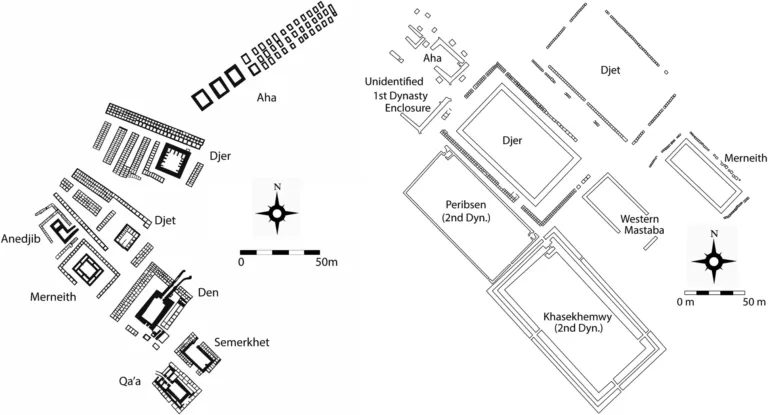
What made the graves particularly unusual was their arrangement. Large numbers appear to have been created as part of closely connected funerary events rather than gradually over many years.
That pattern helped fuel one of the oldest debates in early Egyptian archaeology: whether members of the royal household were deliberately killed when a king died.
Petrie saw the damage but could not explain it
British archaeologist Flinders Petrie excavated at Abydos in the early 20th century and already suspected that some of the subsidiary graves represented what archaeologists call “retainer sacrifice.”
Under this interpretation, members of a ruler’s household were killed so that they could continue serving the king after death.
Petrie, however, reported little convincing skeletal evidence for violent killing.
The new analysis suggests that the evidence may have been present all along. In several cases, paraffin wax applied during early conservation surrounds fractures now identified as injuries sustained around the time of death.
Campbell argues that Petrie probably noticed some of these cracks but regarded them as damage caused after burial. Modern forensic research now allows archaeologists to distinguish much more reliably between fractures in fresh bone and damage that occurred centuries later.
Were these people sacrificed?
Abydos has long been one of the strongest candidates for human sacrifice in early Egypt because so many people were buried directly around royal monuments.
The new trauma evidence strengthens that interpretation, but it cannot prove that every person in these graves was deliberately killed.
Only a small proportion of the original burial population survives in a condition suitable for modern examination. Many skeletons are incomplete or no longer available, making it impossible to reconstruct the cause of death for the entire group.
Some individuals may have died violently as part of a planned royal funeral. Others may have died from causes that left no traces on the skull, while some may have died naturally.
The important shift is that violent death can no longer be treated as a purely speculative explanation.
Not the familiar image of a pharaoh with a mace
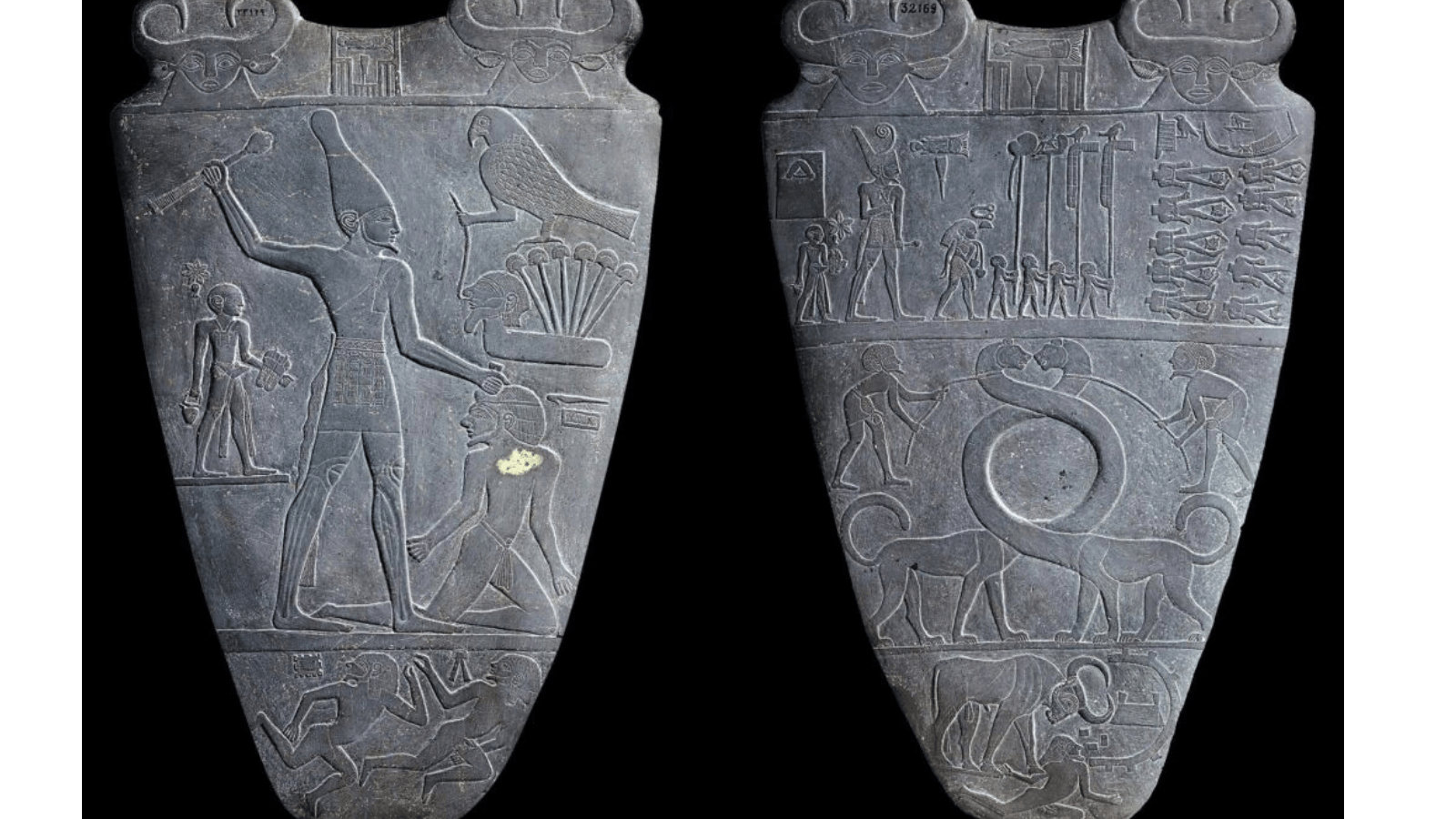
Ancient Egyptian art repeatedly shows kings raising a mace over defeated enemies. The famous Narmer Palette is one of the best-known examples of this image of royal power.
The injuries at Abydos, however, do not fit neatly into that familiar scene.
Many of the skulls show linear fractures rather than the deep, depressed injuries expected from a heavy mace strike. The people buried around the royal tombs were also members of the Egyptian court or household, not foreign enemies of the kind usually shown beneath the king’s weapon.
The evidence therefore points to violence without revealing exactly how that violence was carried out. It may have followed a ritual procedure very different from the symbolic executions shown in royal art.
A century-old mystery looks different today
The Abydos skulls show how old archaeological collections can produce new evidence long after excavation ends.
Petrie and his colleagues were already asking whether Egypt’s earliest kings were accompanied in death by members of their households. What they lacked was the forensic framework needed to interpret the injuries preserved on the bones.
More than a century later, those same remains are beginning to provide a clearer picture.
At least some of the people buried around Egypt’s first kings suffered potentially lethal violence at or near the time of death. Whether every injury belonged to a formal system of human sacrifice remains uncertain, but the possibility is now supported by physical evidence that early excavators could see without fully understanding.
Cover Image: The Narmer Palette, dating to around 3100 BCE, depicts King Narmer raising a mace over a defeated enemy. The famous scene became one of ancient Egypt’s most enduring images of royal power and violence. Credit: Public domain.