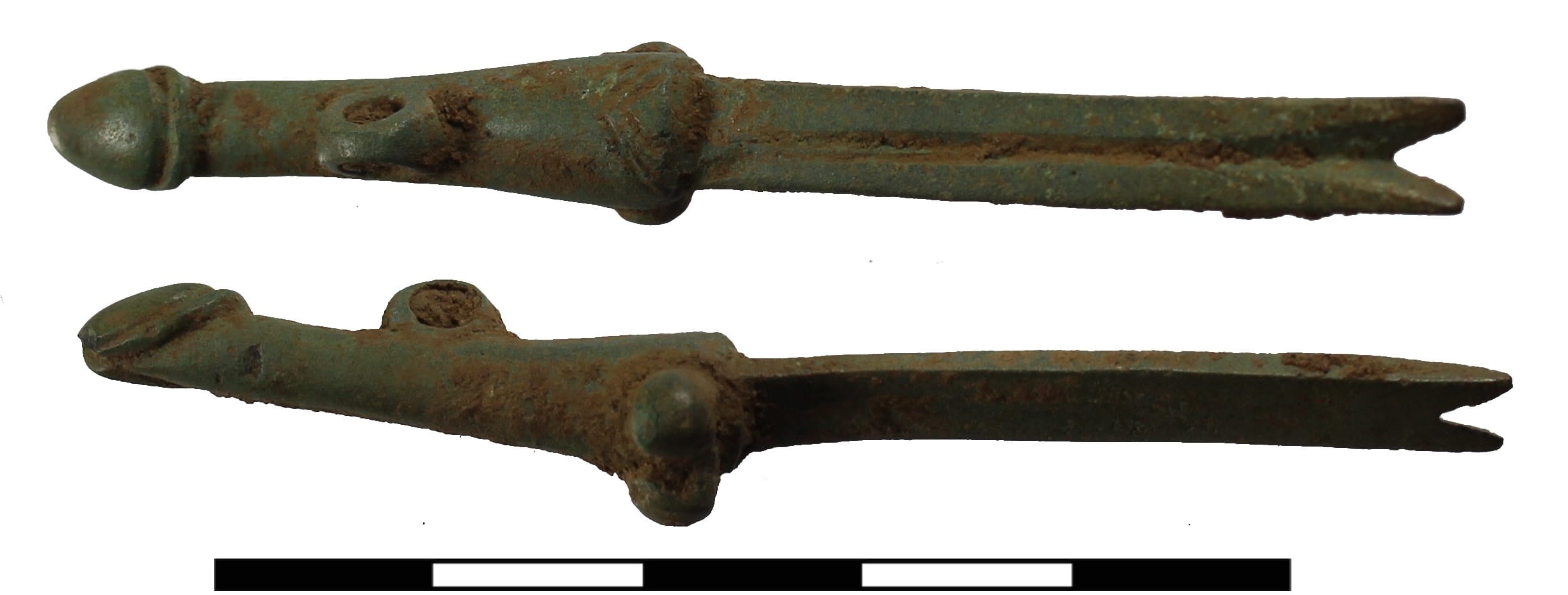
A small Roman object discovered near Cheltenham combined personal grooming with supernatural protection. One end was designed to clean beneath the fingernails; the other was shaped into a phallus believed to ward off evil and bad luck.
The copper-alloy tool was found in Gloucestershire during archaeological excavations carried out ahead of improvements to the M5 Junction 10. Archaeologists have dated it to approximately AD 300–400, placing it in the final centuries of Roman rule in Britain.
Although late Roman nail cleaners are known from several parts of England, the phallic handle makes the Cheltenham example unusually distinctive.
A Roman Tool with Two Purposes
The lower part of the object consists of a narrow, flattened blade with a groove running along its centre. Its tip divides into two prongs, forming a small fork that could be used to remove dirt from beneath the fingernails.
Above the blade, the object changes completely. The handle is modelled as a three-dimensional phallus with rounded testicles, a tapering shaft and a clearly defined glans. A small loop attached to the upper side allowed the tool to be suspended from a cord, chain or set of personal implements.
Nail cleaners formed part of the Roman world’s everyday grooming equipment. They were practical objects, but the Cheltenham find also carried a symbolic meaning.
Phallic imagery was widely used throughout the Roman Empire as an apotropaic symbol—an image intended to repel the evil eye, curses and misfortune. Phallus-shaped pendants and decorations have been found on jewellery, military equipment, horse harnesses and household objects across Roman territories.
For its owner, the Cheltenham tool may therefore have served as both a manicure implement and a portable protective charm.
Similar nail cleaners dating from the late Roman period have previously been recorded in Gloucestershire, Leicestershire and Lincolnshire. The excavation team said the newly discovered object appears to be one of the best examples of its type found in Britain, although its combination of grooming blade and phallic handle remains particularly unusual.
Decorated Roman Belt Buckle Found Nearby
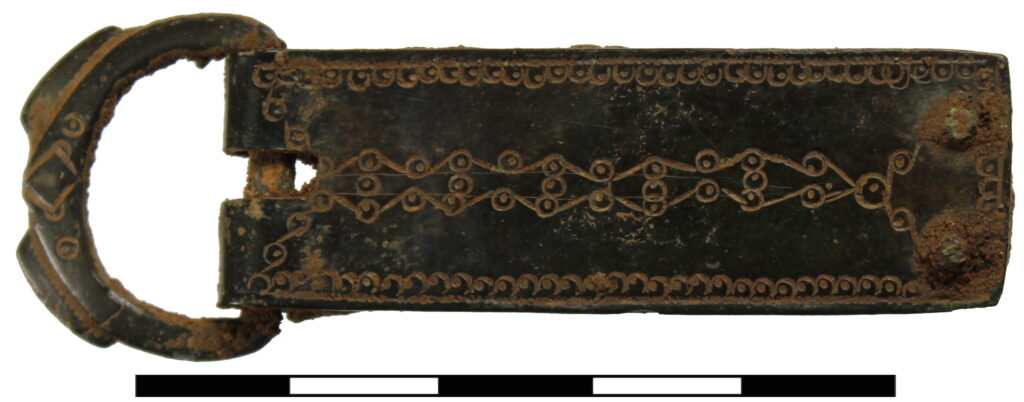
Archaeologists also recovered a decorated copper-alloy belt buckle from the same excavation area. The object dates to approximately AD 300–450, broadly overlapping with the period of the nail cleaner.
The buckle has a D-shaped frame attached to a long rectangular plate made from folded sheet metal. Two rivets secured the plate around the buckle, allowing the frame to rotate when worn.
Its surface was decorated with stamped circle-and-dot motifs. Similar designs form a border around the plate and appear in connected rows across its centre, creating a pattern resembling leaves or vines.
The buckle offers another glimpse into personal appearance in late Roman Britain. Even an everyday item used to fasten clothing could be carefully shaped and decorated.
Roman Life Beneath a Modern Road Project
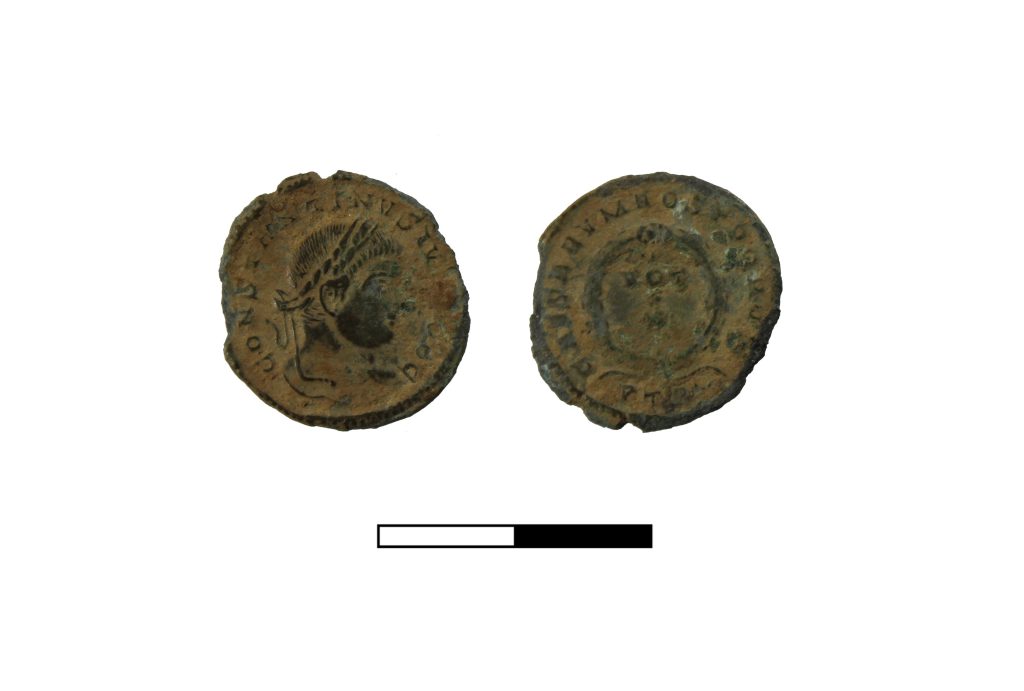
The finds were uncovered at an excavation site containing evidence of settlement, agriculture and other activity. Archaeologists identified a well, ditches, pits, postholes, trackways and enclosures, along with deposits of domestic material.
Together, the remains reveal a landscape that was occupied and used over a long period. Yet the phallic nail cleaner provides a particularly intimate connection with one of its Roman inhabitants.
It was not a ceremonial treasure or military weapon, but a small object carried close to the body—used for an ordinary task and shaped by a belief that protection from unseen dangers could be built into everyday life.
Cover Image Credit: Archaeological Research Service