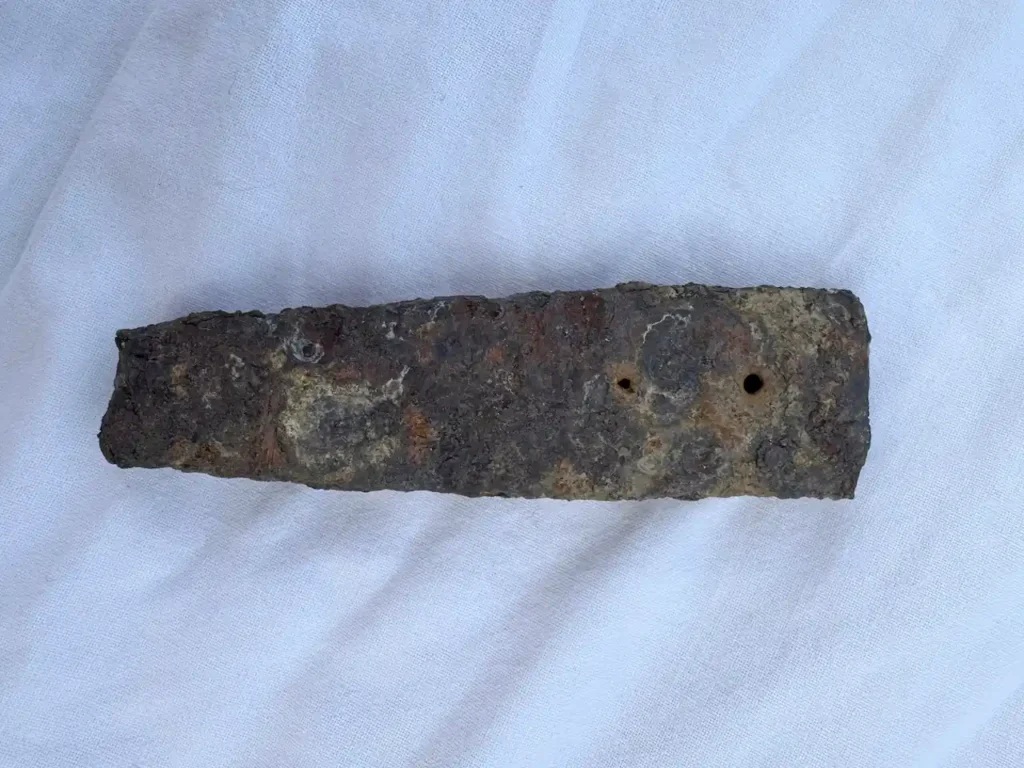
A small iron plate, punctured with a precise sequence of holes, may hold the key to how Roman craftsmen produced one of the empire’s most recognizable forms of armor. Discovered in the Czech Republic, the object appears to have been used to draw metal wires—an essential step in the production of Roman chainmail.
Archaeologists believe the tool could represent rare, direct evidence of wire-making tied to military supply systems. If confirmed, it would offer a tangible link between local craftsmanship and the equipment used by Roman soldiers across Europe.
A Railway Project Uncovers a Deep Past
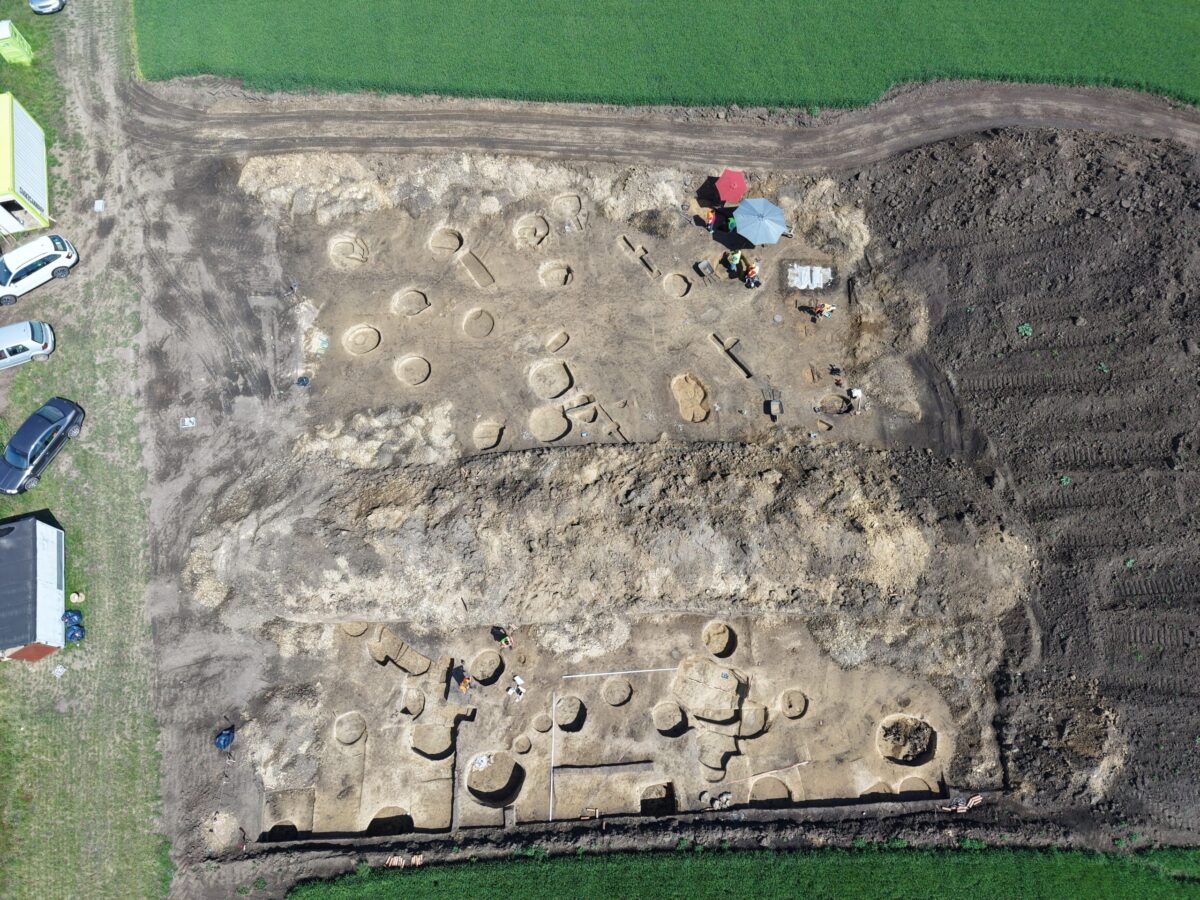
The discovery comes from a rescue excavation carried out ahead of a planned high-speed railway between Nezamyslice and Kojetín. The work, led by the Archaeological Center Olomouc, covered a 1.2-kilometer stretch of land—but revealed far more than expected.
More than 1,000 archaeological features were documented, pointing to nearly continuous human activity in the Haná River valley over thousands of years.
“This is one of the most significant settlement complexes identified in this region,” said spokesperson Nikola Jandová.
What initially appeared to be routine pre-construction work quickly turned into a layered record of human settlement, stretching from early farming societies to communities interacting with the Roman world.
Before Rome: Craft, Exchange, and Daily Life
The earliest traces belong to the Věteřov culture, an Early Bronze Age society known for its distinctive house construction.
Archaeologists uncovered the remains of post-built homes, where wooden frameworks were interwoven with branches and sealed with clay. When fire destroyed these structures, the clay hardened, preserving remarkably detailed impressions—finger marks, smoothing techniques, even the texture of the wooden rods beneath.
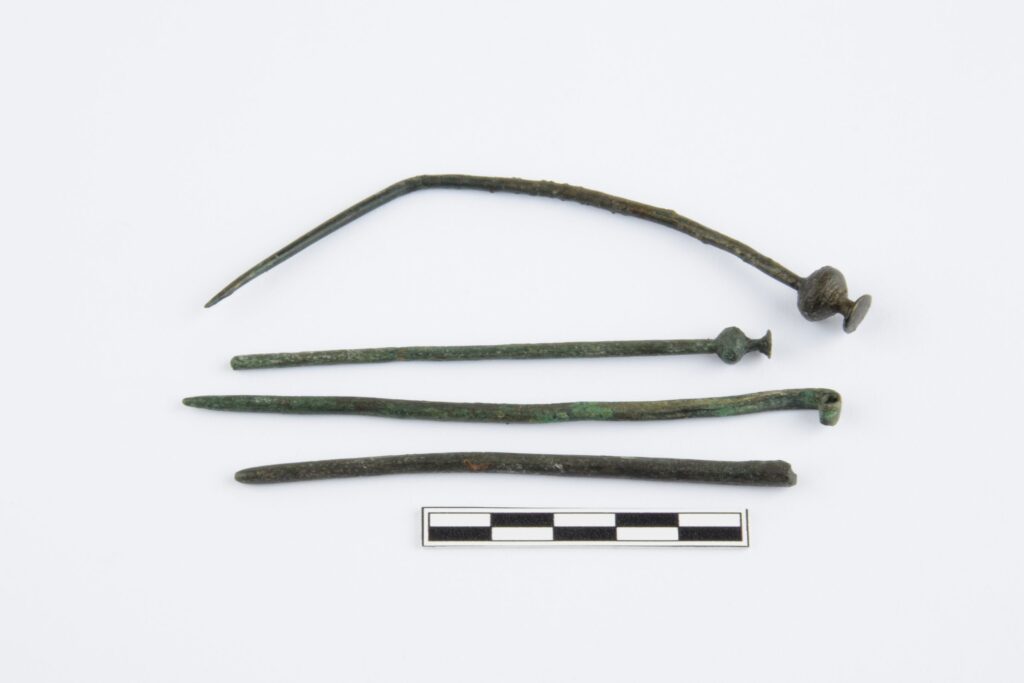
The material culture suggests a community both skilled and connected. Pottery, spindle whorls, beads, and bone tools point to textile production and domestic life, while a bronze pin with a Cypriot-style head hints at long-distance exchange networks extending far beyond Central Europe.
Burials found within the settlement reinforce this picture. In one case, the remains of an adult and a child were placed together—a pattern consistent with known funerary practices of the period and now under detailed analysis.
A Puzzling Ritual Landscape
Later occupation layers tied to the Urnfield culture reveal a more complex and less understood chapter.
Instead of the expected cremation burials, archaeologists identified features containing partial human remains. One pit, in particular, stands out: six human skulls arranged carefully side by side.
“The absence of complete skeletons suggests we may be looking at a specific ritual practice,” explained lead archaeologist Arkadiusz Tajer.
Why these individuals were treated differently remains uncertain. The find challenges conventional interpretations of Urnfield burial customs and points to a more varied ritual landscape than previously assumed.
Early Industry at the Edge of the Settlement
At the margins of the prehistoric settlement, evidence of specialized production begins to emerge.
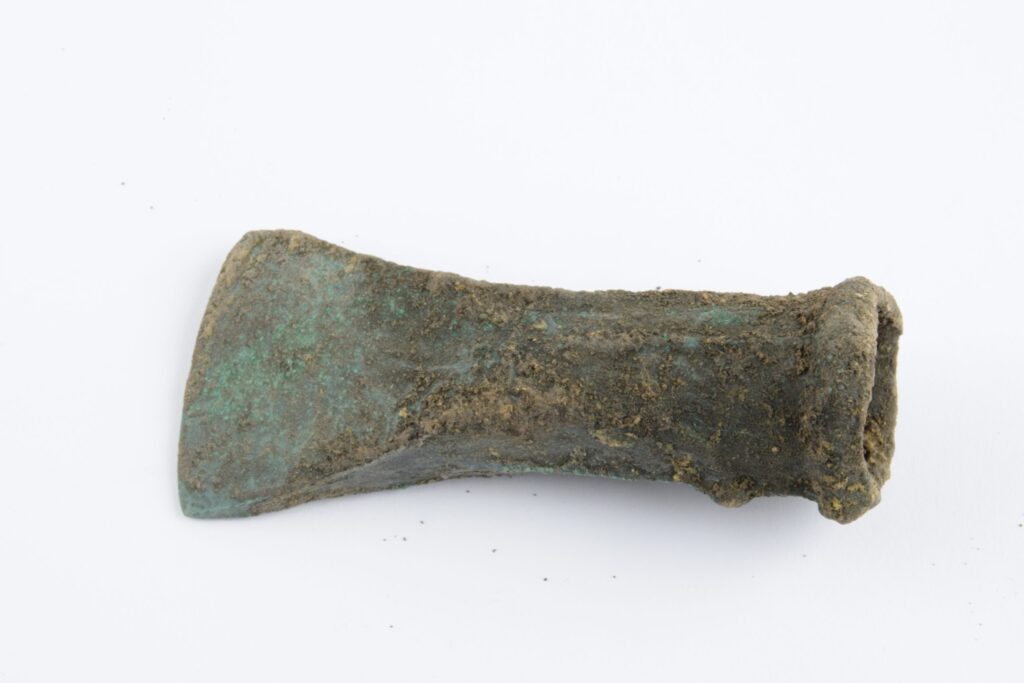
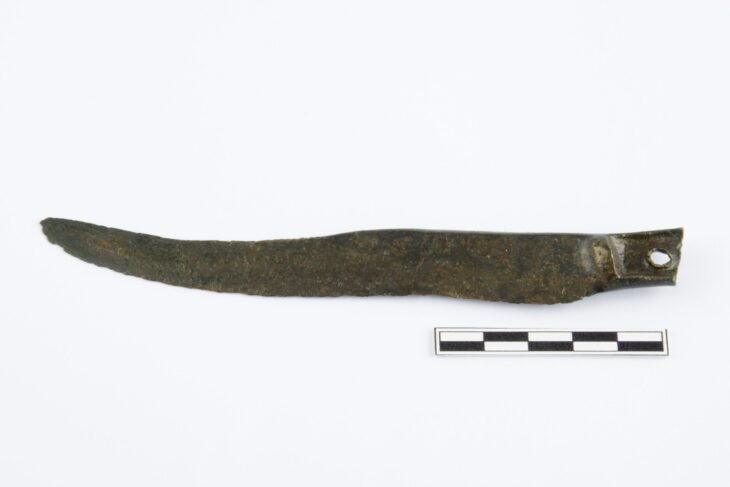
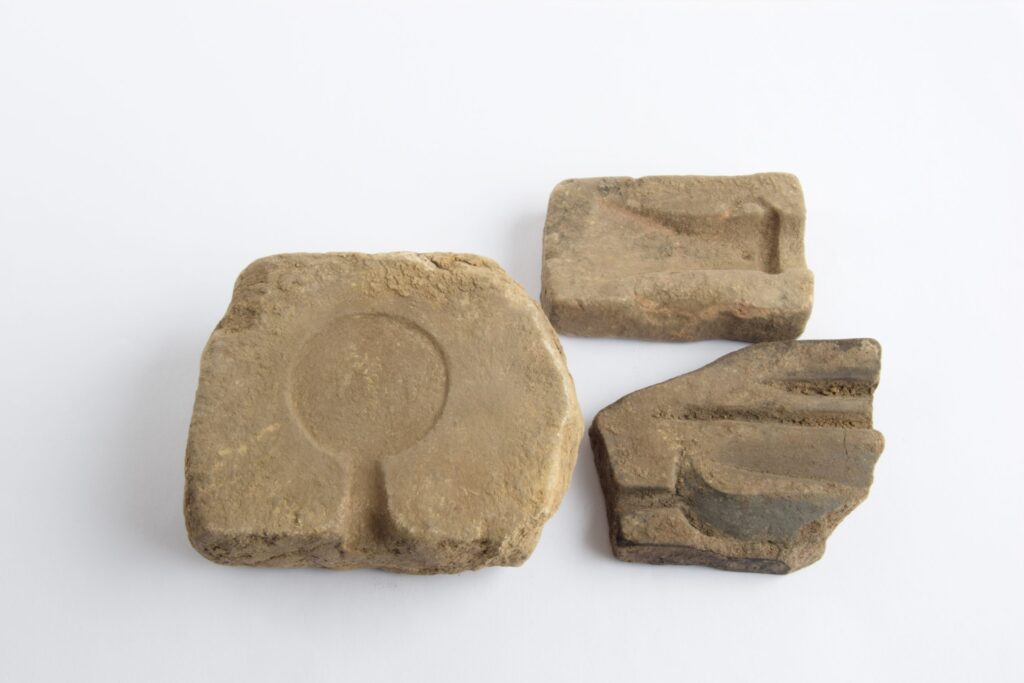
Fragments of crucibles and stone casting molds indicate that bronze working took place on-site. Finished objects—axes, needles, a bracelet, and a knife—suggest that this was not a temporary activity, but a localized workshop environment.
Ongoing laboratory tests aim to determine whether these items were produced within the settlement itself. Confirmation would point to a dedicated Bronze Age production center operating in the region.
The Roman Layer: A Tool with Military Implications
The most recent phase of occupation dates to the Roman period, when Germanic communities lived beyond the empire’s formal frontiers but remained connected through trade and cultural exchange.
Among more typical finds, such as a lime kiln used in construction, one object stands apart: a metal calibration plate.
Its function is straightforward but technically precise. Metal wire would be pulled through a series of progressively smaller holes, each pass refining its thickness. Residues preserved within the perforations suggest repeated, sustained use.
This process was fundamental to producing fine metal wires—and crucially, to manufacturing chainmail armor, known in the Roman world as lorica hamata. Each suit required thousands of interlinked rings, all dependent on consistent wire dimensions.
If the tool was used for this purpose, it may represent a rare physical link between raw metalworking and the production of Roman military equipment.
The plate is now set to undergo spectrometric analysis. Researchers hope to identify traces of the metals processed through it, which could confirm whether it played a role in supplying materials for armor production.
A Rare Continuum of Human Activity
Beyond the significance of any single artifact, the site offers something less common: continuity.
Few locations in Central Europe preserve such a clear sequence of occupation, from early agricultural communities to societies interacting with the Roman world. Each layer adds to a long-term story of adaptation, craft, and cultural exchange.
At the same time, the excavation highlights the role of rescue archaeology. Large infrastructure projects continue to expose—and, crucially, document—archaeological landscapes that would otherwise remain hidden.
Researchers, however, caution that future legislative changes could limit funding for such work. Without it, similar discoveries may never come to light.
For now, this small, perforated plate offers an unusually direct glimpse into ancient craftsmanship. And possibly, into the quiet, methodical process behind the armor worn by Roman soldiers—ring by ring.
Cover Image Credit: Drone shot of the archaeological site. Archaeological Center Olomouc