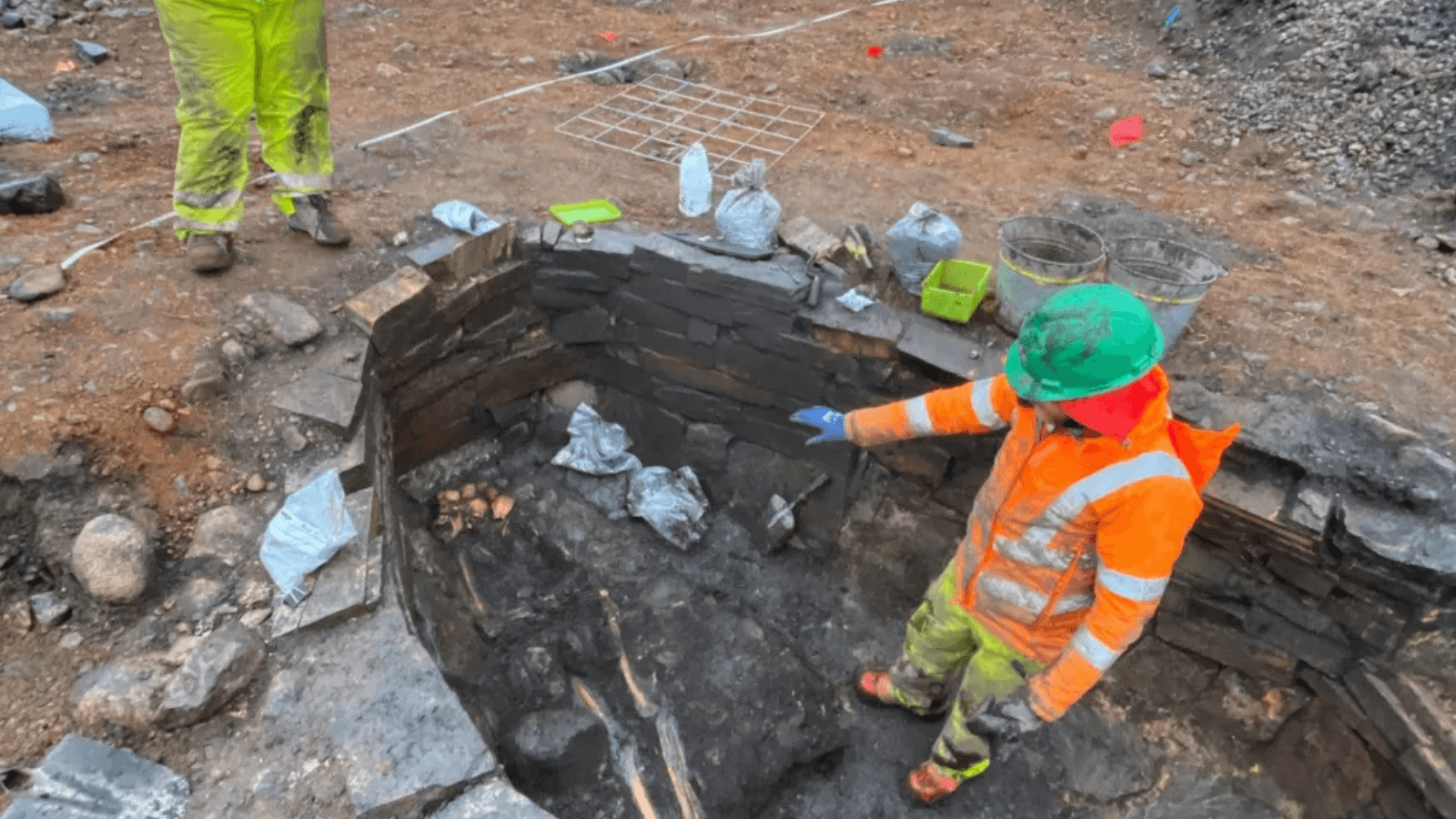
Archaeologists working ahead of a quarry expansion in northern Scotland have uncovered the remains of a woman inside an unusually elaborate stone-lined structure dating to the Iron Age.
The approximately 2,000-year-old burial was discovered at Evelix Quarry near Dornoch in Sutherland, where traces of what may have been an Iron Age settlement are also emerging. Postholes and pits found nearby could mark the former positions of timber roundhouses, suggesting the structure once stood within or close to a prehistoric community.
The discovery was made by Highland Archaeological Services (HAS) during archaeological work commissioned by quarry operator GF Job Ltd ahead of a planned extension.
What initially appeared to be an unexpectedly well-built underground structure has become the most unusual discovery at the site.
A carefully built structure beneath the ground
The sunken feature was cut into sand and measures roughly 3 meters (10 feet) long, 2 meters (6.5 feet) wide and 1 meter (3 feet) deep.
Rather than resembling a simple grave pit, it was carefully constructed. A stone-slab floor was bordered by large foundation boulders and blocks, while several regular courses of stone formed its sides. A small flight of steep stone steps led down into the structure.
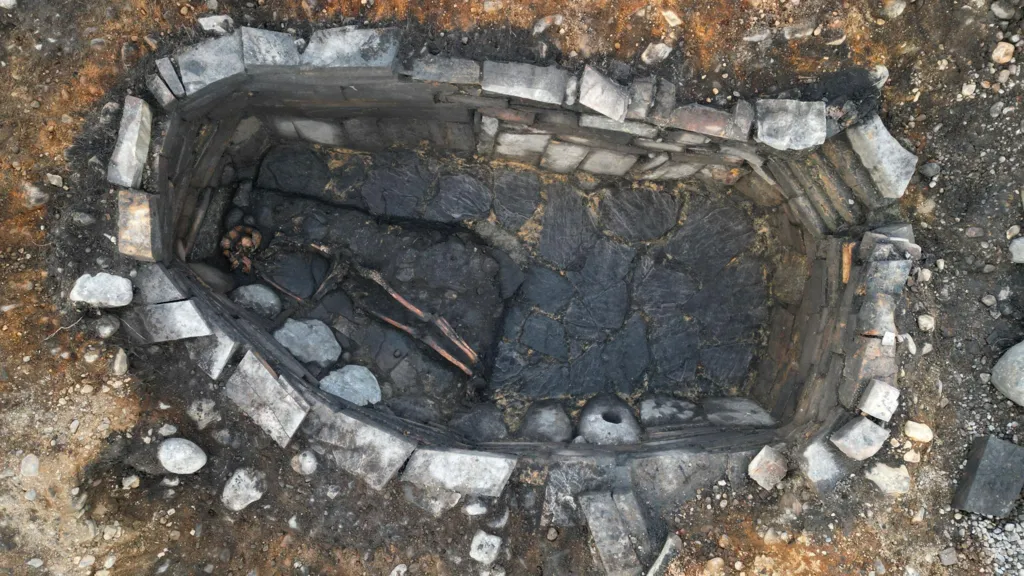
The construction was so substantial that archaeologists initially questioned whether it might be relatively modern. Evidence recovered from the feature and surrounding archaeology, however, points instead to an Iron Age date.
More intriguingly, the structure may not originally have been built as a grave. A thick, clay-like material used around parts of the lower stonework may have helped seal the structure. This has raised the possibility that it was designed to hold liquid and perhaps functioned as a well or another water-related feature.
Archaeologists have also suggested that it may have had a ritual purpose, although that interpretation remains provisional and will require further analysis.
At the lowest level of the structure, the remains of an adult were found deliberately placed in one corner. The skeleton is thought to be that of a woman who may have lain undisturbed there since the Iron Age.
Animal bones may point to a final ceremony
A large quantity of animal bone was recovered from a deposit covering the skeleton. Above this lay another layer containing substantial amounts of charcoal.
The staircase also appears to have been deliberately blocked. Together, these features raise the possibility that the structure was intentionally closed after the burial was placed inside. Archaeologists are considering whether this sequence could represent some form of ceremonial or ritualised abandonment, but the evidence has not yet produced a definitive interpretation.
During the initial archaeological investigation, researchers recorded 57 archaeological features as well as the stone structure, spread across several concentrations of pits and postholes. Only about 18 percent of the planned investigation area was examined during this first phase.
Some of the posthole groups may represent the remains of timber roundhouses, indicating that the unusual stone structure was not isolated but formed part of a wider Iron Age landscape.
Finds from the site include a fragment of a shale bangle and part of a broken steatite, or soapstone, bowl, both of which support an Iron Age date for activity at Evelix.
Further analysis could reveal who the woman was
Researchers do not yet know exactly when the woman died, how old she was, or why she was placed inside the stone-lined structure.
Further study of the human remains could provide information about her age, health and possibly diet, while analysis of the animal bones, soil samples and other environmental material may help archaeologists reconstruct what happened inside the feature before it was sealed.
The structure itself is being documented through photography and 3D scanning, creating a detailed archaeological record before work at the quarry continues.
The remains are eventually expected to be made available to Treasure Trove Scotland for possible allocation to a museum.
The wider importance of Evelix may become clearer as further work is completed. What began as archaeological investigation ahead of quarry expansion has already revealed possible domestic structures, dozens of buried features and an unusually sophisticated stone-lined pit containing a human burial.
Whether the structure began life as a well, a water-holding installation or something with a more specialised purpose remains uncertain. What is clear is that its final use involved the deliberate placement of a woman’s body, followed by deposits containing animal bone and charcoal and the apparent blocking of its entrance — a sequence that offers an unusual glimpse into how an Iron Age community in northern Scotland treated both people and places at the end of their use.
Cover Image: The stone-lined Iron Age structure at Evelix Quarry, with the human remains visible in one corner. Archaeologists are investigating whether the feature may originally have served as a water-holding or ritual structure. Credit: Highland Archaeological Services