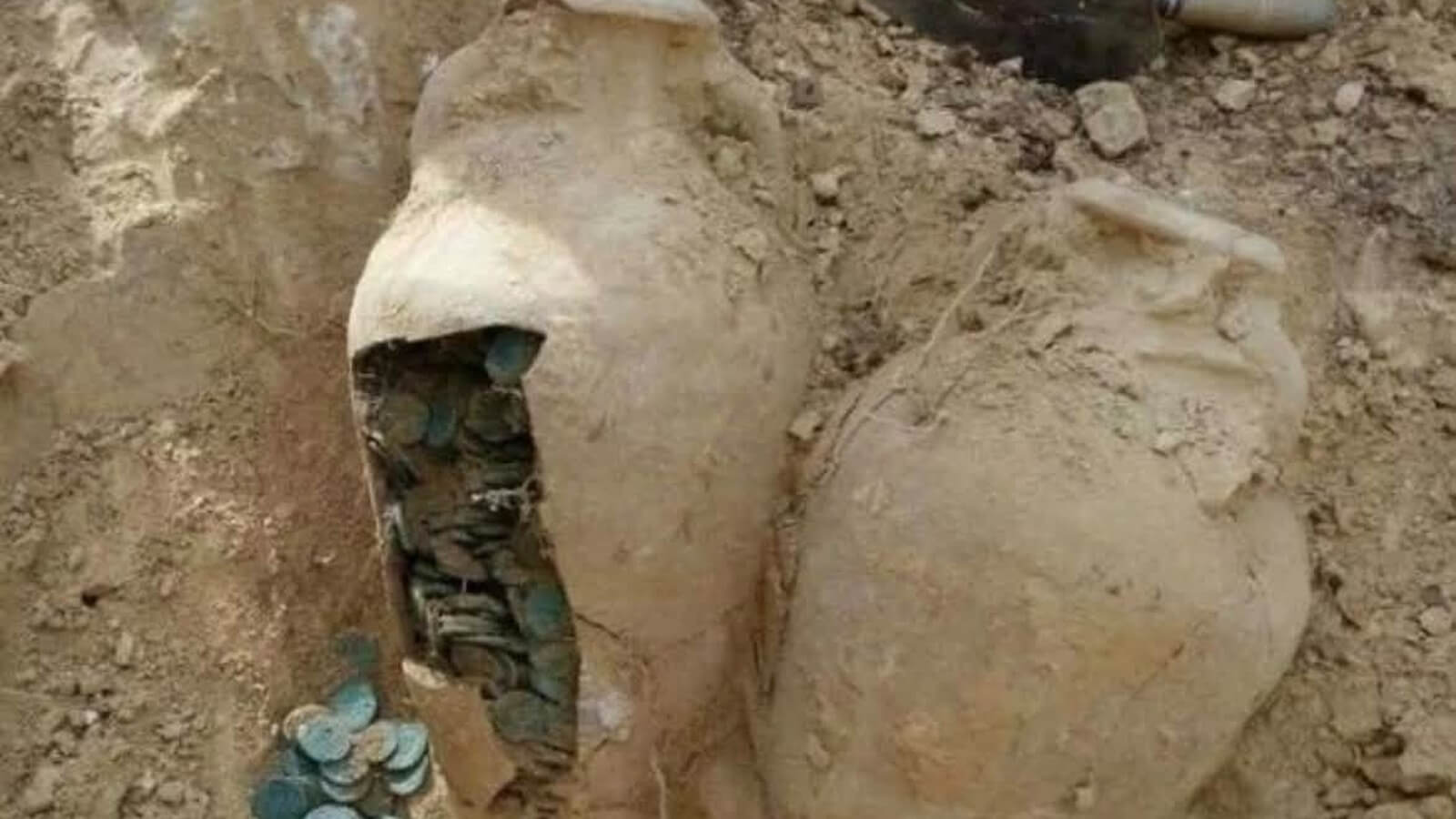
Ten years after 53,208 Roman coins were discovered inside 19 amphorae near Seville, researchers have learned when the enormous deposit was assembled, where its money came from and how the containers were packed. One question, however, remains unanswered: what was all that money meant for?
Known as the Tomares Treasure, the hoard was unearthed on April 27, 2016, during construction work at Olivar del Zaudín Park in Tomares, southern Spain. A mechanical excavator struck several ceramic vessels beneath the ground, releasing thousands of coins and revealing the largest Roman coin deposit yet documented in Spain.
The initial headlines focused on its extraordinary scale: nearly 600 kilograms of coins packed into reused Roman oil amphorae. A decade of conservation and study has since transformed the find into something more significant—a tightly dated record of how money was produced, transported and possibly managed in Roman Hispania.
A Reserve Assembled Within a Few Years
Early reports placed the number of coins at around 50,000. The official inventory eventually established a total of 53,208 pieces, most of them bronze nummi struck between AD 294 and 312.
This narrow date range places the deposit during the Tetrarchy, the system introduced by Emperor Diocletian to divide control of the Roman Empire among two senior emperors and two junior rulers. The coins carry portraits and titles associated with Diocletian, Maximian, Galerius, Constantius Chlorus and other figures from this turbulent period.
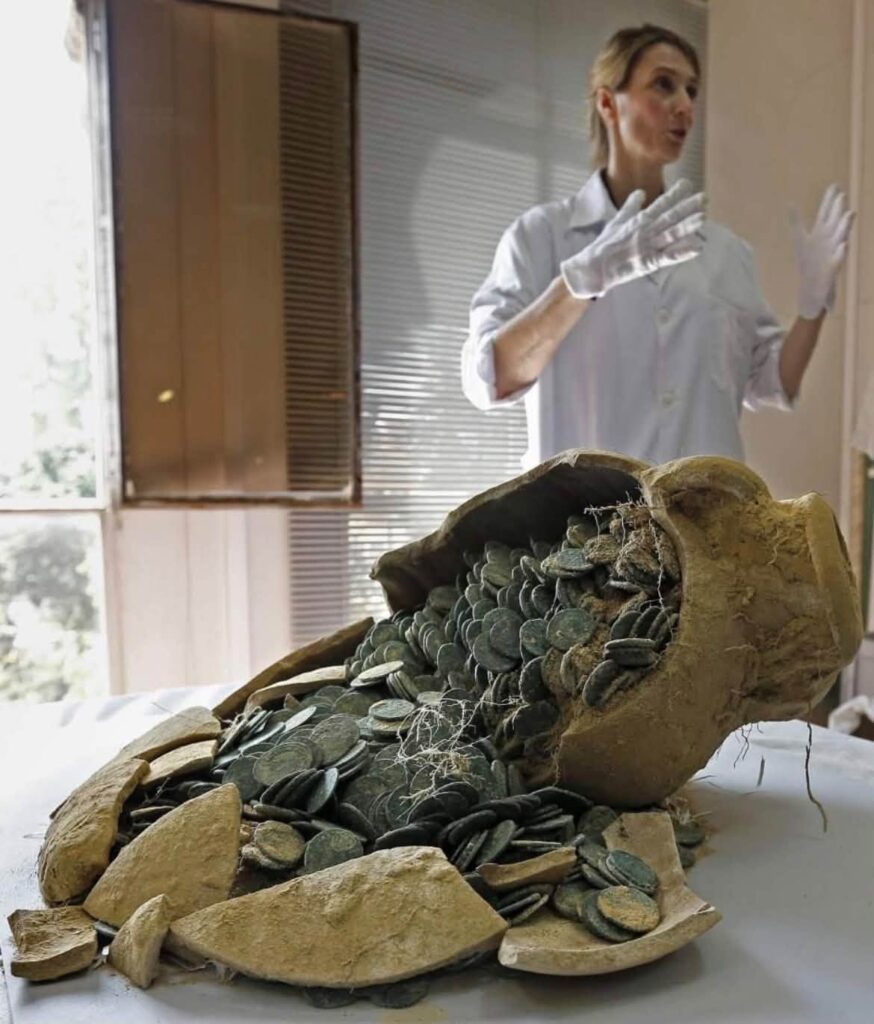
The money came from several imperial mints rather than a single local source. Its composition therefore offers researchers an unusually large sample for tracing how newly issued currency travelled across the empire and entered circulation in the Iberian Peninsula.
Many of the coins display limited wear, while the assemblage as a whole is remarkably homogeneous. This makes it unlikely that the amphorae held one person’s savings accumulated slowly over a lifetime. Instead, the money appears to have been brought together within a relatively short period.
Some pieces may originally have carried a thin silvered surface, giving the newly minted bronze coins a more valuable appearance. Time in the ground and later corrosion removed much of that finish, leaving the darker metal visible today.
Roman Money Stored in Oil Jars
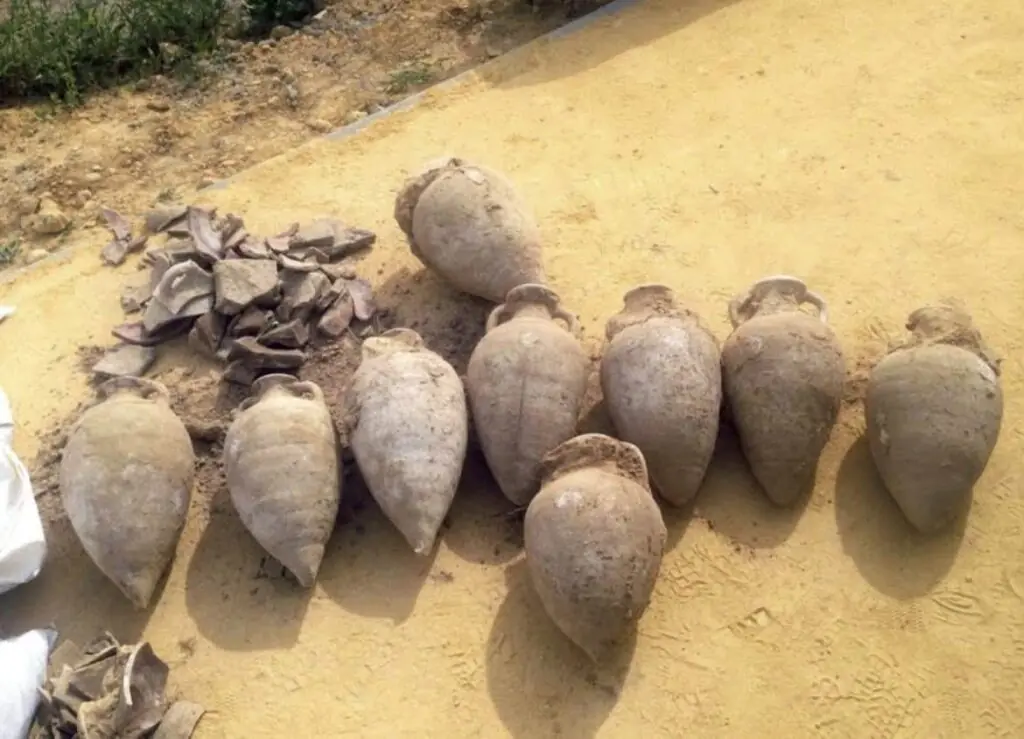
The containers add another layer to the mystery. Before they became coin chests, the amphorae had been used to transport olive oil—one of the defining products of Roman Baetica.
The region supplied oil on an enormous scale to consumers across the empire. Baetican amphorae travelled as far as Rome and the northern frontiers, carrying a commodity essential to domestic life, trade and military supply.
At Tomares, the vessels were reused and placed inside a building belonging to an agricultural complex associated with olive-oil production. The property stood within the territory of ancient Hispalis, the Roman predecessor of Seville, placing the coins inside an active economic landscape rather than at an isolated hiding place.
That context has changed how the deposit can be understood. The amphorae may have held money connected with the estate’s operations, perhaps as working capital, revenue or a reserve awaiting a large payment. Administrative and military explanations have also been proposed, although no surviving inscription or document identifies the owner or intended recipients.
The way the amphorae were preserved has allowed researchers to investigate more than the coins themselves. Several vessels survived with their contents largely intact, and video-endoscopic examinations showed coins separated within the containers and sealed with soil.
By studying the contents of individual amphorae, researchers can ask whether the money was deposited in batches, whether particular issues were grouped together and whether every vessel was filled at the same time. These details may eventually reveal how the reserve was organized before it disappeared from use.
Hidden Treasure or Abandoned Cash Reserve?
The traditional image of a coin hoard involves an owner burying personal wealth during a crisis and dying before it could be recovered. The Tomares deposit does not fit that story comfortably.
Nineteen heavy amphorae filled with more than 53,000 coins would have required planning, labour and a secure place for storage. Their location inside an agricultural building may indicate that the money was being kept there deliberately as part of the estate’s normal operations rather than hurriedly concealed from attackers.
The deposit nevertheless belongs to an unsettled chapter in Roman history. Diocletian’s reforms followed decades of political instability, civil conflict, inflation and rapid changes of emperor. Roman authorities repeatedly altered the currency as they attempted to restore confidence and meet the costs of government and defence.
The Tomares coins could have been connected to that changing monetary system. They might represent funds gathered for wages, taxes, commercial transactions or state payments, but the evidence does not yet support a single conclusion.
Nor should the hoard’s importance be measured only in modern financial terms. These were largely base-metal coins, not 19 amphorae of gold. Their exceptional value lies in their number, narrow chronology and survival together within a documented archaeological setting.
A selection from the treasure was displayed at Spain’s National Archaeological Museum in Madrid in 2025, while research and conservation continued. The tenth anniversary of the discovery in 2026 brought renewed attention to what the deposit can reveal about the economy of late Roman Spain.
Researchers now know far more than the construction workers who first saw coins spilling from the broken jars. They can identify the rulers represented, reconstruct the dates of production and follow connections between Baetica and mints across the empire.
Yet the discovery’s central mystery has endured. Someone assembled an immense quantity of Roman money, packed it into used oil amphorae and left it inside an agricultural estate. Ten years of research have shown that the deposit was carefully organized—but not why it was created, or why it was ultimately abandoned.
Cover Image: Two of the amphorae discovered at Tomares, including a damaged vessel still packed with Roman coins. The hoard contained 53,208 coins stored in 19 amphorae. Credit: Tomares City Council / EFE