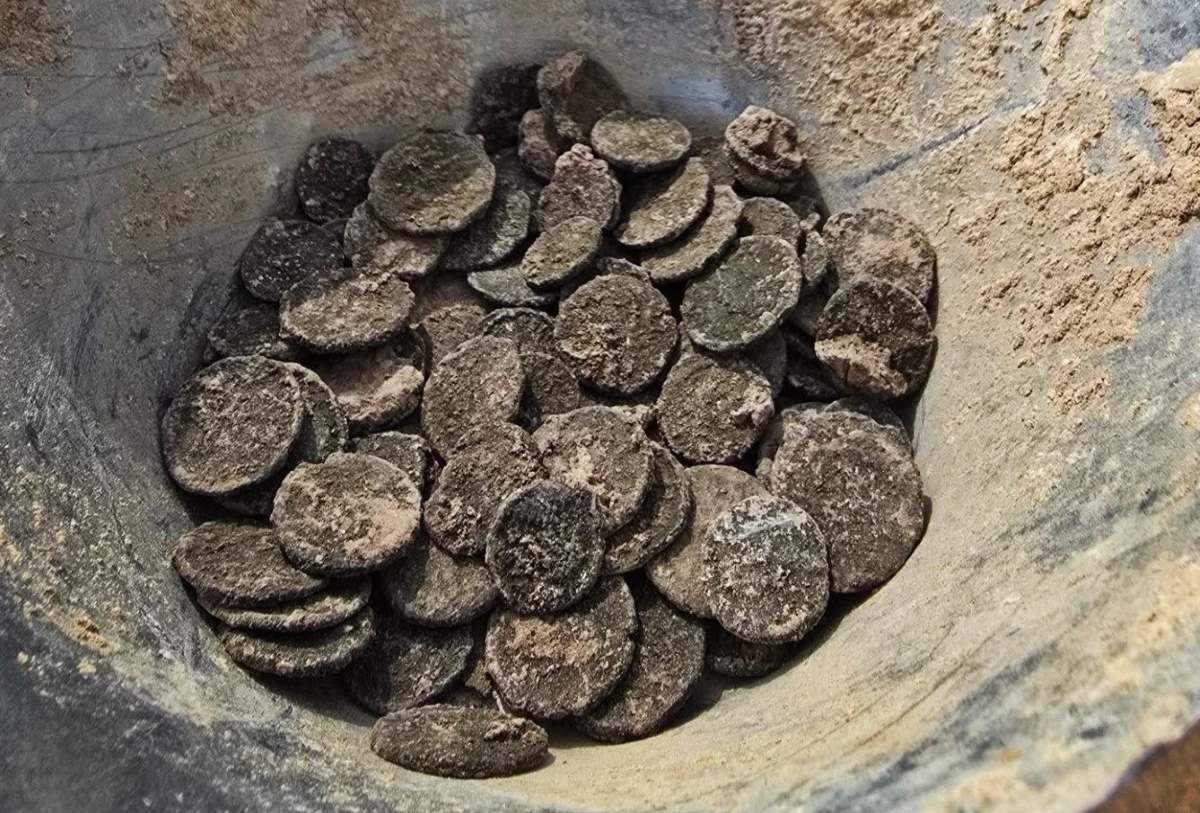
The first coin appeared in the soil of a defensive ditch. Then another surfaced. Within a small area near the village of Mohovo in eastern Croatia, archaeologists soon realized they were not dealing with ordinary lost change, but with a concentrated hoard of 302 Roman coins buried beside a frontier watchtower on the Danube.
The discovery was made during archaeological investigations led by the Institut za arheologiju in Zagreb, which has been studying Roman military infrastructure in Vukovar-Srijem County. Preliminary analysis suggests that many of the coins belong to the 4th century CE, a period when Rome’s Danube frontier remained one of the empire’s most sensitive and heavily monitored borders.
A small tower on a dangerous imperial edge
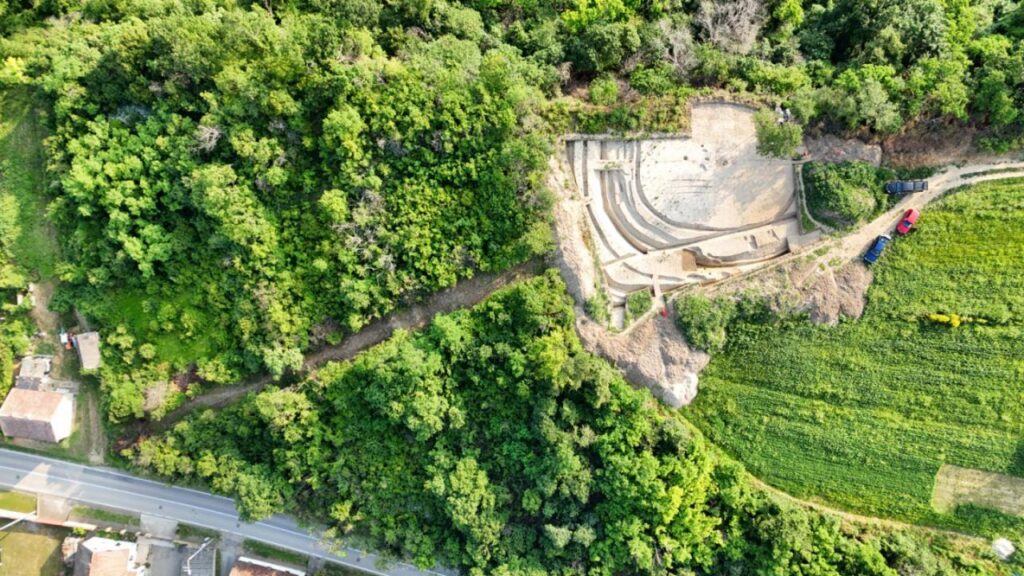
Mohovo lies close to the Danube, the river that formed one of the Roman Empire’s most important military frontiers. This was not a border protected only by monumental forts and large military camps. Much of Rome’s control depended on smaller posts, timber watchtowers, patrol routes, temporary camps, ditches, and observation points placed where movement toward the river could be watched.
The Mohovo watchtower belonged to that wider defensive chain. The site has been associated with the Roman military zone between Sotin, ancient Cornacum, and Ilok, ancient Cuccium, two important points along the Croatian Danube. Between such larger centers, smaller posts helped soldiers monitor crossings, ravines, river approaches, and possible movement from beyond the frontier.
Earlier research identified the Mohovo structure as one of the key Roman watchtower sites on the Croatian section of the Danube Limes. Archaeologists documented traces of a wooden tower surrounded by defensive ditches, suggesting a modest but strategically placed post. Its purpose was simple: watch the frontier, communicate danger, and help maintain Roman presence along a vulnerable river line.
A hoard buried in the ditch
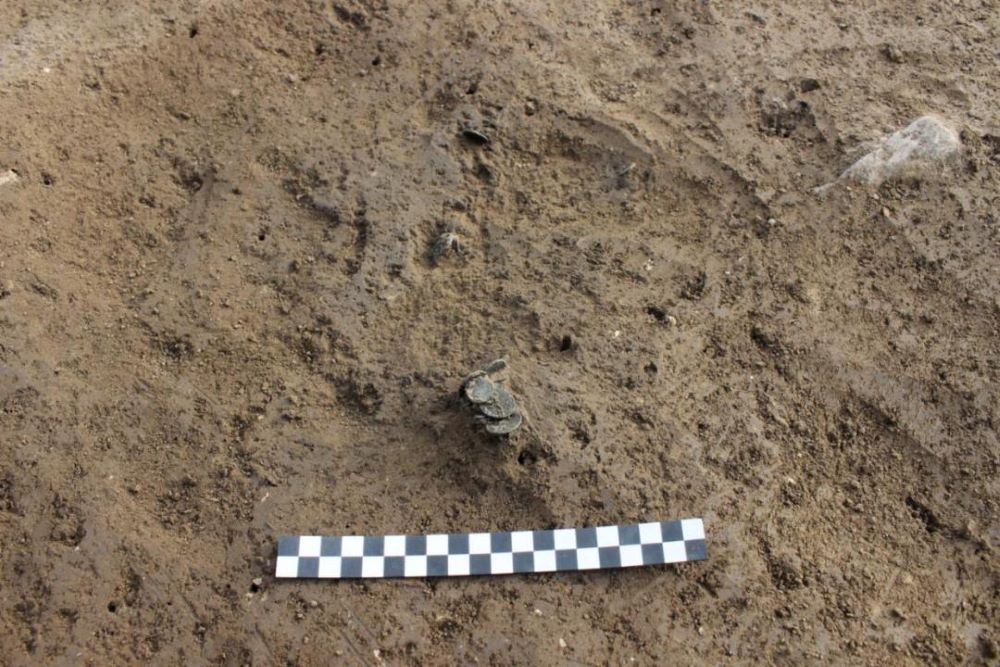
The 302 coins were recovered from one of the defensive ditches, concentrated within roughly one square meter. That density makes the find unusual. It does not look like a few coins accidentally dropped over time. Instead, it suggests a deliberate deposit, perhaps hidden quickly during a moment of uncertainty.
One interpretation offered by researchers is that the coins may have belonged to soldiers stationed at the watchtower. They could have represented pay, shared funds, or money kept by a small military group at the post. If the garrison buried the coins during an attack, alarm, or sudden withdrawal, they may have expected to return once the danger had passed.
They apparently never did.
That possibility gives the Mohovo hoard its emotional force. The coins are not only archaeological evidence. They may preserve the final trace of men stationed on the edge of the Roman world, guarding a river frontier where danger could come without warning.
Coins from the age of Valentinian
The preliminary dating of the hoard makes the discovery even more significant. Many of the coins appear to belong to the reign of Emperor Valentinian I, who ruled the western half of the Roman Empire from 364 to 375 CE. Valentinian is closely tied to this region because he was born at Cibalae, the Roman city beneath modern Vinkovci, not far from Mohovo.
Cibalae was an important late Roman urban and military center in southern Pannonia. It was also associated with Valentinian’s brother Valens, who became emperor in the East. That makes the Mohovo coins part of a frontier landscape deeply connected to imperial history, military service, and the political geography of late Rome.
Valentinian’s reign was marked by major efforts to strengthen Roman defenses, especially along the Rhine and Danube. In that world, small watchtowers mattered. The empire still had power, but that power had to be maintained through constant surveillance, local garrisons, rapid communication, and disciplined defense at vulnerable points.
The Mohovo hoard fits precisely into that late Roman reality. It shows not the grandeur of Rome, but its daily mechanics: soldiers, ditches, towers, coins, and the uneasy work of watching a frontier.
More than a military outpost
Other finds from the Mohovo area broaden the picture. Roman-period brooches, equipment fragments, pottery, and objects linked to daily activity show that the watchtower was not merely a military marker on a map. Men lived there. They fastened cloaks, repaired gear, prepared food, used the river landscape, and endured the routine of frontier service.
That is what makes the discovery so compelling. A watchtower can seem like a technical feature of Roman military archaeology. But a buried hoard turns it into a human scene. Someone placed those coins in the ground. Someone knew where they were. Someone, perhaps, intended to come back.
Mohovo is also part of a wider archaeological landscape still being mapped. Researchers have identified additional potential Roman military sites in the surrounding area, suggesting that the watchtower may have been one element in a larger defensive network hidden beneath fields near the Danube.
A frontier story still under study
The discovery also strengthens the importance of Croatia’s section of the Danube Limes, the Roman frontier system that once stretched across large parts of Europe. The frontier was not a single wall. It was a network of rivers, roads, forts, towers, camps, settlements, and military routes shaped by local geography.
Mohovo helps make that system visible at a small scale. It shows how Rome watched the Danube not only from major forts, but from modest wooden posts built in carefully chosen places. These sites rarely look spectacular at first glance, yet they were essential to how the empire held its border.
The coins will now require conservation, restoration, and detailed scientific analysis. Their mint marks, wear patterns, metal composition, and distribution may help archaeologists refine the dating of the hoard and better understand why it was buried.
For now, the discovery has already given Mohovo a sharper place in the story of Roman Croatia. More than 1,600 years after they were hidden in a ditch, the 302 Roman coins may still carry the memory of a small garrison on the Danube frontier, caught in a moment of danger and lost to history.
If the interpretation is correct, they never came back for their money.
Cover Image: 302 Roman coins discovered at the Mohovo Roman watchtower site in eastern Croatia, where archaeologists uncovered a late Roman hoard linked to the Danube frontier defense system. Credit: Institute of Archaeology in Zagreb
Institut Za Arheologiju (Institute of Archaeology in Zagreb)