
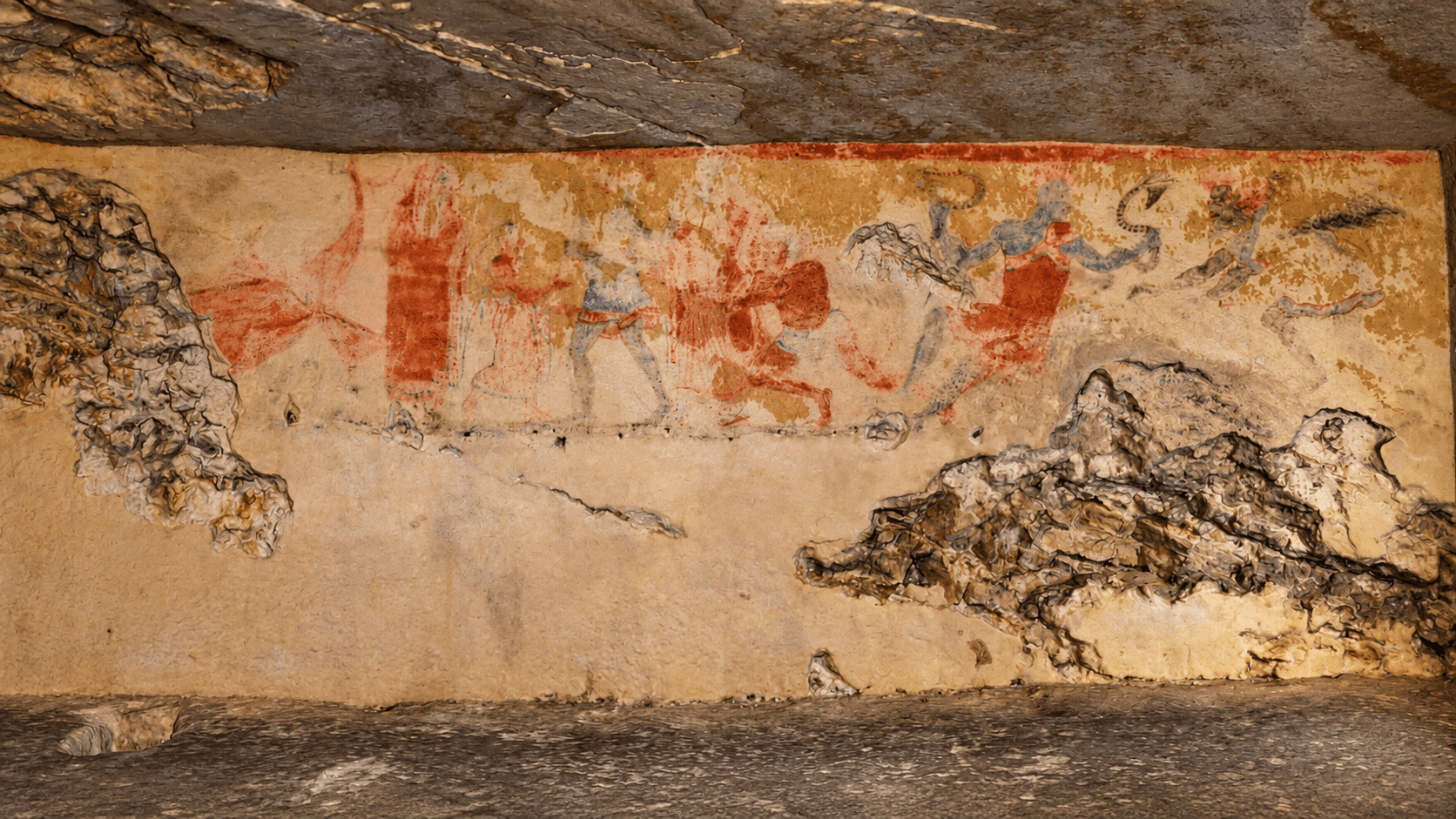
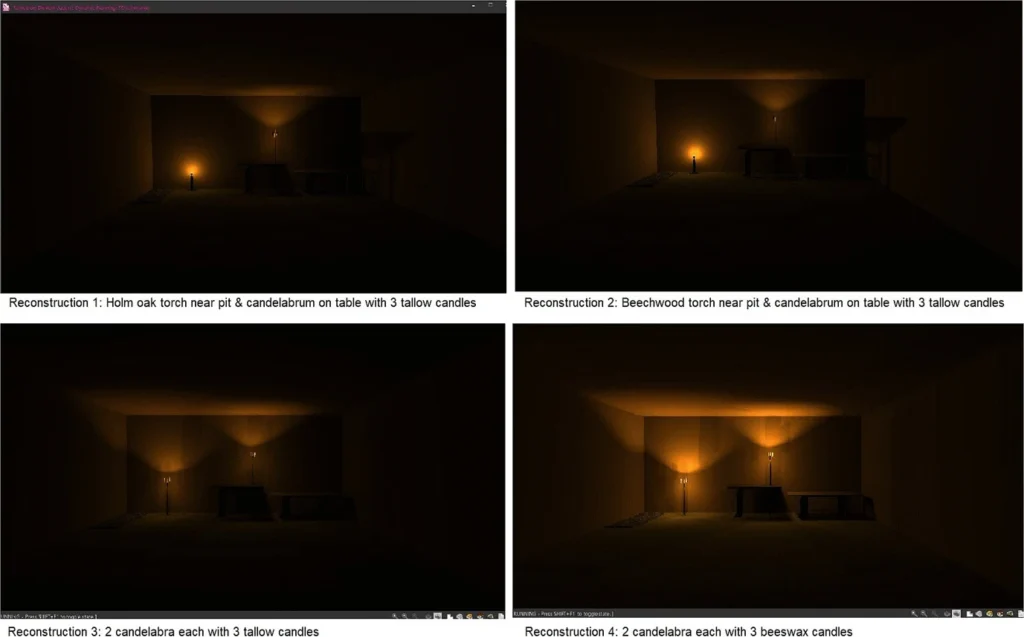
Anyone descending into the Etruscan Tomb of the Blue Demons would have left daylight behind and entered a chamber of flickering illumination, distorted voices and painted supernatural figures. At the rear of the tomb, low-frequency sounds could reverberate for more than seven seconds, making their source difficult to locate and allowing the echoes to be felt as much as heard.
New research suggests that this extraordinary acoustic environment may have played an important part in ceremonies conducted inside the 2,400-year-old tomb. Combining measurements taken within the chamber with three-dimensional modelling and artificial intelligence, researchers found that its architecture, paintings and sound could have guided visitors through successive moments of observation, fear and sensory disorientation.
The study, published in the Journal of Archaeological Method and Theory, examines two fifth-century BCE painted tombs at Tarquinia in central Italy: the Tomba dei Demoni Azzurri, or Tomb of the Blue Demons, and the Tomba del Gallo. Despite belonging to the same funerary tradition, the two monuments created markedly different experiences for those who entered them.
An Etruscan tomb with cathedral-like echoes
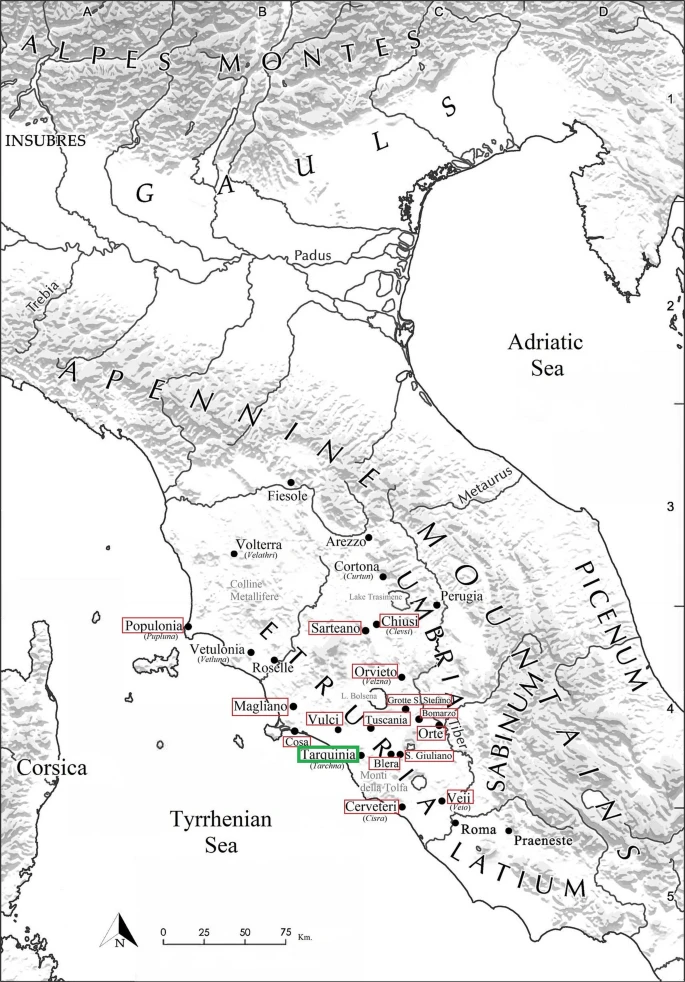
Tarquinia was one of the most important cities of the Etruscans, who dominated much of central Italy before the rise of Rome. Its vast Monterozzi necropolis is famous for painted underground chambers decorated with banquets, dancers, musicians, processions and figures connected with death and the afterlife.
The most surprising acoustic results came from the Tomb of the Blue Demons. Several reverberation measurements were comparable to those recorded inside cathedral settings such as St Paul’s Cathedral in London, according to the researchers.
The strongest effect was documented near the banquet scene on the chamber’s rear wall. At frequencies of 125 hertz and below, reverberation lasted as long as 7.52 seconds. This figure was measured inside the tomb and should not be understood as a direct numerical comparison with St Paul’s Cathedral; rather, it illustrates the exceptional acoustic character of the chamber.
Drums, clappers, chanting and human voices could have produced overlapping echoes within this space. Sounds generated inside the chamber also travelled along its wide entrance corridor, while speech originating outside could be heard from within the tomb.
Under these conditions, spoken words may have become difficult to understand and their direction hard to identify. Low-frequency sounds could also have produced vibrations felt through the body, potentially weakening a visitor’s sense of orientation in the darkened chamber.
A blue demon waiting in the darkness
Sound formed only one part of the experience. The tomb’s walls depict musicians, a procession, a funerary banquet and supernatural beings associated with the Etruscan journey into the afterlife. The most arresting is the blue-skinned figure that gives the tomb its modern name.
Computer-vision analysis identified the Blue Demon as the chamber’s strongest visual focal point. Its unusual colour, threatening posture and position at the centre of the right wall could have made its appearance especially startling when revealed by moving candlelight.
The paintings appear to have created a visual sequence. Visitors entering the chamber first encountered the more orderly procession on the left. As they moved farther inside and turned towards the right wall, they came face to face with the demon while the tomb’s echoes made voices and sounds increasingly difficult to place.
The journey then led towards the banquet painted on the rear wall, where the longest reverberation was measured. The combination of darkness, supernatural imagery and prolonged low-frequency sound may have made this part of the chamber feel separated from the world outside.
Two tombs that treated death differently
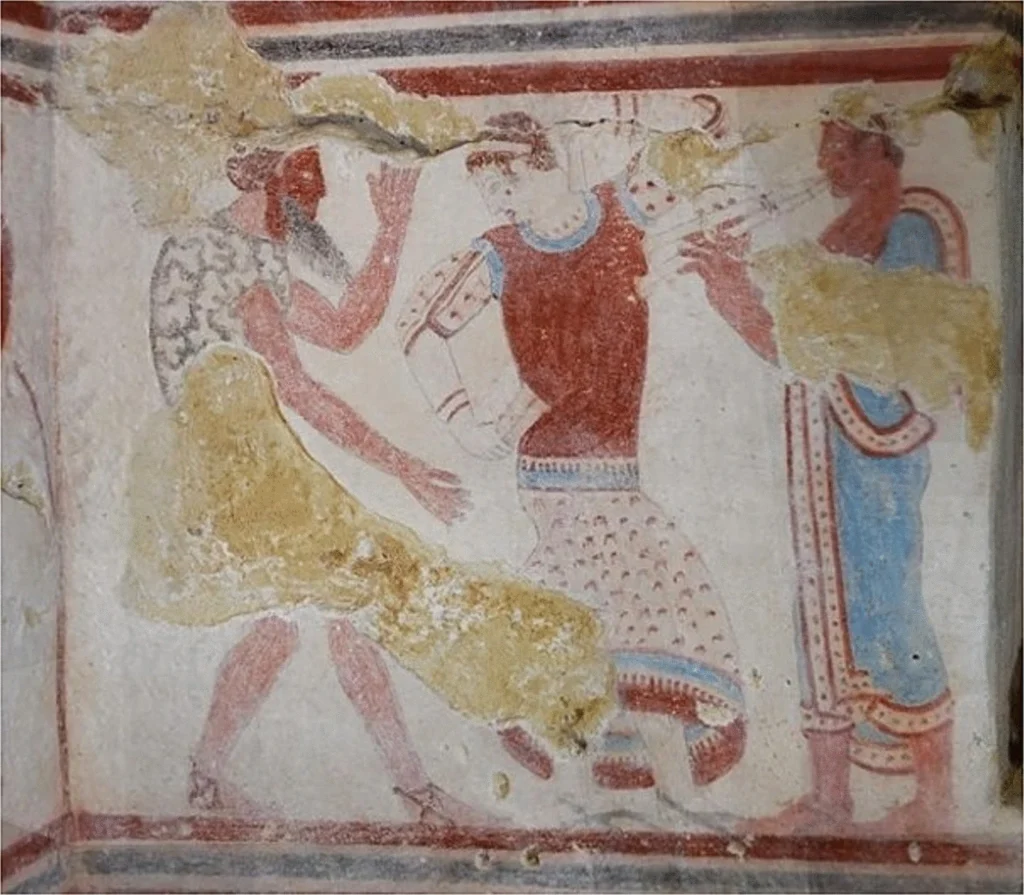
The nearby Tomba del Gallo produced a sharply contrasting result. Its steep passage leads into a much smaller burial chamber measuring approximately 3.3 by 2.5 metres. Although its paintings also include dancers, musicians and banqueting figures, its architecture restricted movement and controlled when individual images became visible.
Most frequencies within the chamber reverberated for only about one to 1.5 seconds. Sound became concentrated near the bottom of the entrance corridor instead of spreading throughout the burial chamber as it did in the Tomb of the Blue Demons.
The comparison indicates that Etruscan painted tombs did not offer a uniform ritual experience. The smaller Tomba del Gallo directed the visitor’s movement and gaze, while the Tomb of the Blue Demons surrounded the body with sound and visual surprises. Architecture was not merely a backdrop for the paintings; it determined how they were encountered.
Was the effect deliberately created?
Excavations in the Tomb of the Blue Demons uncovered burned human remains, animal bones, pottery, iron objects and traces of a chariot. Its unusually spacious chamber, widened entrance corridor and features cut into the floor also point to complex activities conducted within the monument.
These discoveries raise the possibility that the tomb served as more than a place where the dead were deposited. Ceremonies commemorating ancestors may have been held there repeatedly before the entrance was finally sealed.
The researchers do not claim to have recreated an actual Etruscan ceremony or proved that the chamber was deliberately engineered to induce trance. Artificial intelligence was used to model how measurable features—including colour, spatial restrictions, visibility and acoustic intensity—could influence attention and movement. It cannot reveal exactly what an ancient visitor thought or felt.
Nevertheless, the acoustic measurements show that the sounds inside the Tomb of the Blue Demons were real physical properties of the monument. Those entering its darkness would have confronted a space in which voices lost their direction, deep echoes lingered and a painted demon emerged unexpectedly from the wall.
For the Etruscans who gathered there, approaching the dead may therefore have been more than a symbolic act. It may have been an experience that unsettled the eyes, ears and body at the same time.
Cover Image: The right wall of the 2,400-year-old Tomb of the Blue Demons at Tarquinia, where supernatural figures formed part of an intense visual and acoustic environment. Image reproduced from Forte and Ortoleva (2026), licensed under CC BY 4.0. Credit: J. K. Ortoleva.
Source: Maurizio Forte and Jacqueline K. Ortoleva, “Performing Power and Transitional Space: the Use of Acoustics and Multimodal AI in Etruscan Painted Tombs,” Journal of Archaeological Method and Theory.