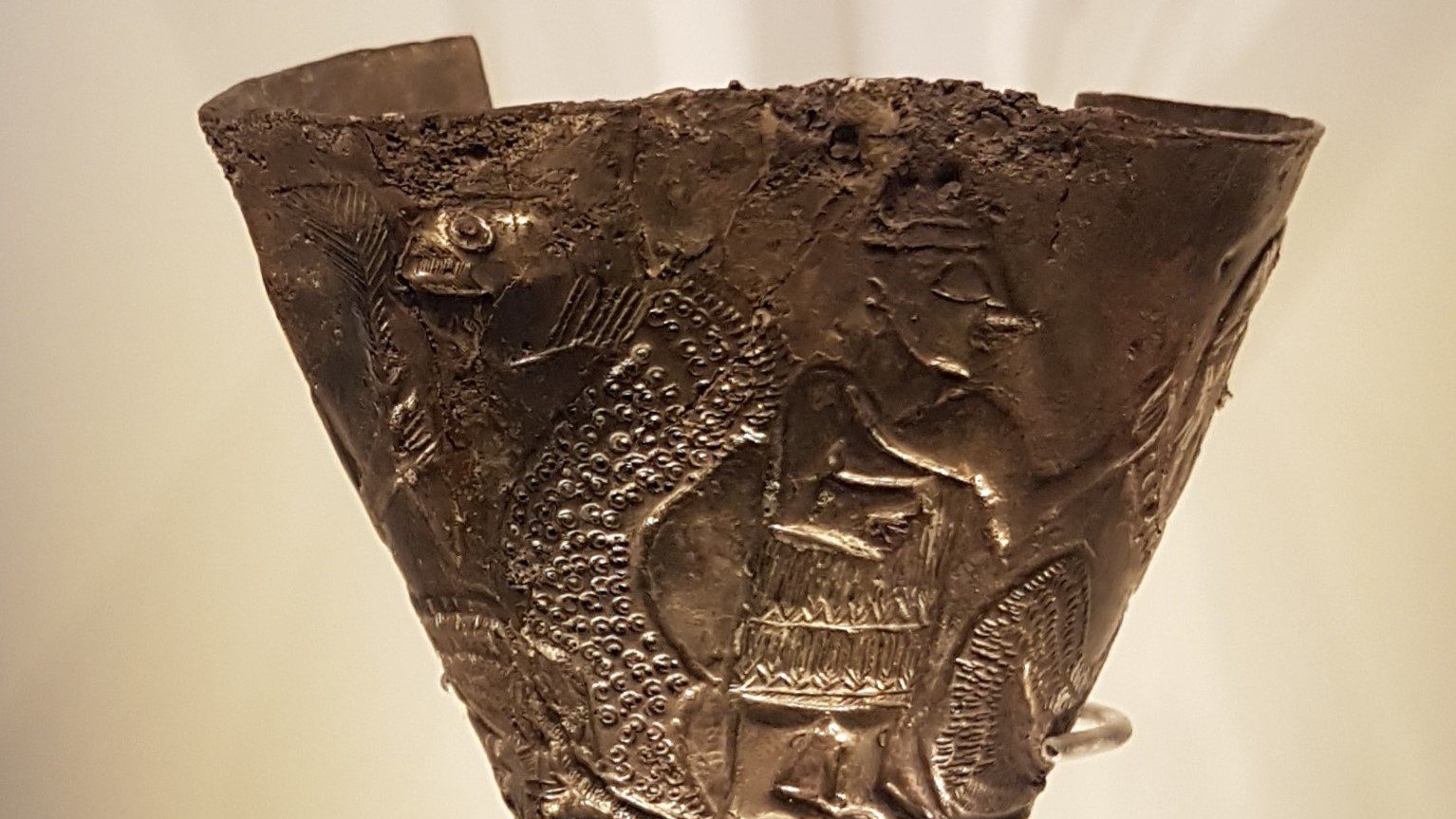
A small silver cup, barely taller than a matchbox, is reshaping how archaeologists think about the origins of cosmic thought. Known as the ʿAin Samiya Goblet, the vessel dates to the Intermediate Bronze Age (ca. 2650–1950 BCE) and carries an unusually complex symbolic program—one that may predate written creation myths by centuries.
An Object That Never Fit the Mold
The goblet was uncovered in 1970 near the spring of ʿAin Samiya, in the Judean Hills.
Its burial context was modest. The grave contained common pottery and weapons—nothing extraordinary.
Except for the cup.
To this day, it remains the only known luxury silver vessel from this period found in the southern Levant.
Rethinking Ancient Creation Imagery
In a new study, geoarchaeologist Eberhard Zangger and his team argue that the goblet does not illustrate a single, named myth. For decades, scholars linked its imagery to the Mesopotamian creation epic Enuma Elish.
The problem is chronology.
The goblet is nearly a thousand years older than the earliest written versions of that text.
Instead, the researchers propose a broader interpretation: the cup visualizes the emergence of cosmic order from primordial chaos, a concept shared across the ancient Near East long before formal mythologies were written down.
Two Images, One Transition
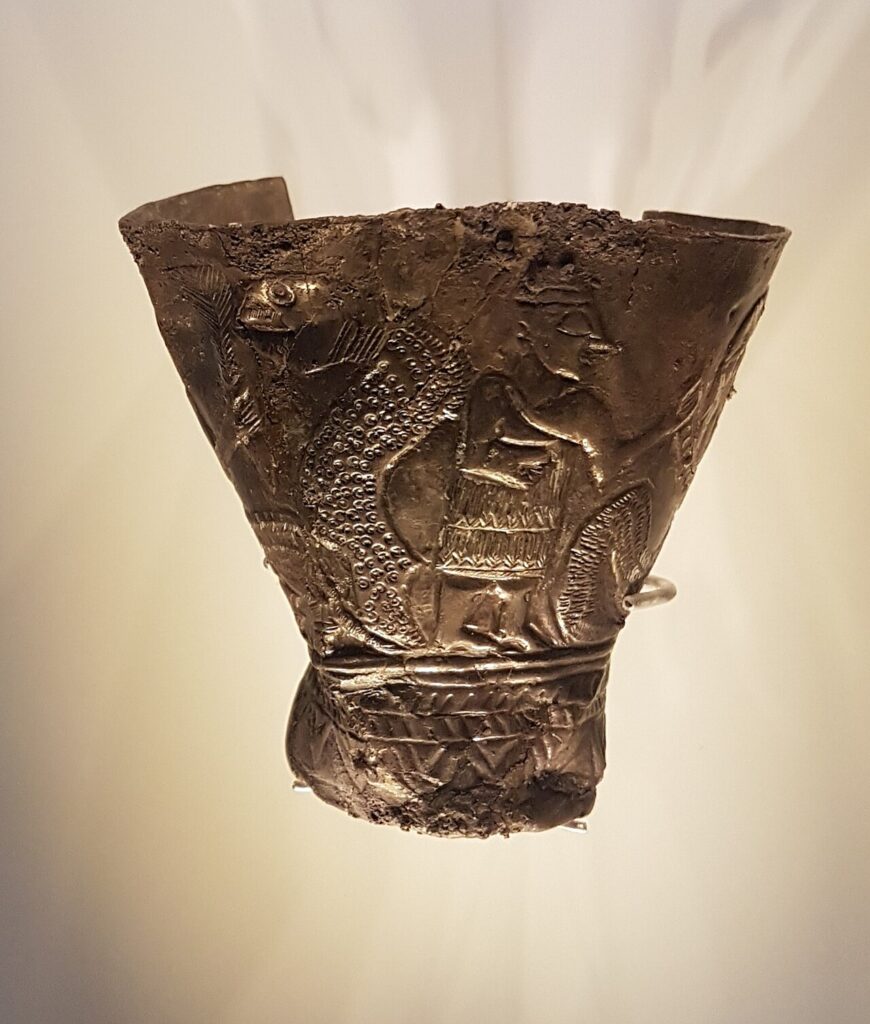
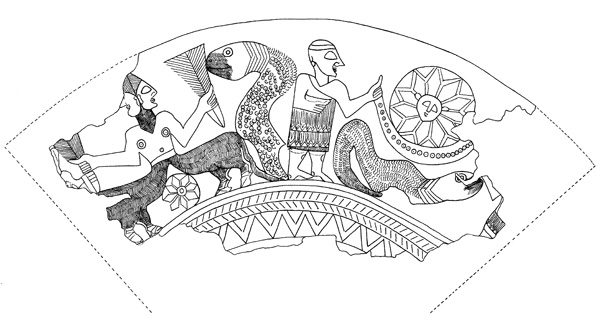
The goblet’s surface is divided into two adjacent scenes.
In the first, hybrid figures—part human, part animal—appear interwoven with serpents and plant forms. The imagery feels unstable. Boundaries are blurred. Nothing is fully defined.
The second scene shifts dramatically.
Two human figures raise a crescent-shaped object holding a radiant solar disk. Below, the once-upright serpent lies flattened and controlled. The crescent is interpreted as a celestial boat, a symbol associated with the regulated movement of the sun and moon.
Together, the scenes suggest a sequence: from disorder to structure, from chaos to a governed universe.
Anatolia Enters the Picture
Although the goblet was buried in the Judean Hills, its symbolic language extends far beyond the Levant.
The study highlights parallels from Mesopotamia, Egypt, and notably Anatolia. A limestone prism from Lidar Höyük in southeastern Türkiye carries related celestial motifs, showing that such cosmological imagery circulated widely across regions connected by Bronze Age trade networks.
The researchers suggest the design concept may have originated in southern Mesopotamia, while the goblet itself was likely produced in northern Syria—before traveling south through interconnected routes that also linked Anatolia to the wider Near Eastern world.
Debate Remains Open
Not all scholars are persuaded. Critics point to unresolved issues surrounding the goblet’s restoration history and caution against drawing sweeping conclusions from a single object. Zangger’s earlier controversial theories have also made some researchers wary.
Yet even skeptics agree on one point.
A Tiny Cup with an Enormous Reach
The ʿAin Samiya Goblet represents one of the earliest known attempts to visualize humanity’s place in an ordered cosmos—long before creation stories were written down.
Whether it reflects a funerary vision, a universal cosmological model, or an early synthesis of Near Eastern thought, the message is clear:
big ideas often arrive in very small forms.
Zangger, E., Sarlo, D., & Haas Dantes, F. (2025). The earliest cosmological depictions: Reconsidering the imagery on the ʿAin Samiya goblet. Journal of the Ancient Near Eastern Society Ex Oriente Lux 49–66.
Cover Image Credit: Public Domain – Wikipedia Commons