

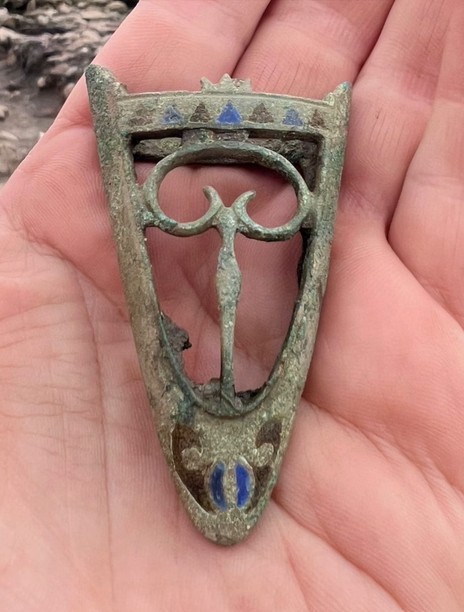
An enamelled Roman sword fitting has emerged from a second-century layer at Roman Vindolanda, the frontier fort near Hadrian’s Wall in northern England. Although small enough to fit in one hand, the object preserves a detail rarely associated with the popular image of the Roman army: color.
The copper-alloy fitting has been identified as a scabbard chape, a piece attached to the lower end of a sword sheath. Archaeologists uncovered it during the latest excavation season, and the Vindolanda Trust introduced it as a “Friday Find” by the season’s Period 10 excavation team.
A protective fitting designed to be seen
A chape protected the vulnerable tip of a scabbard as it moved against a soldier’s clothing, equipment or surroundings. Yet the surviving enamel shows that the Vindolanda example was not made for protection alone.
Colorful decoration could turn an otherwise practical component into a visible part of a soldier’s appearance. Suspended beside the body, the end of the scabbard would have moved with its wearer and remained in view, making the choice of decoration meaningful even on such a modest object.
The Trust has so far described the find simply as a copper-alloy scabbard chape with enamelled ornament. Its measurements, decorative pattern and precise typological classification have not yet been published, so any attempt to associate it with a particular workshop, military unit or owner would be premature.
Its archaeological setting nevertheless provides an important chronological anchor. The fitting came from a second-century context, placing it within a period when Rome was consolidating and reorganizing its northern British frontier.
A fort older than Hadrian’s Wall
Vindolanda stood on the Stanegate, the military road that formed Rome’s earlier frontier across northern Britain. The first fort was established before construction began on Hadrian’s Wall in AD 122, and the site later served as an important garrison and construction base connected with the new frontier system.
The settlement did not remain unchanged. According to the Vindolanda Trust, Roman forces demolished and rebuilt Vindolanda nine times, leaving a dense sequence of timber and stone structures beneath the visible ruins.
These overlapping occupation layers have preserved traces of successive military communities. Archaeologists have recovered weapons and tools alongside shoes, textiles, wooden objects and writing tablets containing private letters and administrative records.
The enamelled chape belongs to this material world of equipment that was carried, worn and eventually lost or discarded. Unlike a monument or formal inscription, it records a personal choice in the appearance of an everyday military object.
What the enamel may reveal
Enamel decoration was created by placing colored material within prepared recesses in a metal surface and heating it until it fused. On Roman military equipment, the technique could add contrast and visual interest to fittings attached to weapons, belts and horse gear.
Further conservation may clarify the chape’s design and reveal how much of its original color survives. Comparison with other examples could also help specialists refine its date and determine whether its ornament followed a widespread fashion or a more regional tradition.
For now, the evidence remains limited, and the fitting cannot be linked to an individual soldier. Even so, its survival offers a useful correction to the familiar grey image of the Roman frontier: the people stationed at Vindolanda carried equipment that could be carefully finished, brightly decorated and intended to catch the eye.
After approximately 1,800 years underground, one of those flashes of color has returned.
Cover Image: Aerial view of Roman Vindolanda, the frontier fort south of Hadrian’s Wall where the enamelled scabbard chape was uncovered. Credit: Vindolanda Trust