
The figures were almost invisible—faded shapes clinging to a cliff in the highlands of central Turkey. A hiker, pausing to catch his breath on a steep slope, noticed something that should not have been there: deliberate lines, human forms, a pattern emerging from the rock itself. That moment of curiosity has now opened a new chapter in Anatolia’s prehistoric story.
Archaeologists believe the markings belong to the Neolithic period, carved or painted by communities who lived in the region more than 8,000 years ago. If confirmed, the discovery could anchor central Turkey among the continent’s most significant early rock art landscapes.
A Discovery That Redraws the Map of Anatolian Prehistory
For years, Neolithic rock art in Turkey has been associated with iconic sites such as Latmos, the engravings of Hakkari, or the symbolic art connected to Çatalhöyük. Kayseri, by contrast, had remained largely absent from that prehistoric map—until now.

Prof. Dr. Osman Özsoy of the ÇEKÜL Foundation describes the find as nothing short of unprecedented.
“We have been documenting Kayseri’s cultural layers for more than a decade,” he said. “But this type of Neolithic imagery has simply never appeared here. It has the potential to shift our understanding of the region’s earliest communities.”
What stands out are the shapes themselves: elongated human-like silhouettes, earth-toned pigment traces, and the intriguing T-shaped motifs—a form seen across some of the most enigmatic prehistoric sites of Anatolia.
Echoes of Latmos, Hakkari and the Deepest Past of Anatolia
Specialists quickly noted stylistic parallels with Latmos, where family groups, ritual scenes, and everyday gestures appear in natural rock shelters. The Kayseri figures share similar tones, proportions, and compositional logic.
Yet some elements hint at something older. The simplicity of the lines, the posture of the figures, and the absence of decorative details recall early Anatolian symbolic traditions—raising the possibility that these paintings could be contemporary with rock art in Hakkari or even with the earliest cultural horizons surrounding Göbeklitepe.
“Until the pigments and methods are studied, we cannot know the precise age,” Özsoy cautions. “But everything points to a prehistoric horizon—likely early or middle Neolithic.”
Painted or Carved? The Rock Keeps Its Secrets—for Now
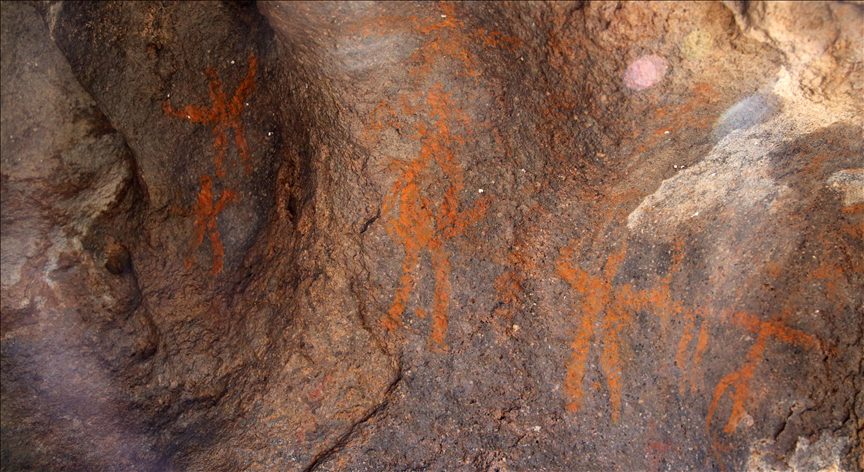
Under changing light, the figures appear alternately painted and incised, a mystery that will require laboratory work to resolve. Across Anatolia, Neolithic artists frequently used pigments made by mixing hematite with clay or crushed minerals. Whether the Kayseri figures were produced the same way remains to be determined.
Weathering patterns suggest great age. Some areas display the kind of erosion seen only on long-exposed pigment surfaces; others resemble shallow carving. The ambiguity only adds to the excitement.
A Hidden Cultural Landscape Waiting to Be Explored
Perhaps the most tantalizing question is whether these figures stand alone. In Turkey, Neolithic art rarely appears in isolation. Entire slopes, valleys, or mountain belts sometimes preserve clusters of related panels.
Archaeologists now plan to survey the surrounding ridges, searching for additional compositions that may have gone unnoticed for centuries in this rugged landscape.
If more panels are found, central Turkey could quickly become one of the most significant new prehistoric art regions in the Near East—an unexpected node connecting the symbolic traditions of western, eastern, and southeastern Anatolia.