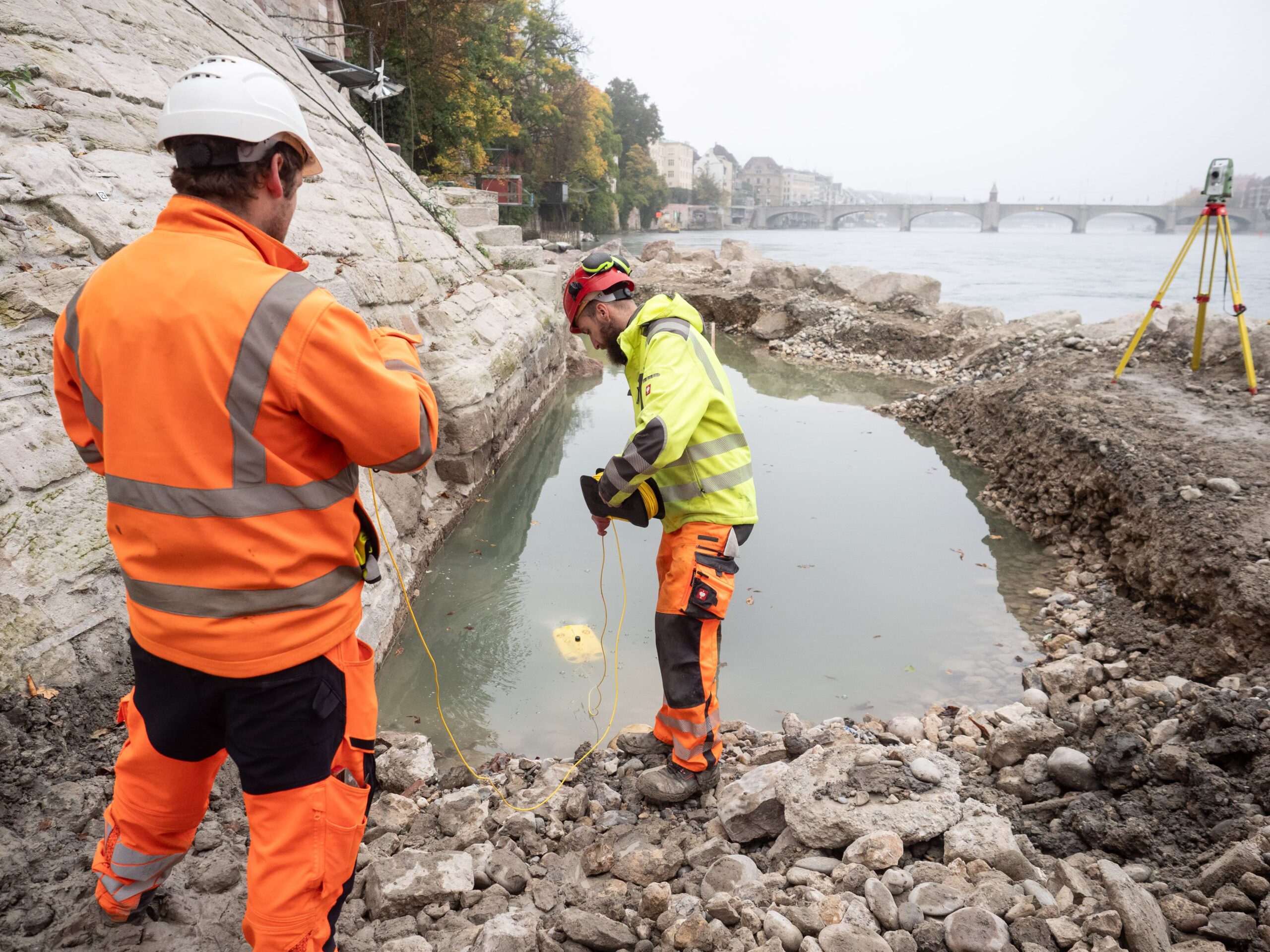
For the second time in less than a century, Basel’s riverbank has delivered another unexpected window into its deep urban past. During ongoing repair works on the massive retaining wall beneath the Pfalz terrace—directly behind the city’s iconic Münster Cathedral—archaeologists uncovered a remarkably well-preserved medieval seal stamp that once belonged to Rudolf Kraft, the cathedral’s cantor at the end of the 13th century.
The find surfaced during underwater investigations at the foot of the Pfalz, a vantage point where the bishop’s palace once rose above the Rhine. Today the terrace is a quiet lookout over the river, but in the Middle Ages it was tightly woven into the daily life of the cathedral complex. The cloister lies only a short passage away, and in Rudolf Kraft’s lifetime around 1296–1305, his residence on what is now Augustinergasse 8 stood barely a minute’s walk from the discovery site.
A Seal Carved for a Cathedral Official
The newly discovered object is a pointed oval seal die cast in brass and showing remarkably little wear despite spending centuries in river sediment. Its imagery is unmistakable: a cleric in liturgical robes stands at a lectern, holding an oversized book that hints at his role within the cathedral hierarchy. The cantor was far more than a master of chants and liturgical music. He served as guardian of the cathedral’s documentary memory, overseeing records of deaths, charters and annals, and managing the liturgical library that preserved the institutional identity of medieval Basel.
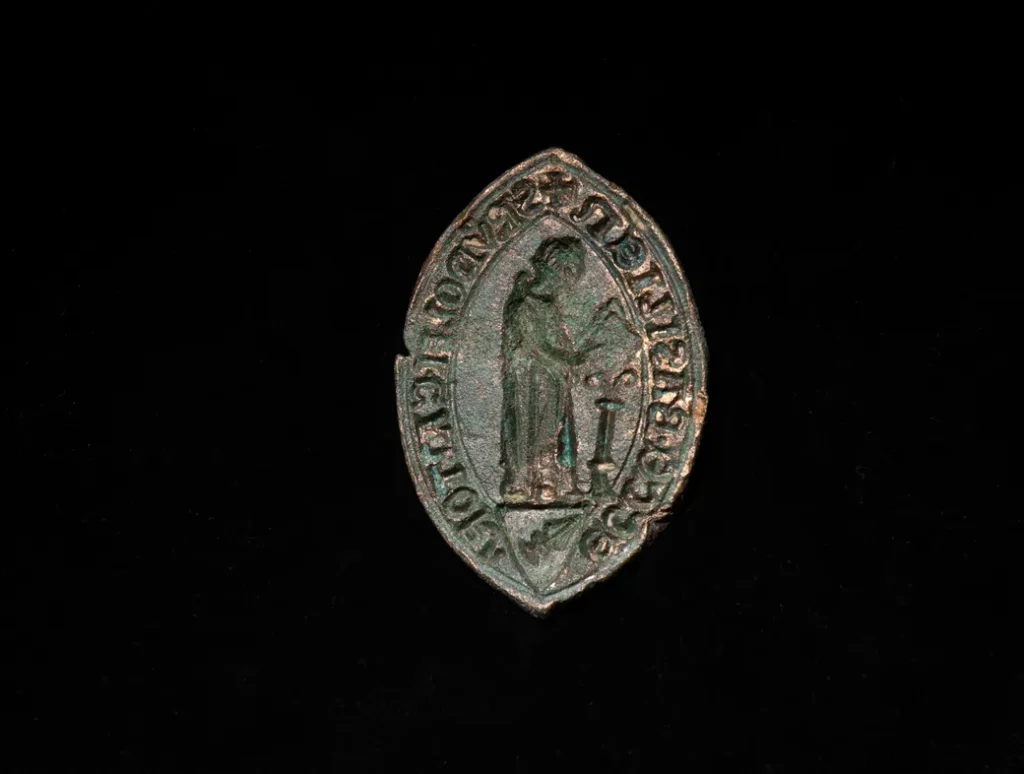
Along the outer edge of the seal runs an inscription rendered in elegant Gothic lettering: ECCLESIA BASILIENSIS + SIGILLUM RUDOLFI CANTORI, identifying the owner as Rudolf Kraft, cantor of the cathedral. His biography aligns precisely with the archaeological context. Basel at that time was not yet part of the Swiss Confederacy, an affiliation it achieved only in 1501, nearly two centuries after Kraft carried this seal through the cathedral precinct.
Two Thousand Years Underfoot
The discovery unfolded as engineers and archaeologists work together to stabilise the Rhine embankment and refurbish the Münsterfährbödeli landing stage. These interventions have opened a rare opportunity to examine the river’s muddy margins, which have accumulated human debris and architectural fragments for two millennia. As the slope beneath the cathedral eroded or collapsed, everything from Roman coins to medieval household objects slid downward into the water.
This phenomenon has been documented before. During an unusually dry winter in 1932–33, low water levels revealed hundreds of Roman coins and medieval artefacts embedded in the same stretch of the riverbank. For centuries, material from the bishop’s residence and the adjacent Palatinate was routinely discarded down the slope, while dramatic events—such as the Rhine bank collapse of 1346 and the collapse of the Palatinate in 1502—sent entire layers of masonry and household debris tumbling into the river.
New Archaeology Beneath the Waterline
What distinguishes the current project is the combination of heavy construction and precision archaeology. Mud dredged from the river’s edge is now being examined item by item using metal detectors by the Archaeological Soil Research team, while underwater cameras and drones are deployed whenever visibility allows. This marks the first time Basel’s archaeologists have used drone-based underwater imaging to document structures and artefacts along the riverbank.
The result is an unusually detailed record of a zone that is normally inaccessible. The seal of Rudolf Kraft, preserved in brass and still bearing its inscription with striking clarity, is one of the most evocative pieces to emerge—an official emblem dropped or swept away more than seven centuries ago, now resurfacing as Basel renews the historic wall that has held the river at bay for generations.
As renovation continues, archaeologists expect more layers of the city’s long and turbulent relationship with the Rhine to appear, each one adding depth to a landscape where Roman soldiers, medieval clerics, and modern engineers have all left their mark.
Cover Image: Archaeologists and engineers working along the Rhine riverbank in Basel, where underwater surveys uncovered the medieval seal of cathedral cantor Rudolf Kraft. Credit: Kanton Basel-Stadt