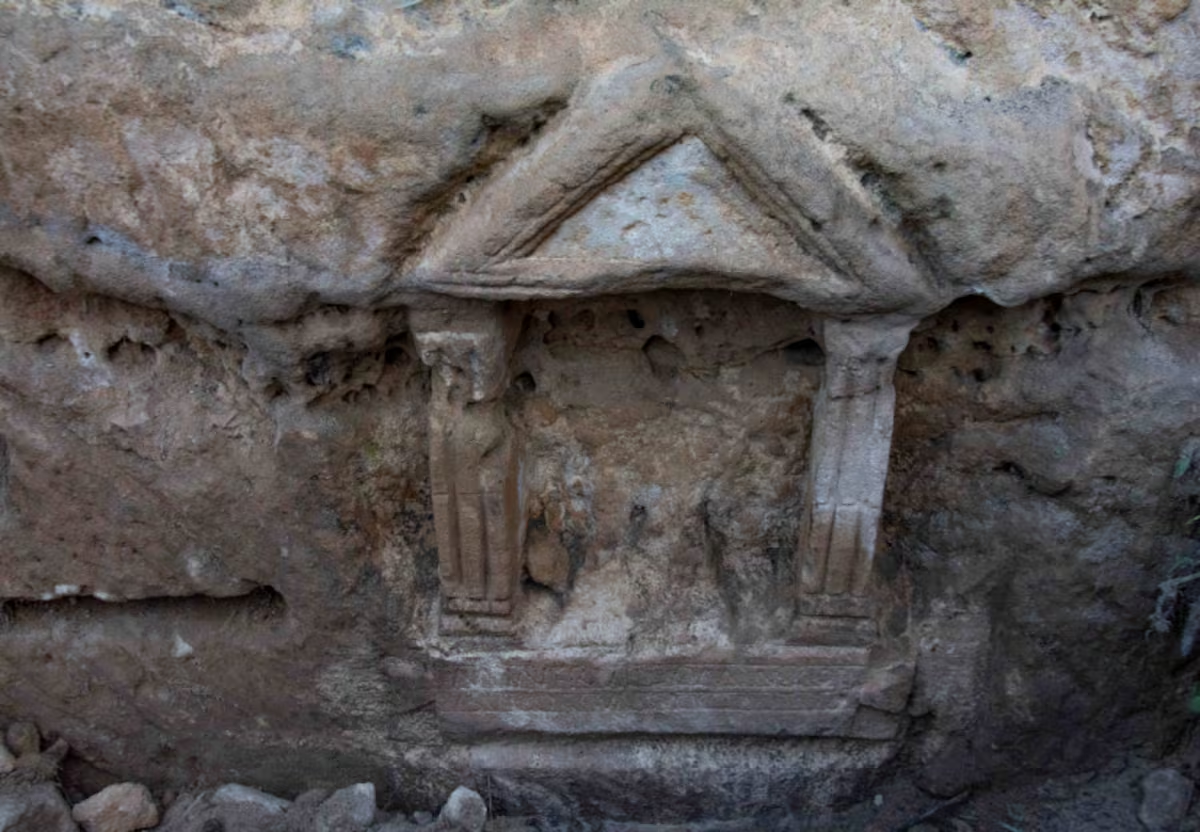
A Roman quarry in central Spain has yielded an unusually intimate trace of worship: a tiny rock-cut shrine to Minerva, carved directly into the same sandstone face where workers once extracted building material.
The sanctuary, found near Campos del Paraíso in the province of Cuenca, dates to the late second century A.D. It stands about 15 kilometres from Segóbriga, one of the most important Roman cities of inland Hispania and a centre closely tied to the region’s mineral wealth.
The discovery was published in the journal Mantva by archaeologists María José Bernárdez Gómez and Juan Carlos Guisado di Monti of the Don Felipe de Borbón y Grecia Mining History Museum at the Polytechnic University of Madrid.
A miniature temple in the quarry wall
The shrine is small, but carefully conceived. It was carved as an aedicula, a miniature temple-like façade cut into the quarry face. Measuring about 70 centimetres wide and 50 centimetres high, it has two fluted semi-columns and a triangular pediment, giving the impression of a classical temple reduced to the scale of a sacred marker.
At the centre is a relief of Minerva, the Roman goddess of wisdom, war, crafts and technical skill. The surface has suffered centuries of weathering, yet the surviving details are enough to identify the deity.
Minerva appears standing and facing forward. She wears a helmet and long tunic, and carries the attributes normally associated with her cult. A spear, a shield and the aegis, her protective emblem, are still recognisable. On the shield, researchers also identified an owl, the animal most closely linked with Minerva and one of the best-known symbols of wisdom in the Roman world.
The placement of the shrine is what makes the find especially striking. This was not a city temple, nor a sanctuary built for public display in a forum. It was cut into a working quarry, in a landscape shaped by stone extraction, labour and movement.
The inscription names Plotius Vigor
Below the relief, archaeologists documented a two-line Latin inscription. It reads: “To Lady Minerva, Plotius Vigor dedicates this with his entourage.”
That inscription gives the monument a rare personal dimension. The sanctuary was not anonymous. It was commissioned by Plotius Vigor, a man connected with a family name known in Roman Hispania and other parts of the empire.
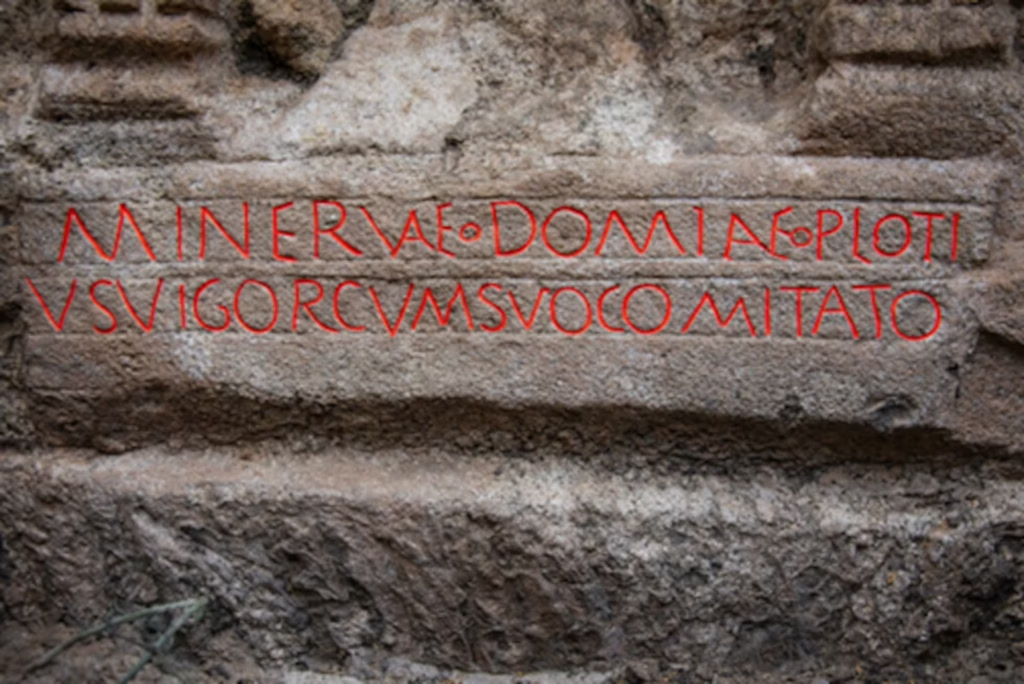
The wording also suggests that the act of dedication involved more than one person. The phrase referring to his entourage may point to a group connected with him, whether companions, dependants, workers or a small community attached to the quarry. The exact nature of that group remains uncertain, but the inscription makes clear that the shrine was a shared religious gesture, not just a casual carving on stone.
Researchers also identified a small carved shelf beside the shrine. It was probably used to hold offerings left before the goddess. That detail supports the interpretation of the monument as an active cult place within the quarry.
Segóbriga’s mining wealth and Minerva’s protection
The sanctuary stood in the wider territory of Segóbriga, a Roman city whose prosperity was strongly connected to lapis specularis. This transparent gypsum mineral was widely used as window glass in the Roman world, and the deposits of central Hispania helped make the area economically important.
Segóbriga’s public buildings, including its theatre, amphitheatre and baths, belonged to a city enriched by mining, quarrying and trade. The Minerva shrine adds a more human detail to that broader economic picture. It shows how the people involved in extraction and production could also mark their working environment with religious meaning.
Minerva was a fitting goddess for such a place. Beyond her role as a deity of wisdom and war, she was closely associated with craft, skilled work and disciplined technique. In a quarry, where labour required knowledge of stone, tools, risk and organisation, her protection would have had practical force.
The shrine therefore links two worlds often treated separately: Roman industry and Roman religion. In this quarry, the same stone face that carried traces of extraction also carried the image of a goddess.
Religion in the working landscapes of Roman Hispania
The discovery is important because it shows how religious life in Roman Hispania extended beyond major temples and official sanctuaries. Sacred spaces could appear in smaller, more practical settings, especially where daily work involved danger, skill and dependence on natural resources.
The Minerva sanctuary also adds to a growing body of evidence that mining and quarrying landscapes in the Roman world were not purely economic zones. They could be places of devotion, protection and identity.
For the people who used this quarry, the goddess was not distant. Her image was carved into the working surface itself, close to the stone and close to the labour that gave the region much of its wealth.
The find shows that Roman religious life in Hispania was not confined to civic temples or ceremonial centres. In the territory of Segóbriga, even a quarry face could become a sacred surface, marked by a goddess, an inscription and the name of the man who placed them there.
Cover Image: José Martínez Hernández
Bernárdez Gómez, M. J., & Guisado di Monti, J. C. (2026). El santuario rupestre de Minerva en Campos del Paraíso (Cuenca): Un nuevo espacio cultual en cantera en el territorio del lapis specularis. Mantva, 8. ISSN 2695-5423.