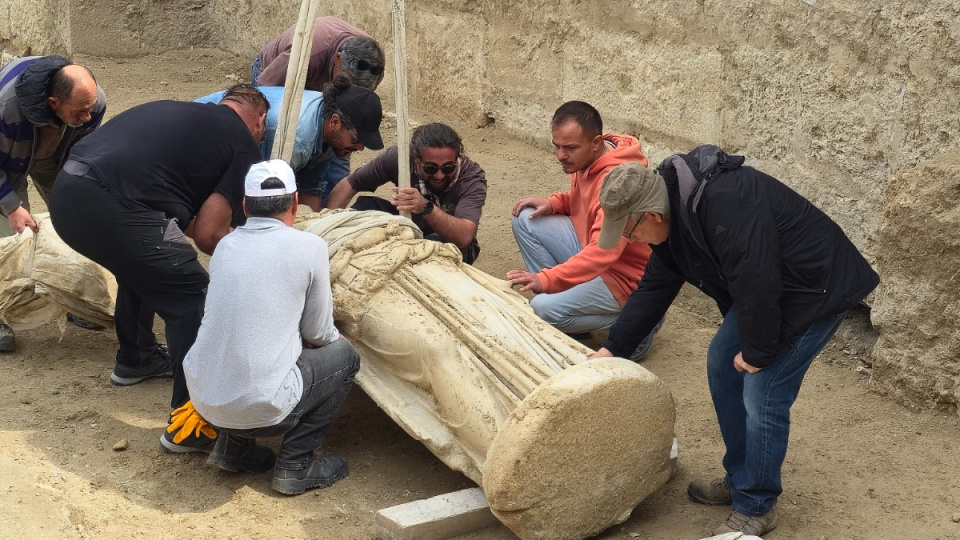
For centuries, it lay hidden beneath collapsed stone and dust. Now, a 2,000-year-old marble statue of Athena has surfaced in the ancient city of Laodikeia, offering a rare glimpse into how this Anatolian city once expressed identity through art, architecture, and myth.
The nearly two-meter-tall sculpture was discovered in the Western Theater, one of the site’s most monumental structures. Archaeologists found it face down within a layer of rubble along the outer wall of the stage building. Although the head has not yet been located, the preserved body already reveals a work of notable artistic quality. The discovery was announced by Turkey’s Minister of Culture and Tourism, Mehmet Nuri Ersoy.
A sculpture buried within the theater’s architecture
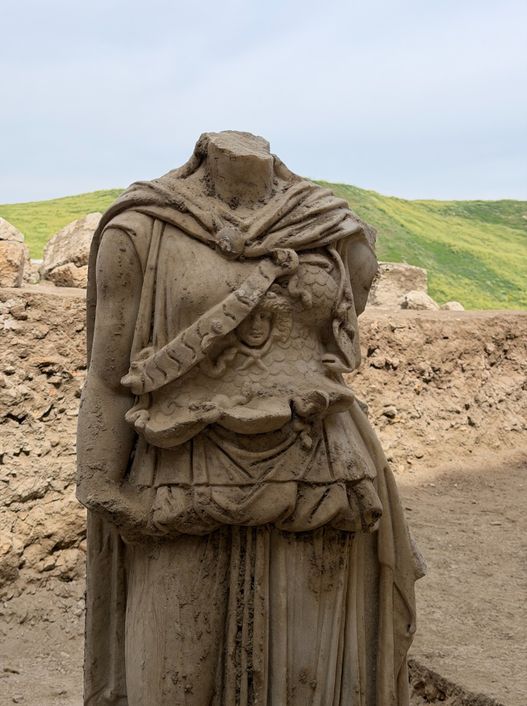
The statue emerged from the section known as the postscenium, the rear architectural zone of the stage complex. Its position suggests it once formed part of the theater’s decorative program before being displaced, likely during a collapse or later structural reuse.
The fact that it was left face down is telling. Rather than being carefully removed, the figure appears to have fallen and remained where it landed, gradually buried as the building deteriorated over time.
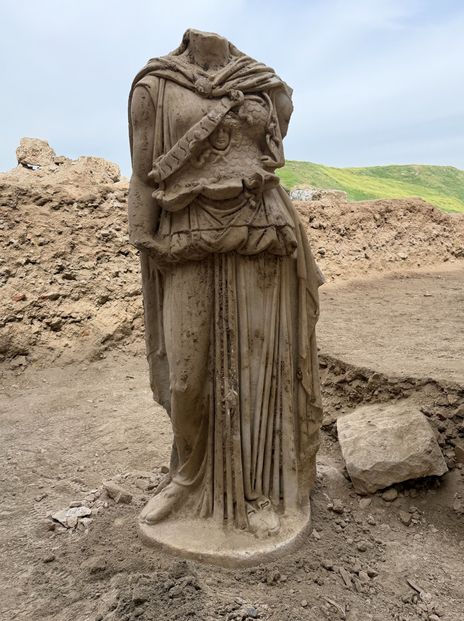
Even without its head, the sculpture retains strong visual presence. Carved from white marble, Athena stands on a rounded base, dressed in a finely rendered peplos. The folds of the garment fall naturally across the body, reflecting a sculptor with clear technical confidence.
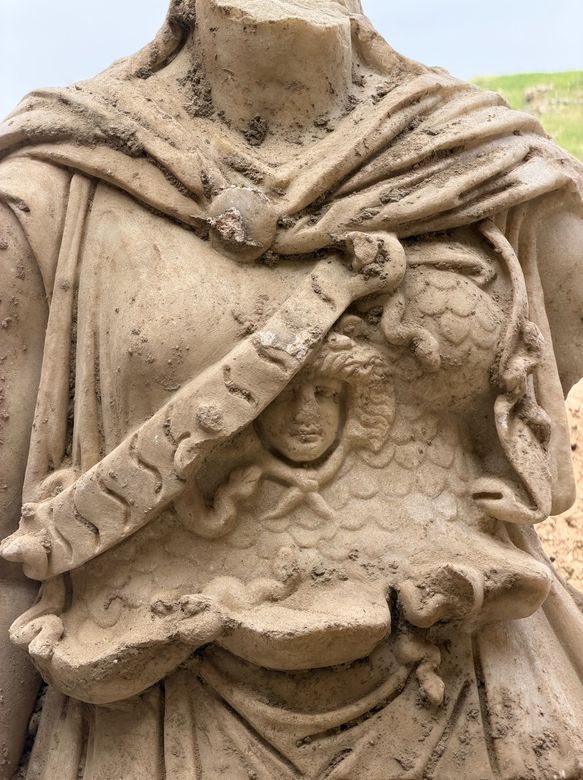
Across the chest, the aegis is still visible, marked by the head of Medusa and surrounding serpents—an unmistakable sign of the goddess.
A rare variation of Athena
One detail immediately sets this statue apart. A cloak rests at the neck, an unusual feature in standard depictions of Athena. It may seem minor, but this variation suggests the sculpture was not a routine production. Instead, it points to a specific artistic or local interpretation.
The back of the statue offers another clue. It was left roughly finished, indicating the figure was intended to stand between columns and be viewed only from the front. This confirms its role as part of a larger architectural composition rather than an independent display piece.
A theater built to tell stories in stone
Laodikeia’s Western Theater was not simply a venue for performances. Constructed in the 2nd century BCE and later modified, its stage façade rose across multiple levels, structured with rows of columns that framed sculptural displays.
Between those columns, mythological scenes once unfolded in stone. Recent excavations have uncovered fragments linked to episodes from the Odyssey, including encounters with Polyphemus, the Laestrygonians, and the sea monster Scylla.
This suggests that the theater functioned as a visual narrative space, where storytelling extended beyond actors and scripts into the architecture itself.
Roman classicism layered onto a Hellenistic monument
Although the theater dates back to the Hellenistic period, the Athena statue reflects the classical artistic language associated with the reign of Augustus. This places its creation in the late 1st century BCE to early 1st century CE.
The contrast is revealing. Rather than replacing older structures, Roman-era additions reshaped their meaning. Laodikeia evolved over time, integrating new artistic programs into existing monumental frameworks.
Athena in a city of textiles
In Laodikeia, Athena may have represented more than warfare and strategy. The city was known in antiquity as a major textile production center, and inscriptions indicate that the goddess was closely associated with weaving.
Festivals held in her honor appear to have emphasized this aspect of her identity. Within this context, the statue takes on a different meaning. It reflects not only religious devotion but also the economic and cultural character of the city itself.
Excavations continue
Work at Laodikeia has been ongoing without interruption into 2026, with archaeologists steadily uncovering new material that reshapes the understanding of the site.
The Athena statue, incomplete yet powerful, now joins a growing body of discoveries that reveal how one of Anatolia’s key cities once staged its identity through art and space.