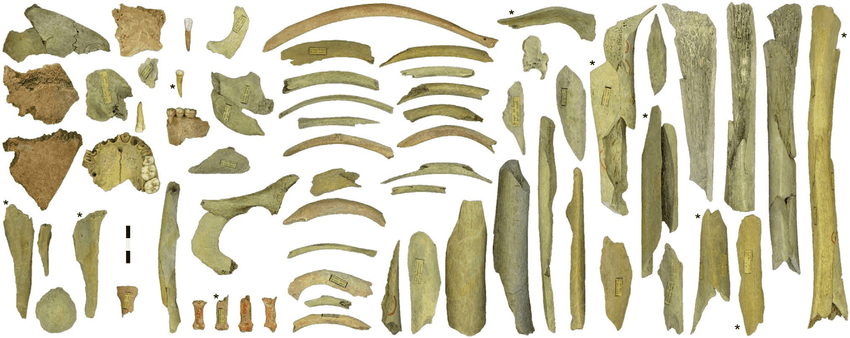
A newly published study has reshaped our understanding of one of Europe’s most intriguing Neandertal assemblages. Human remains unearthed in the Troisième caverne of Goyet in Belgium—dated to between 41,000 and 45,000 years ago—do not fit the demographic profile expected from a natural death assemblage.
Instead, the bones speak of selection: non-local, gracile adult and adolescent women, along with two juveniles, appear to have been deliberately targeted. Combined with clear taphonomic evidence of butchery, researchers argue that the cave preserves a rare case of ritualized exocannibalism, likely rooted in conflict between rival Neandertal groups.
The study, published in Scientific Reports, introduces one of the strongest lines of evidence yet that Neandertals engaged in socially motivated violence toward other communities.
A Group That Didn’t Belong
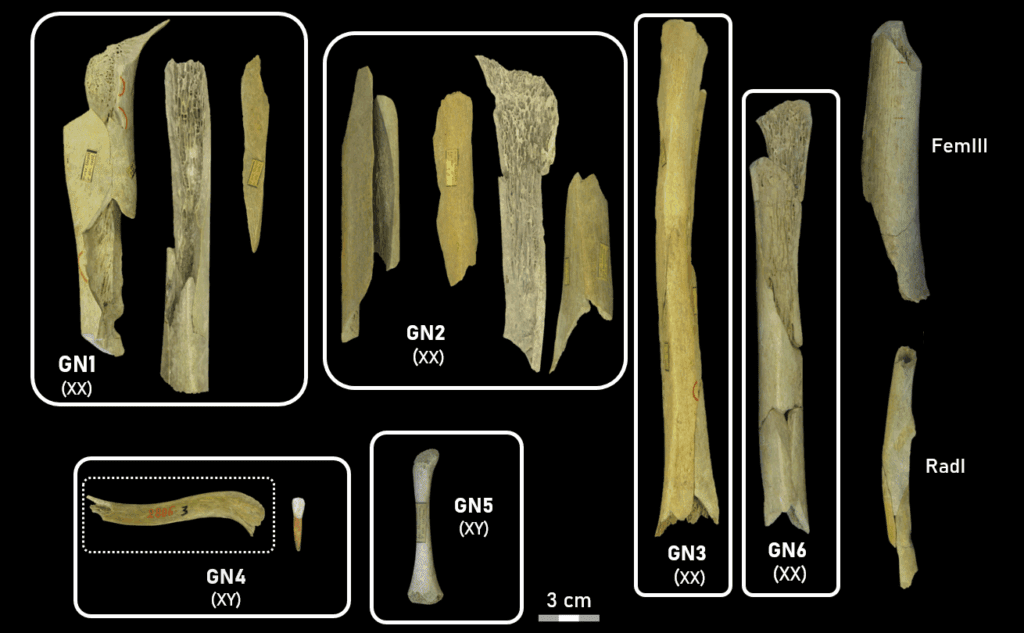
The skeletal material represents at least six individuals: four adult or older adolescent females, a child roughly 6–12 years old, and a newborn male.
Statistical modelling demonstrates that such a strongly female-skewed group is extremely unlikely to appear randomly within typical Neandertal mortality structures.
Isotopic data (carbon, nitrogen, sulfur) reveal that the adult females were not locals. They grew up in different ecological regions, far from Goyet. Their bones also show unusually low limb robusticity, indicating that they were smaller-bodied and less physically strong than the average Neandertal.
Taken together, these indicators reveal a coherent picture: a set of outsider women—less robust than local Neandertals—who ended up inside a cave occupied by another group, likely under violent circumstances.
Clear Evidence of Cannibalistic Processing
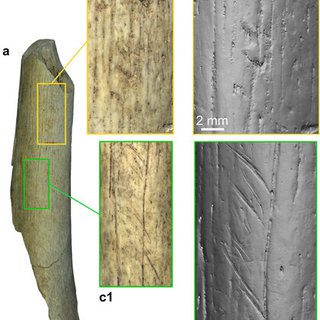
The physical condition of the bones leaves little ambiguity. Long bones were fractured while fresh, creating spiral patterns typical of marrow extraction. Fine slicing marks indicate systematic defleshing. Some fragments were later repurposed as retouchers—stone-tool sharpeners—a practice also observed on butchered animal bones within the same site.
These traces reflect a structured butchery process closely resembling the treatment of hunted fauna, rather than the opportunistic handling of corpses.
Exocannibalism and Inter-Group Conflict
The combination of demographic selectivity, non-local isotopic signatures, and controlled processing strongly supports the interpretation of exocannibalism—the consumption of individuals from outside the group.
This form of cannibalism is often associated with aggression, territorial competition, or ritualized domination rather than survival-driven need.
Why women and juveniles?
One explanation is strategic weakening of rival groups by eliminating reproductive-age females. Another is simple vulnerability: smaller-bodied individuals may have been easier to capture during raids or clashes.
While the researchers avoid asserting a single motive, they emphasize that this is the clearest evidence yet that Neandertal cannibalism could be selective and socially motivated.
Who Committed the Killings?
The remains fall within the transitional period when Homo sapiens began entering western Eurasia.
Could early modern humans be responsible?
Although the possibility cannot be entirely dismissed, the taphonomic and technological signatures—defleshing techniques, the use of bone retouchers, and the pattern of breakage—closely align with established Neandertal behaviors.
This strongly suggests that Neandertals themselves carried out the attacks, targeting outsiders rather than members of their own group.
A More Complex—and More Violent—Neandertal World
The Goyet evidence challenges the long-standing view of Neandertals as small, isolated bands with limited social dynamics.
Instead, the assemblage reveals a world where boundaries mattered, groups clashed, and violence could include the symbolic consumption of rivals.
By showing that non-local, gracile women and juveniles were selectively targeted, the study highlights the darker dimensions of Neandertal inter-group relations—and the complex social landscape of the Late Pleistocene.
Quentin Cosnefroy ve ark., Kuzey Avrupa’nın Geç Pleistosen dönemindeki son derece seçici yamyamlık, Neandertallerin hedef av olduğunu ortaya koyuyor, Scientific Reports (2025). DOI: 10.1038/s41598-025-24460-3
Cover Image: Neandertal human remains from the Troisième caverne of Goyet (Belgium). Highly fragmented bones bear traces characteristic of fresh bone fracturing and percussion, demonstrating intentional treatment of the bodies. The individuals (GNx, for “Goyet Neandertal” x), numbering six at minimum, were identified by genetic analyses: XX indicates female gender, and XY male gender.. Credit: Royal Belgian Institute of Natural Sciences /Scientific Reports