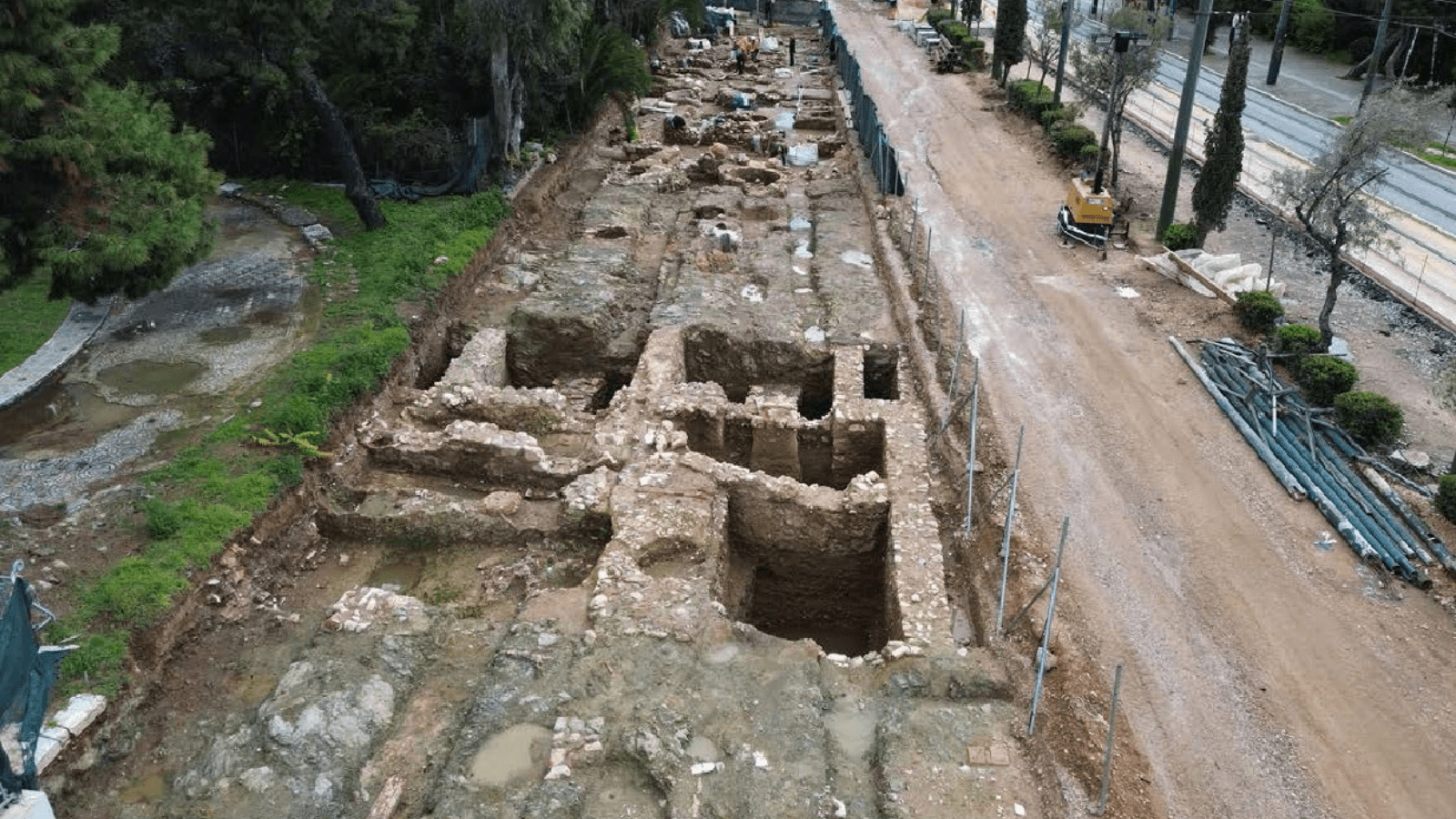
Beneath a major avenue in central Athens lies an extraordinary sequence of the city’s past: a sprawling Roman complex with more than 60 rooms, built directly above a much older defensive ditch associated with the fortifications of Classical Athens.
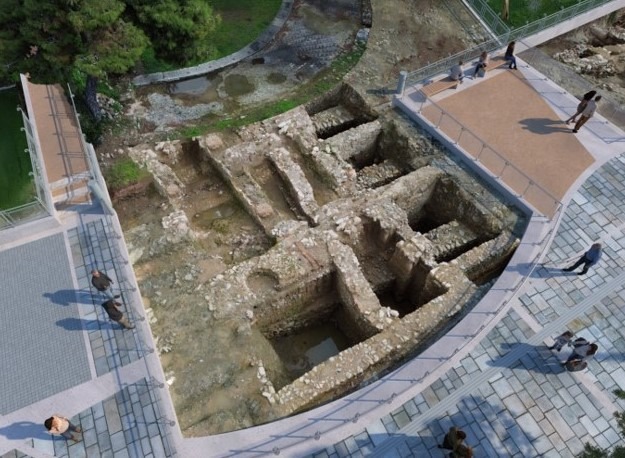
The remains were uncovered during rescue excavations along Vasilissis Olgas Avenue, close to the Temple of Olympian Zeus, as redevelopment work was carried out in 2024 and 2025. Now, Greece’s Ministry of Culture has announced plans to conserve, restore and present the archaeological remains as a unified site, bringing a largely hidden part of ancient Athens into public view.
The Roman building is substantial. Archaeological records describe a structure approximately 68 meters long and 11 meters wide, containing more than 60 rooms arranged around a peristyle courtyard. Porticoes, organized living spaces, drainage channels and a semicircular architectural feature point to a large and carefully planned complex in an area that became increasingly important during Roman rule.
A defensive ditch beneath Roman Athens
Cut into the natural bedrock below the Roman complex is a roughly 10-meter-wide defensive ditch dating to the fourth century BC, following the line of the Themistoclean Wall, the fortification system that protected ancient Athens.
The Greek Ministry of Culture identifies the ditch as the oldest preserved feature revealed by the excavation. Its discovery helps confirm the course of the ancient fortifications through an area that now lies within the center of the modern city.
Archaeologists also identified walls that may have belonged to a bridge connected with an ancient city gate, as well as a nearby courtyard containing a rock-cut well and steps descending into the ground.
The result is an unusually clear archaeological sequence. A landscape once defined by Classical defenses was transformed centuries later into part of Roman Athens, before changing again during Late Antiquity and the Byzantine period.
More than one Roman building phase
Archaeological reporting records an initial construction phase in the second century AD, followed by substantial rebuilding after the Herulian attack on Athens in AD 267. Later alterations continued into Late Antiquity.
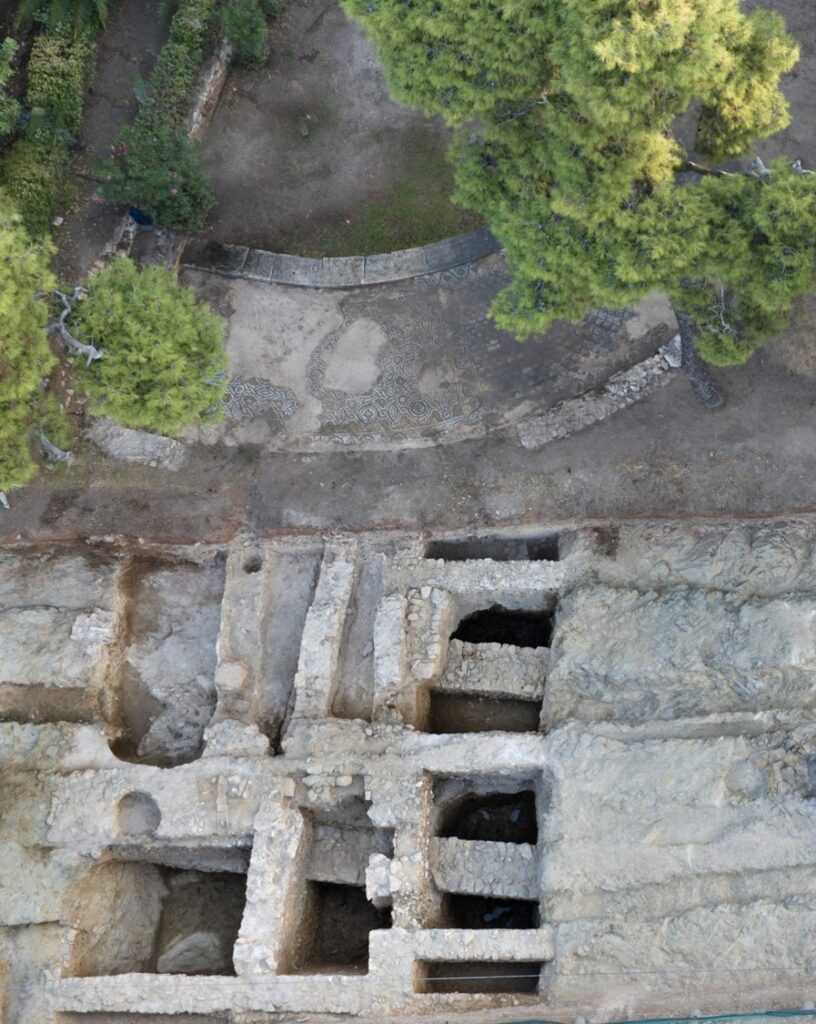
The Ministry of Culture highlights two major later construction phases, one extending from the late third into the early fourth century AD and another dating to the beginning of the fifth century. Smaller alterations and additions suggest that the complex continued to evolve as its occupants adapted the buildings to new needs.
One of its most distinctive surviving elements is a semicircular arcade with a mosaic floor dating to the early fifth century AD. The feature had already been noted in the 19th century, but the recent excavations have placed it within a much broader architectural complex.
The site stood north of the Olympieion, near the ancient course of the Ilissos River. During the Roman period — particularly under Emperor Hadrian — this part of Athens was drawn more closely into the expanding urban landscape and developed into a prosperous district containing monumental public and private buildings.
From monumental complex to storage space
By the Byzantine period, the character of the site had changed dramatically. Simpler walls replaced parts of the earlier monumental architecture, while underground storage pits and large ceramic storage vessels point to an increasing emphasis on production and storage activities.
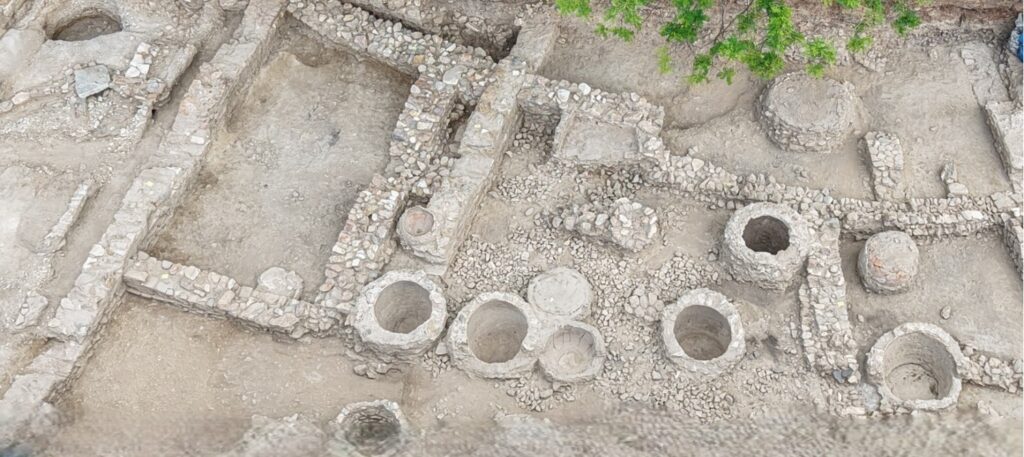
These later features sit alongside the Roman and Classical remains, allowing archaeologists to trace changing patterns of occupation in the same part of Athens across many centuries.
The wider area has an even longer history. The Ministry says human activity north of the Olympieion can be traced from prehistoric times through the early Byzantine period, making the excavation another piece of evidence for the unusually deep archaeological landscape beneath modern Athens.
The remains will become part of the modern city
The latest phase of the project focuses on making the archaeological layers both understandable and accessible.
Conservation work will include the stabilization and restoration of ancient walls, the mosaic pavement and architectural elements, along with vegetation management, improved drainage and the removal of incompatible modern interventions. The goal is to preserve the original materials while making the different phases of the site easier for visitors to distinguish.
Plans developed for the area also envision an open-air archaeological space along Vasilissis Olgas Avenue, with pedestrian routes and viewpoints connecting the remains visually with landmarks including the Zappeion and the Acropolis.
What survives beneath the avenue is therefore more than a large Roman building. Within the same excavation, Athens preserves a Classical defensive ditch, monumental Roman architecture and later Byzantine activity — successive versions of the city occupying the same ground.
Cover Image: Aerial view of the Roman complex uncovered along Vasilissis Olgas Avenue in central Athens, where more than 60 rooms were identified during archaeological excavations. Credit: Hellenic Ministry of Culture