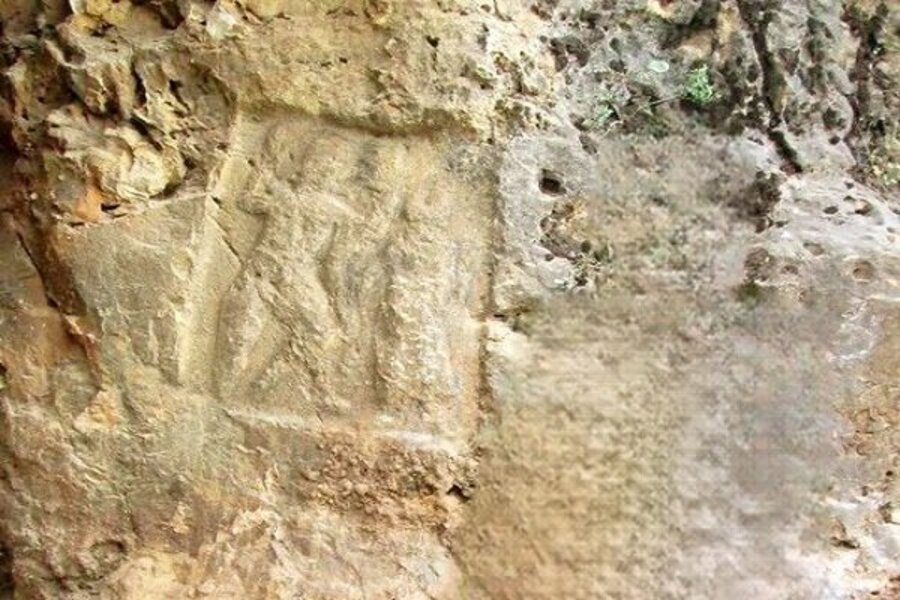
A newly identified Elymaean rock carving in southwest Iran is drawing scholarly attention due to its unusual iconography and its possible visual parallels with the myth of Hercules battling the Hydra. The relief was discovered in the Kuh-e Manar highlands of Andika County, located in Khuzestan Province, a region closely associated with Elymaean cultural activity in the central Zagros.
The discovery was announced by Ayyoub Soltani, director of the Masjed Soleyman Cultural and Industrial Landscape National Base, who described the panel as one of the most distinctive Elymaean rock carvings identified to date.
An Unusual Composition in Elymaean Rock Art
The relief is carved onto an irregular rock surface measuring approximately 70 by 81 centimeters. Although parts of the panel have been affected by erosion and deliberate damage, three figures remain clearly discernible, forming a coherent narrative scene.
On the left, a muscular nude male figure is shown in three-quarter profile. He raises a large round object—possibly a symbolic weapon or ritual implement—while gripping the throat of the central figure. The pronounced modeling of the torso and limbs places strong emphasis on physical strength and heroic dominance.
At the center is a three-headed serpent-like creature, extending roughly 83 centimeters in length. Multi-headed serpentine beings are extremely rare in known Elymaean reliefs, making this figure a key element in the interpretation of the scene.
On the right stands a male figure dressed in Parthian-style clothing, shown frontally. His long garment with clearly defined folds and his static posture resemble priestly or elite figures seen in other Elymaean reliefs across the Zagros.
Mythological Echoes of Hercules and the Hydra
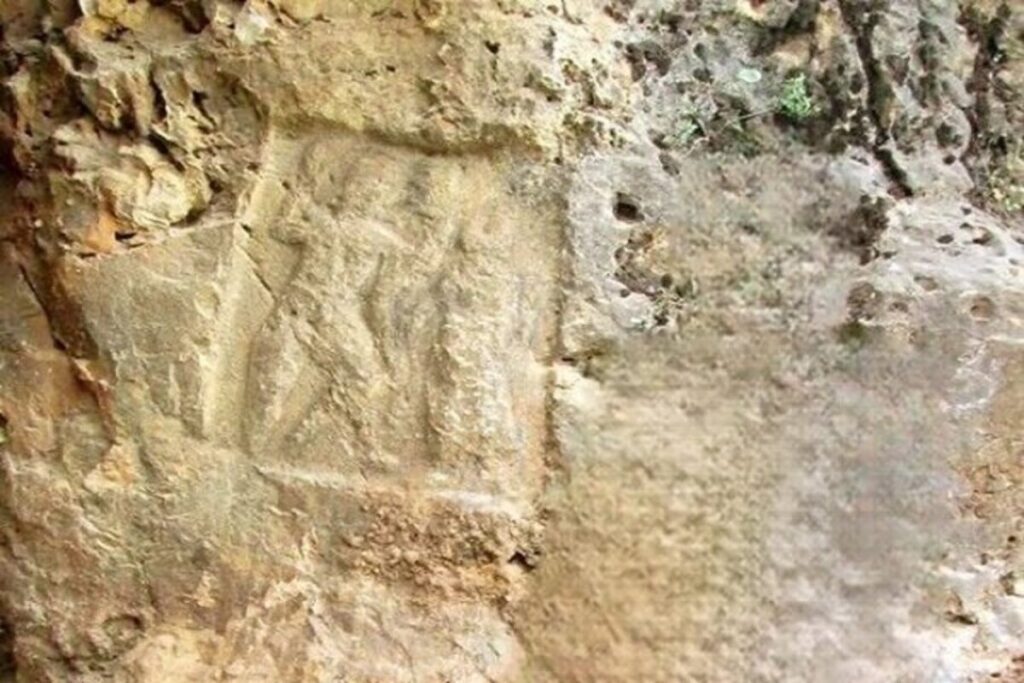
According to Soltani, the composition and gestures suggest a mythological or ritual narrative rather than a purely symbolic scene. The struggle between a heroic figure and a multi-headed serpent recalls the well-known myth of Hercules fighting the Hydra—a theme widely circulated in the Hellenistic world and depicted on Greek coins minted around 325 BC.
Researchers stress that this should not be understood as direct copying. Instead, the Elymaean artist may have selectively adapted a widely recognized mythological motif, integrating it into a local religious framework shaped by Iranian and Mesopotamian traditions.
Andika and Elymaean Cultural Interaction
The Andika region occupies a strategic position between the mountainous and lowland zones of the Zagros, functioning historically as a corridor for movement and cultural exchange. Over recent decades, surveys have documented numerous Elymaean settlements, tombs, shrines, and rock carvings in the Bakhtiari highlands.
Within this broader archaeological landscape, the Manar relief stands out for both its unusual subject matter and its possible engagement with transregional mythological themes.
Preservation and Ongoing Research
Experts emphasize that the relief is scientifically significant and unique within the corpus of Elymaean rock art. Due to ongoing surface erosion, scholars have called for urgent protective measures, including detailed digital documentation and laser scanning.
The discovery has been formally reported to Iran’s Ministry of Cultural Heritage and published in the international academic journal Sinos Persicus, highlighting its importance for future studies of Elymaean religion, art, and cultural interaction.