
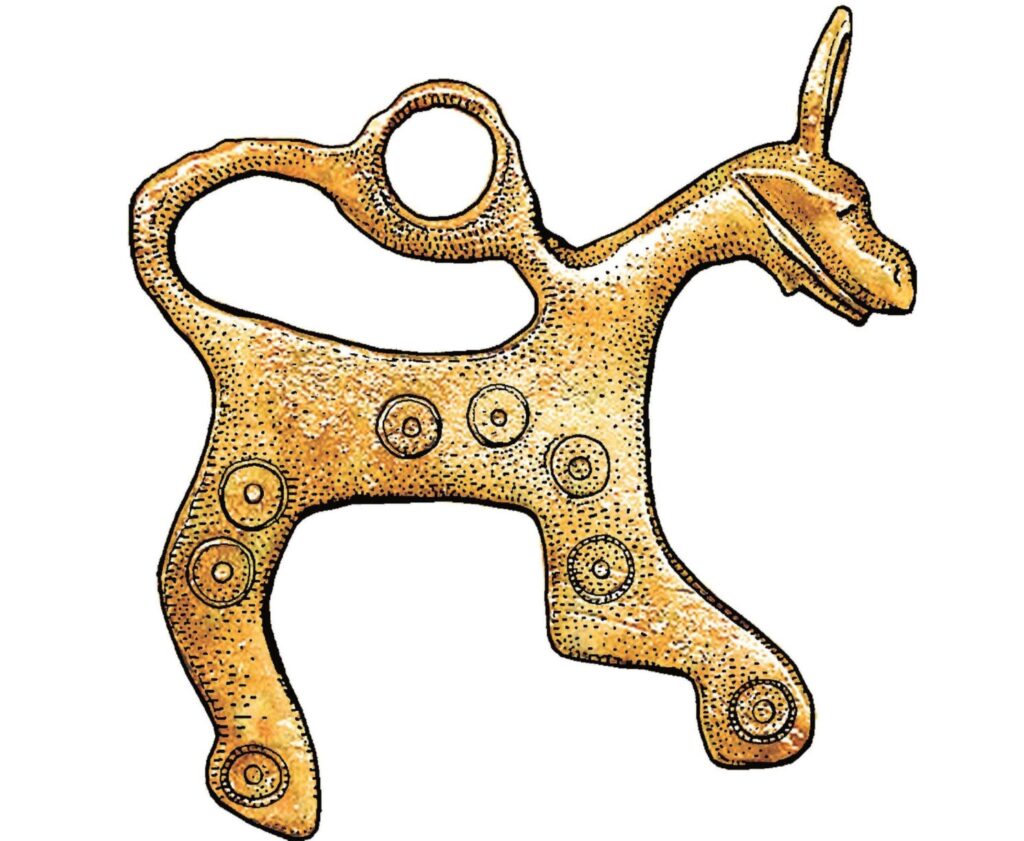
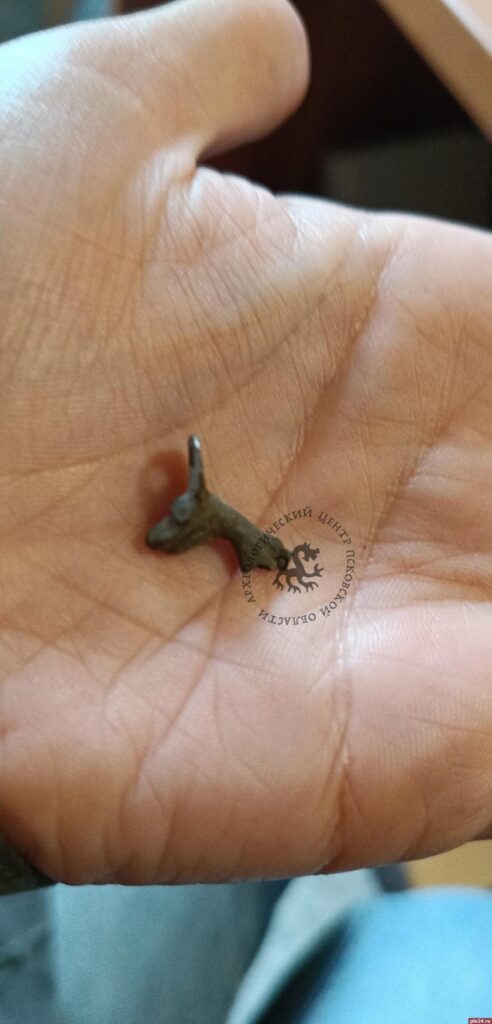
A 1,000-year-old amulet discovered in Pskov’s Zavelychye district depicts a mysterious beast that archaeologists have still been unable to identify. The surviving fragment preserves the creature’s long snout, heavy jaw and exaggerated features.
What the animal represents, however, remains uncertain.
The fragment came from the Olginsky-10 excavation on Paromenskaya Street. Based on parallels from better-preserved examples, archaeologists date the pendant type mainly to the 11th and first half of the 12th century, although some continued to appear in later medieval deposits.
A “Horse” That Does Not Look Like One
Archaeologists traditionally refer to these objects as “Smolensk-type horse pendants.” The name reflects the large number recovered in the Smolensk region, where the type was first studied in detail.
Complete examples usually show a compact four-legged animal with a raised tail, bent legs and an oversized head. A loop allowed the ornament to hang from clothing, a necklace or a belt.
They appear to have been worn mainly by women, often alongside other pendants and small amulets. Their role was probably not purely decorative. Like many medieval zoomorphic ornaments, they may also have been intended to protect the wearer.
Yet the conventional name is misleading. The animal’s broad mouth and distorted proportions bear little resemblance to the clearly identifiable horses seen on other medieval pendants, including double-headed examples associated with Finno-Ugric traditions.
Over the years, researchers have suggested that the creature could be a dog, lynx, leopard or horse. None of the identifications has gained universal acceptance.
Could It Be the Leucrota?
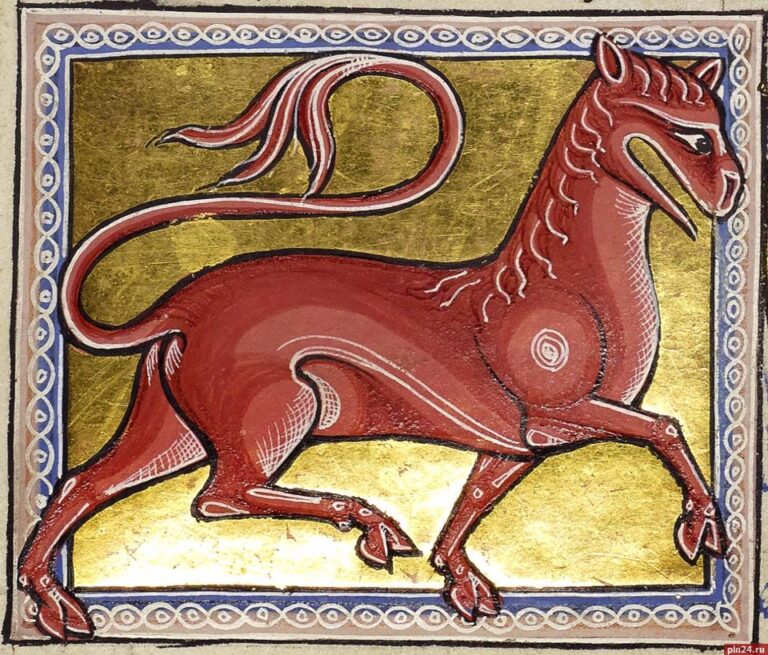
In 2014, Latvian archaeologist Roberts Spirģis proposed a more unusual interpretation. He argued that the pendants may depict the leucrota, a mythical beast known from ancient and medieval descriptions.
Pliny the Elder described the leucrota as a hybrid creature with the hindquarters of a stag, the front of a lion and the size of a donkey. Its mouth supposedly stretched almost from ear to ear, while a single ridge of bone replaced ordinary teeth.
Later stories credited the beast with the ability to imitate the human voice and lure travellers into danger.
The theory is difficult to prove, but it offers an explanation for the pendant’s strange anatomy, especially its oversized mouth and deliberately mixed features. Spirģis also suggested that the image may have circulated through Christian literary traditions rather than surviving only as a pagan horse symbol.
The animal may have carried a moral or protective meaning that is now lost.
A Personal Object from Medieval Zavelychye
The find also adds another detail to the history of Zavelychye, a settlement area on the western bank of the Velikaya River, opposite Pskov’s medieval centre.
Excavations there have uncovered traces of substantial 11th- and 12th-century properties, paved streets and evidence of destruction connected with later attacks. The district was not simply an isolated suburb. It formed part of a busy urban landscape occupied by households with access to imported goods, metal ornaments and wider trading networks.
The pendant fragment belonged to that world. Whether its owner saw the animal as a horse, a guardian or a monster from a religious tale cannot now be known.
Its broken head is nevertheless enough to identify one of the most unusual amulets of medieval eastern Europe—a creature familiar in form, yet still without a certain name.
Archaeological Center of the Pskov Region / VKontakte
Cover Image Credit: Archaeological Center of the Pskov Region / VKontakte