
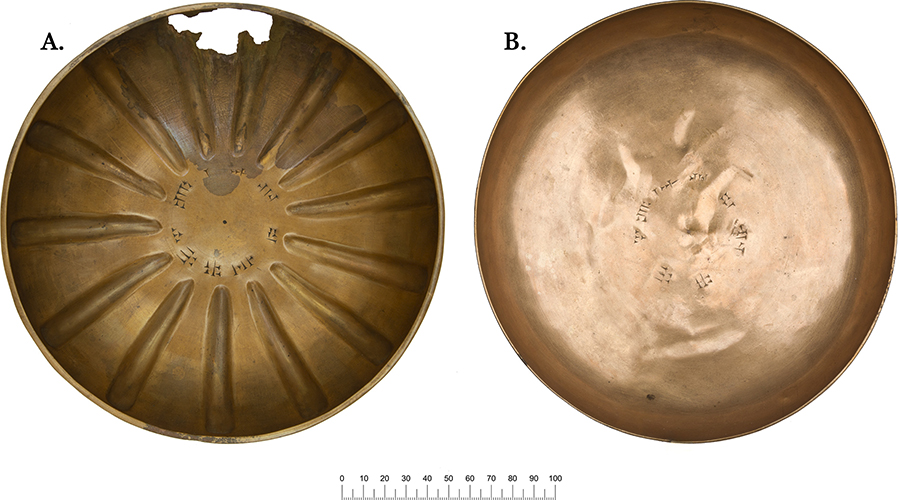
More than 100 bronze bowls inscribed with the names of Urartian kings were designed to do more than hold food or drink. A new study suggests that the vessels circulated royal names, sacred symbols and carefully controlled images of kingship, making them an ancient form of portable political messaging.
Published in Antiquity, the research was conducted by Annarita Stefania Bonfanti, Roberto Dan, Nzhdeh Yeranyan and Astgh Poghosyan. The team examined every known inscribed bronze bowl associated with Urartian rulers from Sarduri I, son of Lutipri, to kings named Rusa.
Dating from the late ninth to the early seventh centuries BCE, the bowls belong to a period when Urartu ranked among the most powerful Iron Age kingdoms in Western Asia. By comparing inscriptions produced across several reigns, the researchers traced how an object influenced by Assyrian court culture developed into a distinctive expression of Urartian rule.
Royal names carried beyond palace walls
The largest collection was recovered at Karmir-blur, the Urartian palace-fortress of Teishebaini in present-day Yerevan, Armenia.
Excavations in 1949 uncovered at least 97 cuneiform-inscribed bowls in Storeroom 25. Further examples, including previously unpublished vessels, were found in Room 23 during excavations conducted in 1958.
Each bowl bears a short circular inscription engraved around the centre of its inner surface. The text identifies a monarch and creates a direct association between the object and the royal household.
These inscriptions may be brief, but their placement was significant. A king’s name became visible whenever the vessel was presented, handled or used in an elite gathering. Rather than remaining fixed on a palace wall or monumental stone, the royal message could travel with the object.
The bowls therefore belonged to several worlds at once. They were valuable metalwork, potentially ceremonial utensils and written artefacts through which the court projected prestige.
An Assyrian model reshaped in Urartu
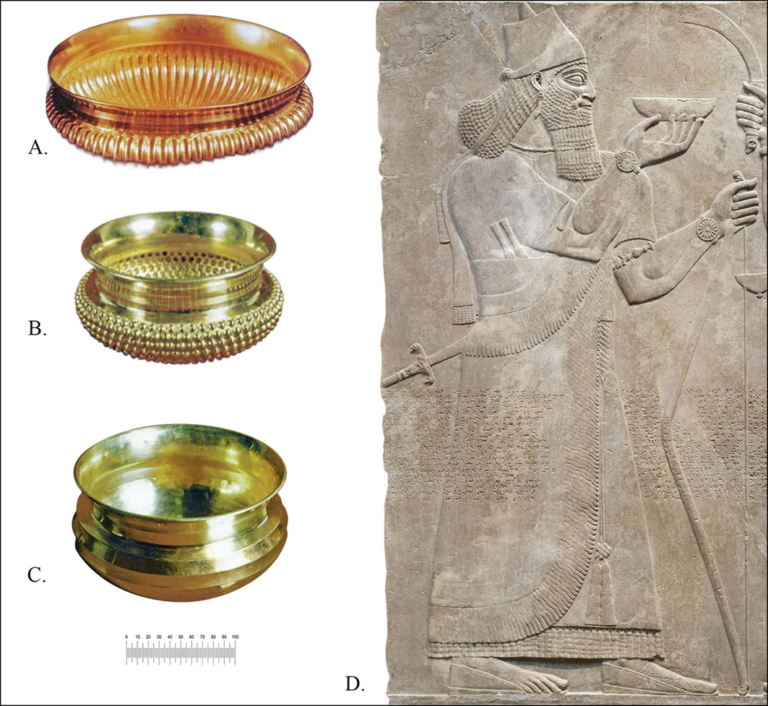
The earliest vessels examined in the study are attributed to Sarduri I, who ruled around 840–830 BCE. Their cuneiform signs closely resemble Neo-Assyrian writing, particularly in the use of elongated wedges.
Their form also recalls vessels represented in ninth-century BCE reliefs from the Northwest Palace of Ashurnasirpal II at Nimrud. Inscribed gold vessels discovered in the tombs of Assyrian queens show that valuable tableware could carry royal or dedicatory texts.
Urartian craftspeople adopted this established language of prestige but gradually altered it.
A ribbed bowl bearing Sarduri I’s name appears to document the transition from an Assyrian vessel type to the plain bronze form that became characteristic of later Urartian examples. The change was not simply decorative. It formed part of a wider process in which imported court traditions were adapted to serve a new political identity.
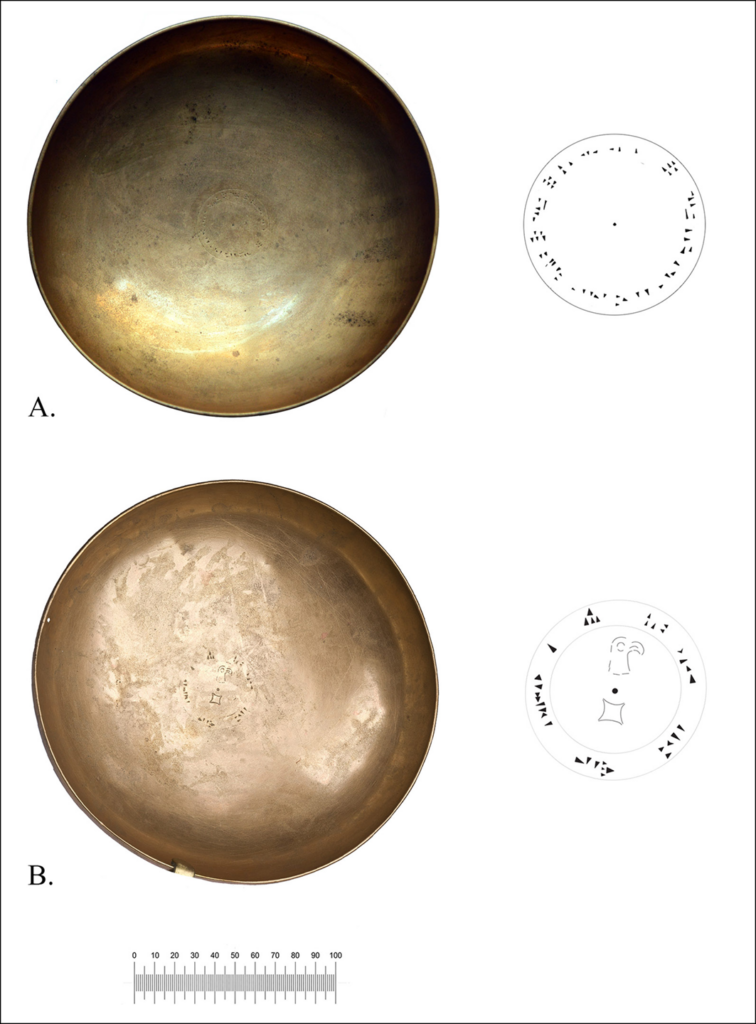
By the reign of Minua, around 820–785/780 BCE, the transformation was clearer. The wedges became shorter, more triangular and more compact, while the inscriptions followed increasingly consistent patterns.
The differences reveal the emergence of a recognisably Urartian scribal tradition. Cuneiform retained the prestige associated with Assyria, but its appearance and use were reshaped within Urartu’s own court and workshop environment.
Lions and temples joined the royal message
Under Argišti I, who ruled around 785/780–756 BCE, the bowls acquired an additional visual dimension.
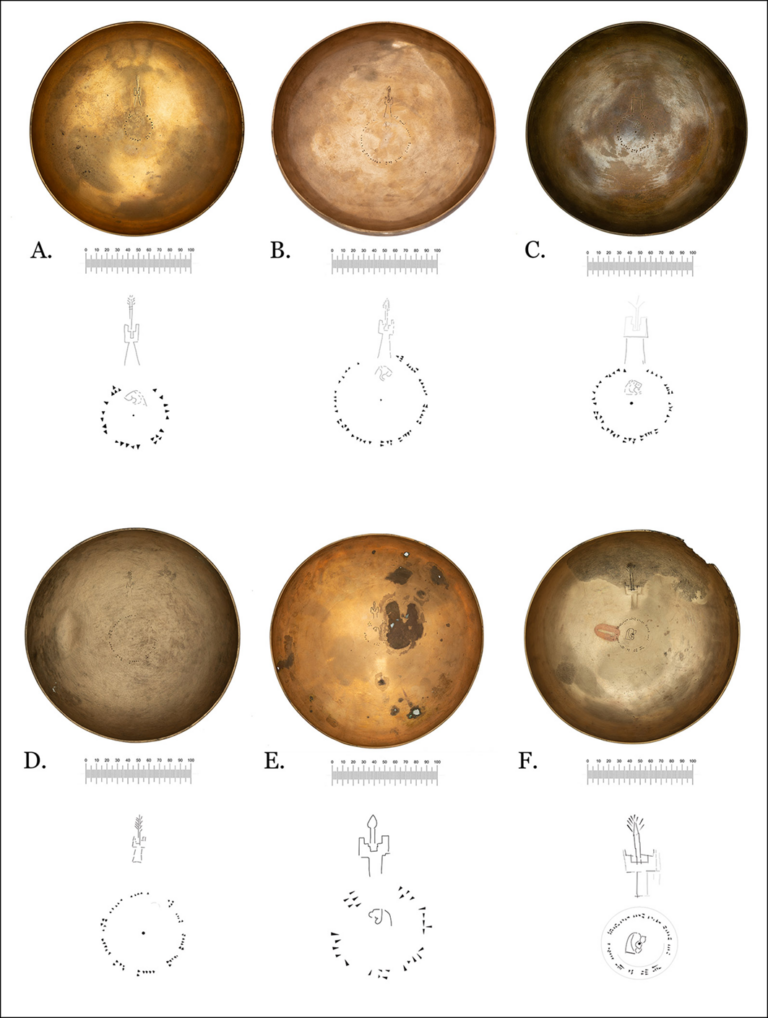
Metalworkers began placing images beside the inscriptions. Early motifs included a bird’s head and a square with concave sides. Over time, these elements developed into more standardised designs: a tower topped by a spear, often interpreted as a susi temple, and the head of a roaring lion.
The images accompanied the names of later rulers, including kings named Sarduri and Rusa. Their repeated use suggests that they had become part of a recognised royal vocabulary rather than isolated workshop decorations.
The lion likely reinforced ideas of strength and royal command. The temple motif connected kingship with the sacred sphere. Together with the inscription, the images presented the ruler through a compact combination of name, religion and authority.
This visual formula helped turn the bowls into more than possessions bearing ownership marks. They became political objects whose shape, material and imagery all contributed to the same message.
Engraving cuneiform onto bronze
The study also shows how the political role of the vessels depended on technical skill.
Cuneiform was traditionally impressed into clay or carved into stone. Engraving wedge-shaped signs onto thin, curved bronze demanded different tools and movements.
The researchers studied the bowls through direct visual examination, macrophotography, digital tracing and comparative palaeography. They recorded the order and orientation of signs, wedge angles, proportions, depth and surviving tool marks.
Their analysis indicates that craftspeople altered the dimensions and layout of cuneiform to accommodate the surface of each vessel. These were not monumental inscriptions reproduced at a smaller scale. They were redesigned for metal.
The result depended on cooperation between scribal knowledge and bronze-working expertise. Text and craftsmanship could not be separated: the political meaning of the inscription was strengthened by the value of its material and the skill required to produce it.
In that sense, writing itself became part of the display. The king’s authority was expressed not only by what the inscription said, but by the precision with which it had been fixed into bronze.
Karmir-blur became a storehouse of royal memory
The concentration of bowls bearing the names of different rulers at Karmir-blur may offer a glimpse into Urartu’s final decades.
Stratigraphic evidence suggests that the vessels were deliberately deposited before the fortress was destroyed. They do not appear to have been scattered during conquest or left randomly amid the ruins.
No comparable collection has been identified elsewhere. The researchers propose that bowls previously distributed among several royal fortresses may have been gathered at Karmir-blur when the site served as one of Urartu’s last major centres.
Their presence together may have carried symbolic weight. Each vessel preserved the name of a past monarch; assembled in one place, they formed a material sequence of royal rule.
The collection could therefore have represented dynastic continuity at a time when the kingdom was approaching its end. What had once functioned as portable expressions of individual kingship may ultimately have become a shared archive of the ruling house.
Karmir-blur was probably destroyed in the middle of the sixth century BCE. Yet the bowls survived, preserving a political language built from royal names, cuneiform signs, temple imagery, lions and bronze.
They show how Urartian rulers made power tangible—and how even a bowl could be made to speak for a king.
Cover Image Credit: Bonfanti, A. S., et al. 2026