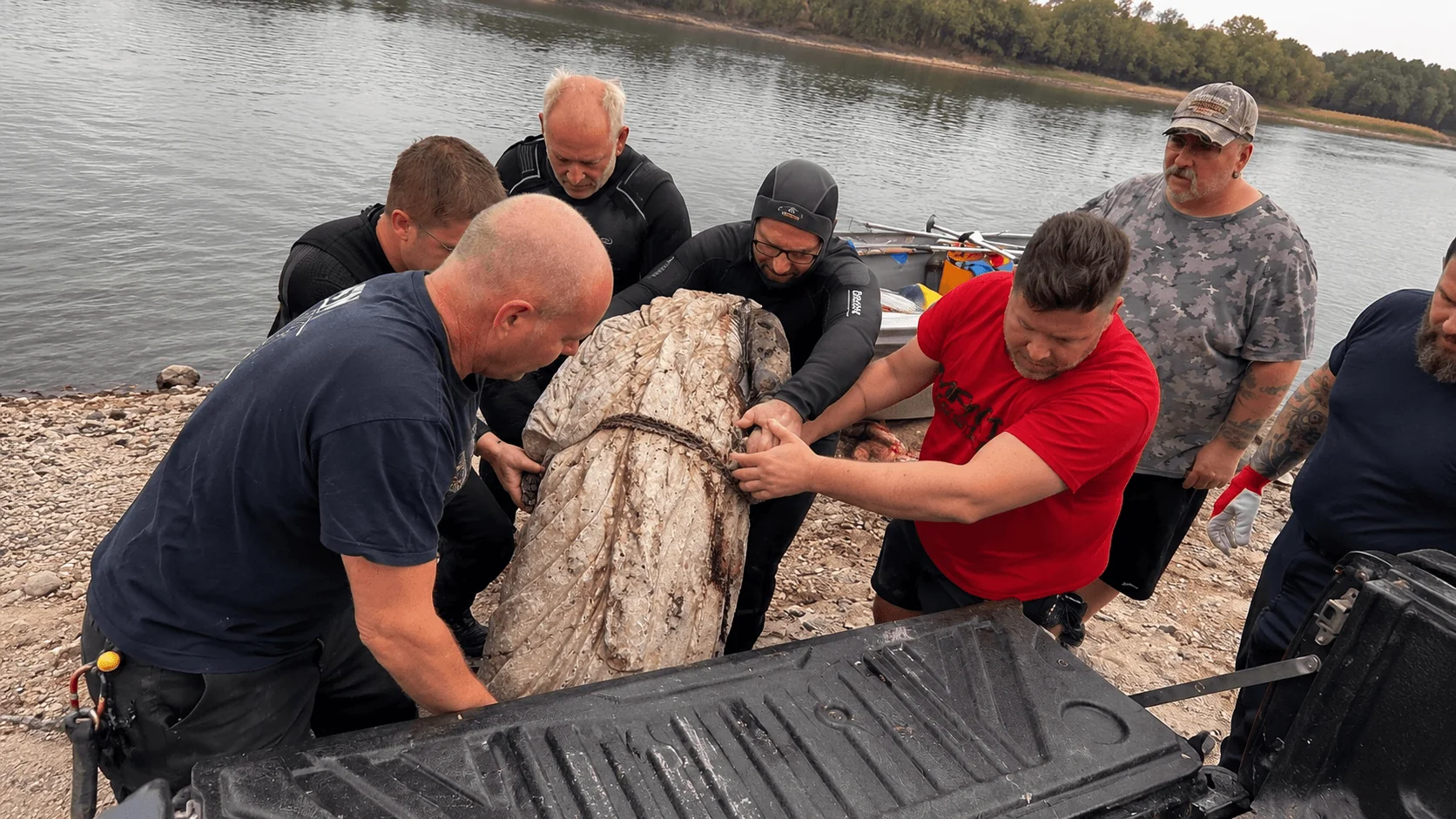
A nearly intact Roman statue weighing several hundred kilograms has been recovered from the Danube near Dunaújváros, Hungary, as exceptionally low water levels continue to expose archaeological remains around the ancient settlement of Intercisa.
Industrial divers discovered the statue in a difficult-to-access section of the river. Its considerable weight made the recovery challenging, and additional help was needed to raise it safely from the water.
The statue has now been transferred to the Intercisa Museum in Dunaújváros for examination. Although its Roman origin is clear, specialists have not yet announced its precise date, the identity of the figure or its original function.
Divers Recover a Massive Roman Statue
The discovery came during archaeological recovery work made possible by unusually low water levels along the Danube.
According to archaeologist and museologist Antal Tibor Szabó of the Intercisa Museum, numerous Roman and medieval stone objects have reached the museum in recent weeks, often with assistance from local residents and people working near the river.
The statue stands out because of both its condition and its size. Divers from Dunai Ipari Búvár Kft. located it while examining a particularly difficult section of the riverbed.
At several hundred kilograms, the statue could not be removed easily. Members of the Pentele Volunteer Firefighters Association assisted with the lifting operation, helping bring the Roman sculpture ashore before it was transported to the museum.
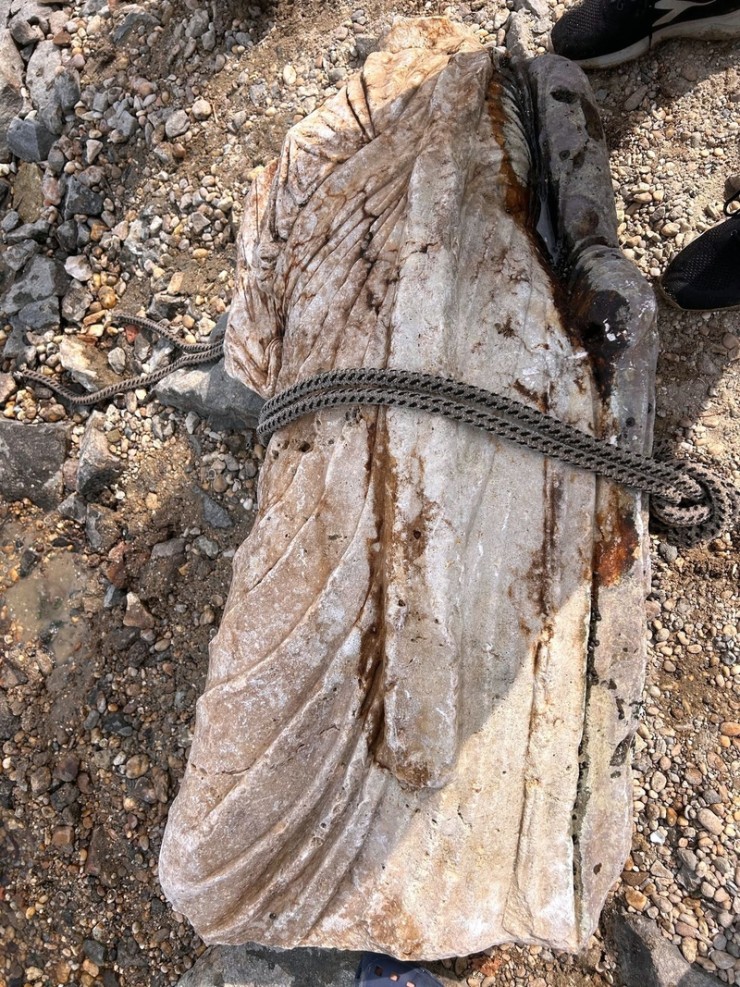
The museum has not yet released a detailed identification of the figure. Further study should establish when the statue was made and whether it originally belonged to a religious, funerary or public setting at Roman Intercisa.
Roman Tombstone Still Preserves Green Paint
The statue is not the only significant Roman object recently recovered from the Danube near Dunaújváros.
A local resident, Végh András, alerted museum staff to a carved stone lying in an area normally covered by the river. Archaeologists identified it as part of a Roman funerary monument.
Remarkably, traces of green paint survive around a carved vine decoration along the side of the stone. Part of its inscription also remains legible.
The surviving text indicates that a man named Marcus Aurelius (…) commissioned the monument for himself and possibly members of his family, although the incomplete inscription prevents a full reconstruction.
Other finds exposed by the falling water include fragments of Roman altars and decorated stonework. One heavily worn inscription appears to record a dedication to Deus Sol, the Sun God, while another altar recovered earlier was dedicated to Jupiter. A separate stone fragment bears carved grape clusters, vines and leaves.
Together, the finds add new material to the already extensive archaeological record of Intercisa.
Intercisa Guarded Rome’s Danube Frontier
Modern Dunaújváros occupies the area of Intercisa, an important Roman military and civilian settlement in the province of Pannonia.
According to the Intercisa Museum, a Roman military fort was established there during the first century AD, and a substantial civilian settlement developed beside it.
Intercisa entered one of its most prosperous periods in the late second century. The settlement suffered major destruction during attacks in AD 259–260, but Roman military occupation continued for considerably longer, with troops remaining there until the early fifth century.
Its position beside the Danube placed Intercisa directly on one of the Roman Empire’s most important frontier zones. More than a century of archaeological research has uncovered inscriptions, tombstones, religious monuments and evidence of both military and civilian life.
The latest finds show that archaeological material also survives in and around the river itself, becoming accessible when water levels fall unusually low.
Museum officials have warned against unauthorized collecting in newly exposed areas. Archaeological objects remain protected under Hungarian law, while searching the Danube can also pose serious safety risks.
For now, the nearly intact Roman statue weighing several hundred kilograms is the most striking discovery from the latest recovery work. Its Roman origin is evident, but its exact date and the identity of the figure still await specialist study.