
A 3,000-year chronicle of movement, exchange, and belief emerges from one of the UAE’s most revealing archaeological sites
Tell Abraq, rising quietly along the western coastline of the United Arab Emirates, has long been known as a major archaeological landmark. New research by the Italian Archaeological Mission in Umm al-Quwain (IAMUQ) now shows that this mound was far more than a settlement. It functioned as a critical stopover on the routes linking Mesopotamia, Iran, India, and South Arabia, a place where traders paused to reorganize goods, seek protection, or offer thanks before launching into the uncertainties of long-distance travel across the Gulf.
A Rare Continuity of Life Across Three Millennia
The site’s stratigraphy preserves an exceptional sequence of uninterrupted occupation from roughly 2500 BCE to Late Antiquity. This continuity helps researchers trace how the community repeatedly adapted to wider political and economic changes in the Near East. Two eras stand out as particularly dynamic: the Late Bronze Age, when Tell Abraq became a processing point for international goods, and the first to third centuries CE, when it evolved into a sanctuary used by travelers moving through a cosmopolitan maritime world.

Bronze Age Building B-I: A Foreign-Monitored Trade Station
The most striking revelation concerns Building B-I, constructed between the late fourteenth and early thirteenth centuries BCE. Its stone walls were fixed with an unusually durable mortar, a technique with no parallel in Arabia. Inside, archaeologists found a tightly focused collection of objects that reveal the building’s purpose. Among them were storage jars made from dense, sandy clays characteristic of southeastern Iran, along with vessels that bore cylinder-seal impressions linked to South Mesopotamia and Elam. The original floor still displays deep circular hollows marking where these imported containers stood, a detail showing that foreign goods were processed or redistributed within the structure itself. Almost no comparable material appears elsewhere at the site, strengthening the view that B-I operated as a controlled checkpoint, potentially supervised by Kassite or Elamite agents monitoring Gulf trade during a politically charged era.
A Quiet Iron Age, Followed by a Dramatic Religious Shift
After this period of intense external engagement, Tell Abraq adopted a more local rhythm. Iron Age II layers, spanning roughly 1100–600 BCE, consist largely of routine household activity and reused kilns, with virtually no imported goods. The settlement remained occupied but turned inward. Many centuries later, however, the site underwent a dramatic transformation. By the first to third centuries CE, Tell Abraq had become a sanctuary overlooking the Gulf, centered on a compact cultic building known as B-III.
B-III: A Sanctuary for Travelers Crossing the Gulf
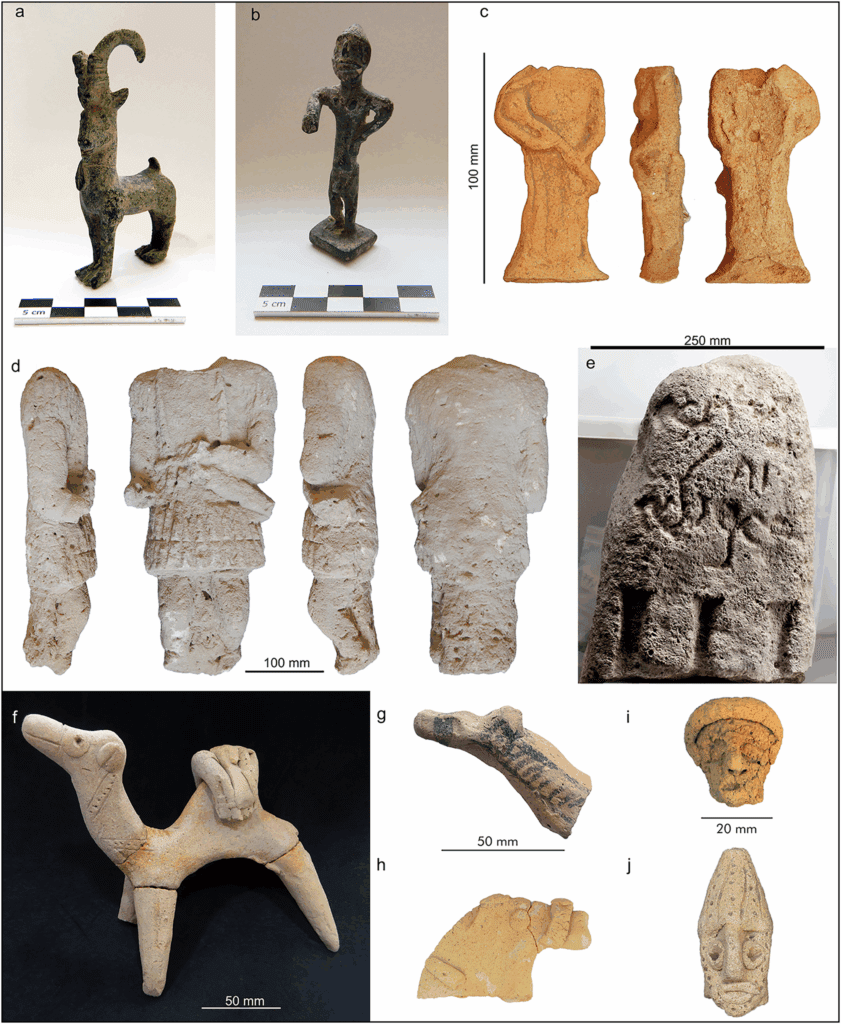
The offerings recovered from the sanctuary illustrate the deep interconnectedness of the Roman-era Gulf. Excavators found clay and bronze figurines shaped in Hellenistic artistic idioms, locally minted bronze coins that circulated beside skillful imitations of Roman aurei, stone statues with stylistic traits pointing toward southern Arabia, and a rare inscription written in Aramaic, the commercial lingua franca once shared by merchants from Mesopotamia to the Levant. Rather than a community shrine, B-III appears to have been a spiritual waypoint, a place where sailors and caravan leaders invoked protection before venturing across unpredictable waters or desert routes. Its emergence aligns with the influence of the Characene kingdom, a Parthian-era polity that dominated maritime exchange at the head of the Persian Gulf. Unlike the more direct foreign oversight suggested for the Late Bronze Age, the Roman-era presence seems commercial rather than administrative, expressed through the cosmopolitan character of the offerings.
A Site Shaped by Shifting Regional Powers

Across three millennia of occupation, one pattern stands out. Moments of intense foreign political influence in the Gulf coincide with sharp increases in imported or exotic objects at Tell Abraq, while quieter geopolitical phases saw the settlement adopt a more localized mode of life. Through all these changes—from Late Bronze Age trade station, to Iron Age domestic settlement, to Roman-era sanctuary—Tell Abraq remained resilient, adjusting to new realities without breaking its long chain of occupation.
A Gulf Crossroads Linking Worlds
Today, Tell Abraq stands as one of the Gulf’s most revealing archaeological archives. Its exceptional stratigraphy shows how communities along the Arabian coastline engaged with far-reaching networks that connected the Indian Ocean to the wider Near East. What looks like a modest mound by the sea was, in reality, a key node in the global systems of antiquity, a place where goods were handled, prayers were spoken, alliances were renewed, and travelers launched themselves toward distant horizons.
Degli Esposti, M. (2025). Tell Abraq: cross-cultural connections in the Persian Gulf from the Late Bronze Age to the early centuries AD. Antiquity, 1–8. doi:10.15184/aqy.2025.10246
Cover Image Credit: Degli Esposti 2025, Antiquity