
For decades, the late Republican history of Hispania Citerior has been marked by silence — a thinly documented interval between civil conflict, economic boom and the administrative reforms of Augustus. A newly restored copper vessel from Cartagena has now broken that silence. From a collapsed room sealed by fire 1,700 years ago, archaeologists have recovered an inscription that names a previously unknown provincial governor and offers some of the clearest evidence to date for Roman lot-casting rituals in the western Mediterranean.
A Vessel Buried by Fire, Preserved by Catastrophe
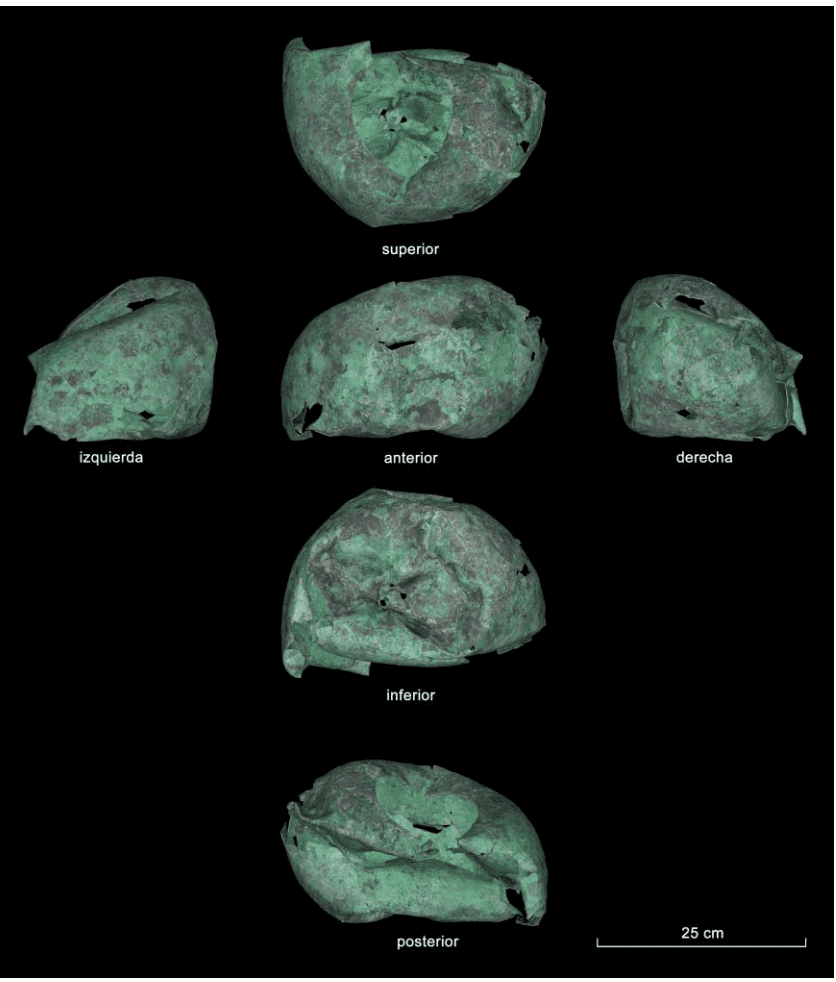
The discovery was made in Cartagena’s Molinete Archaeological Park, where excavations of the Atrium Building uncovered a copper-alloy sitella crushed beneath debris from an upper floor. The fire that destroyed the structure around the year 300 AD carbonized the wooden beams, collapsed the ceiling and unintentionally protected the vessel from further corrosion.
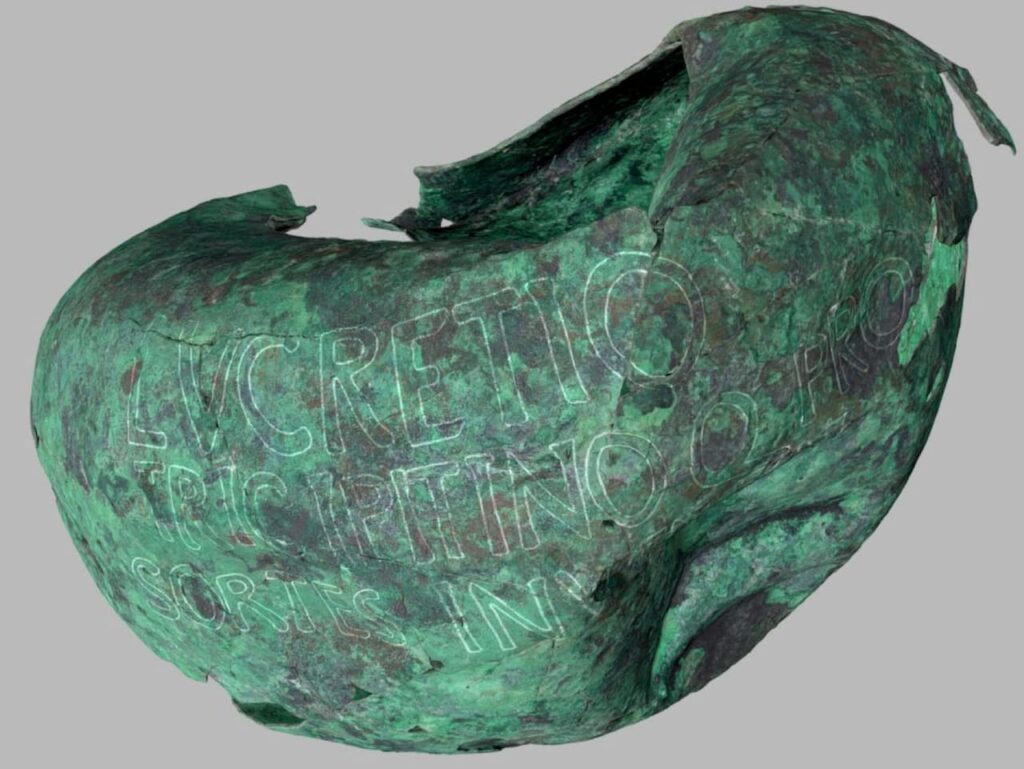
Despite being reduced to more than 250 fragments, the hammered copper sitella — originally globular with a broad circular mouth — preserved an inscription whose fine lines survived the building’s collapse.
A Governor Lost to History: Spurius Lucretius Tricipitinus
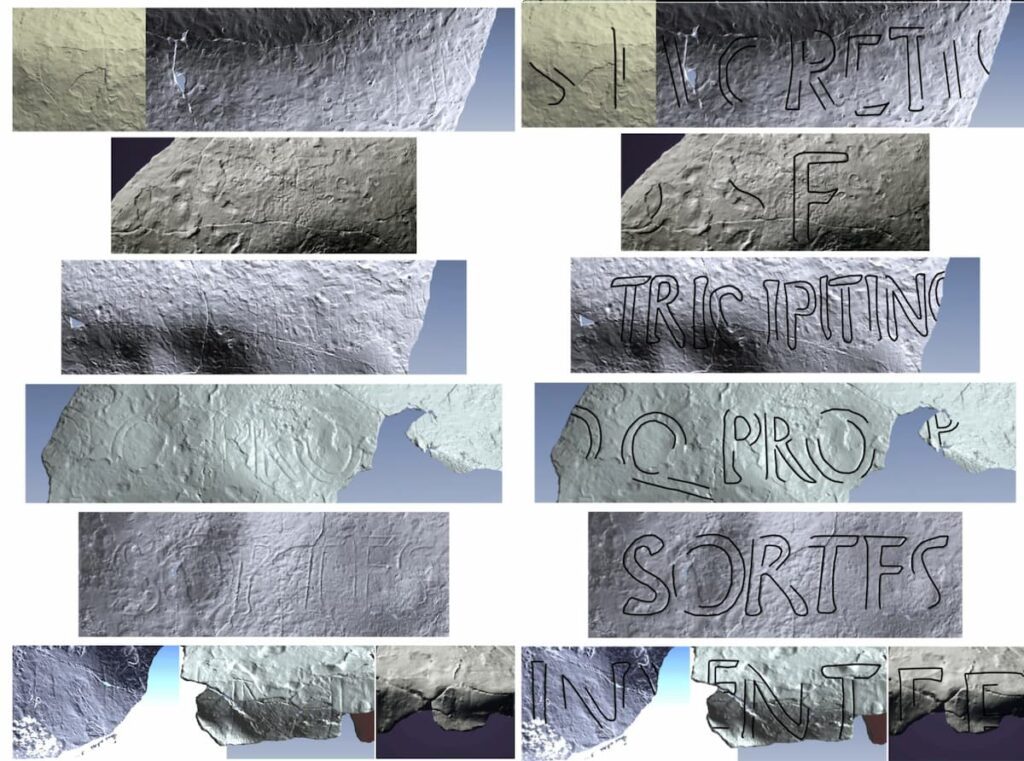
Restorers eventually recovered three clear lines of text naming Spurius Lucretius Tricipitinus, identified as quaestor pro praetore, a rare position in which a quaestor was granted full praetorian authority to govern a Roman province. Only one such emergency magistracy had ever been documented in Hispania Citerior.
Dating to 47–27 BC, the inscription places Tricipitinus in the turbulent final decades of the Republic — a period shaped by shifting allegiances, military demands and the struggle for control over strategic resources.
The name itself is historic. The Lucretii belonged to one of Rome’s oldest families, remembered for the legendary Lucretia whose death helped end the monarchy. Their cognomen Tricipitinus, however, had largely vanished from public life after the early 4th century BC. Its reappearance in Spain is an epigraphic surprise with major historical implications.
Political Power and Mining Wealth
The sitella’s significance deepens when viewed alongside lead ingots found in the Cartagena–Mazarrón mining district stamped S·LVCRETI·S·F, matching the formula on the vessel. These ingots date to the 1st century BC and indicate that the family — or Tricipitinus himself — had direct stakes in the region’s lucrative silver and lead industries.
Carthago Nova was one of the most economically powerful hubs in the western Mediterranean. Its mines supplied coinage, metal for military equipment, and raw material for trade networks stretching from Italy to North Africa. A governor with ties to this industry would have wielded exceptional influence.
The Clearest Evidence Yet of Roman Sortition in Hispania
The inscription’s final line contains its most enigmatic word: sortes — the wooden or metal tablets used in Roman lot casting.
Before the invention of the rotating urn (urna versatilis), officials drew lots from a sitella exactly like this one. Sortition determined:
- distribution of provincial commands
- assignment of jurors
- allocation of land
- and, in some settings, the interpretation of divine will.
The discovery therefore links Cartagena directly to one of the Republic’s most fundamental administrative practices.
Administration or Oracle? A Ritual Borderland
The findspot adds a further layer of ambiguity. The Atrium Building sits beside a sanctuary of Isis, and in the same destruction layer excavators uncovered a large cornucopia associated with Fortuna, goddess of chance and prophecy.
Together, these finds raise the possibility that the sitella may have been used not only for civic lot casting but also for ritual consultations — evoking parallels with famous Italian oracle sites such as Praeneste, where bronze tablets were drawn to reveal divine messages.
A Rare Window into Hispania Citerior
Beyond the rediscovered governor, the vessel offers a vivid snapshot of a province whose importance has long been underestimated. Hispania Citerior formed Rome’s strategic corridor from the Pyrenees to the Levantine coast, combining Punic legacies, Iberian traditions and waves of Italian settlement tied to Mediterranean commerce.
Carthago Nova — with its sheltered port and mineral wealth — was the province’s beating heart. The sitella embodies this world, standing at the intersection of political authority, mining capital and ritual practice.
Why This Small Vessel Matters
The researchers who published the find note that the vessel “illuminates a dark period of Roman administrative history in Hispania and opens a rare window onto the political, economic and religious systems of the time.”
From the ashes of a late antique fire, the name of a forgotten governor has re-emerged, the mechanics of Roman sortition have come into focus and a deeper understanding of Hispania Citerior has taken shape.
Abascal Palazón, J. M., Noguera Celdrán, J. M., Martínez Peris, I., Ruiz de Arbulo Bayona, J., Madrid Balanza, M. J., & García-Aboal, M. V. (2025). S(Purius) Lucretius Tricipitinus, quaestor pro praetore, y la extracción de sortes en una nueva inscripción de Carthago Nova. Boletín del Archivo Epigráfico, 12, 21–62.
Cover Image Credit: Discovery of the Sitella under study, Atrium Building (UE 31161) (late 3rd century AD). Equipo Molinete, Abascal Palazón et al., 2025, Boletín del Archivo Epigráfico.