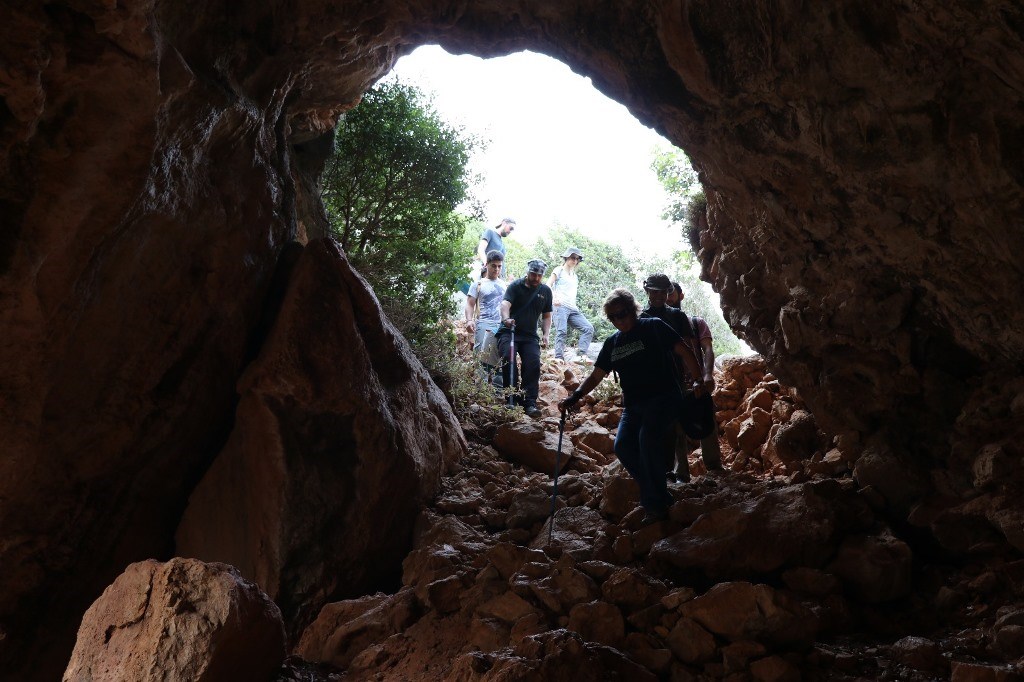
Archaeologists working at Üçağızlı II Cave in Hatay, southern Türkiye, have uncovered evidence that may reshape how researchers understand the transition from Neanderthals to modern humans in the northern Levant.
A new study published in Proceedings of the National Academy of Sciences reports long-term cultural continuity across more than 20,000 years of occupation at the cave. The sequence begins with layers associated with Neanderthals and continues into layers containing Homo sapiens remains, yet the archaeological record does not show a sharp cultural break between them.
A Critical Cave on the Route Out of Africa
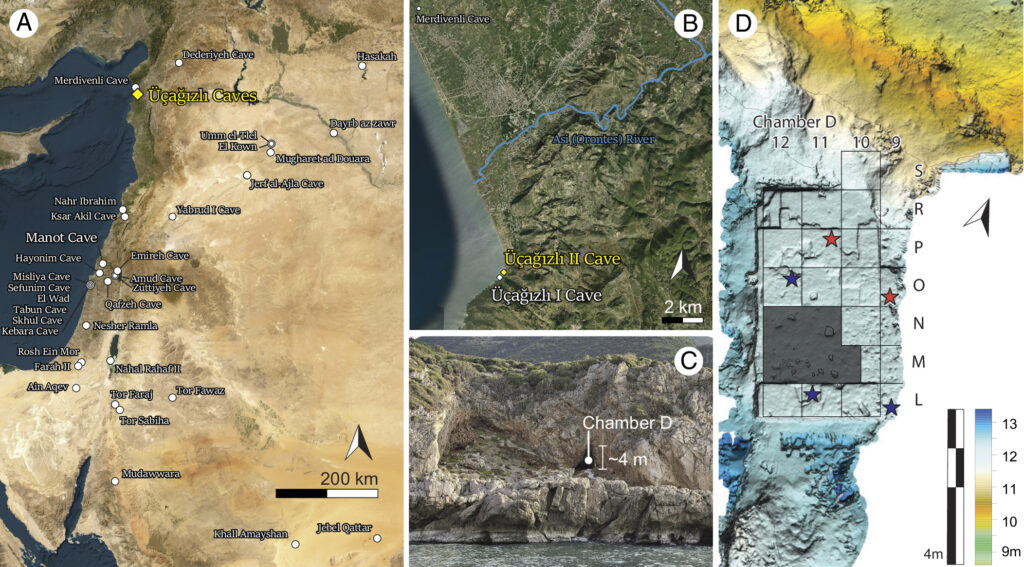
Üçağızlı II Cave lies near the eastern Mediterranean coast, in a region that served as one of the main corridors between Africa and Eurasia. That position makes the site especially important for studying when and how modern humans spread beyond Africa and encountered Neanderthal populations already living in western Eurasia.
The study reports Homo sapiens remains dated to roughly 50,000–60,000 years ago. Human fossils from this period are rare in the Levant, which gives the Üçağızlı II sequence particular weight in debates over early modern human dispersals.
Researchers note that these early modern humans may represent populations close to the ancestry of people who later spread widely across Eurasia, or they may belong to an earlier dispersal wave that left little trace in later populations. Either possibility makes the cave an important record of a poorly documented phase in human history.
The Same Habits Across Different Human Groups
The most striking part of the discovery is not simply that Neanderthals and modern humans used the same cave. It is that several forms of behavior appear to continue across the transition.
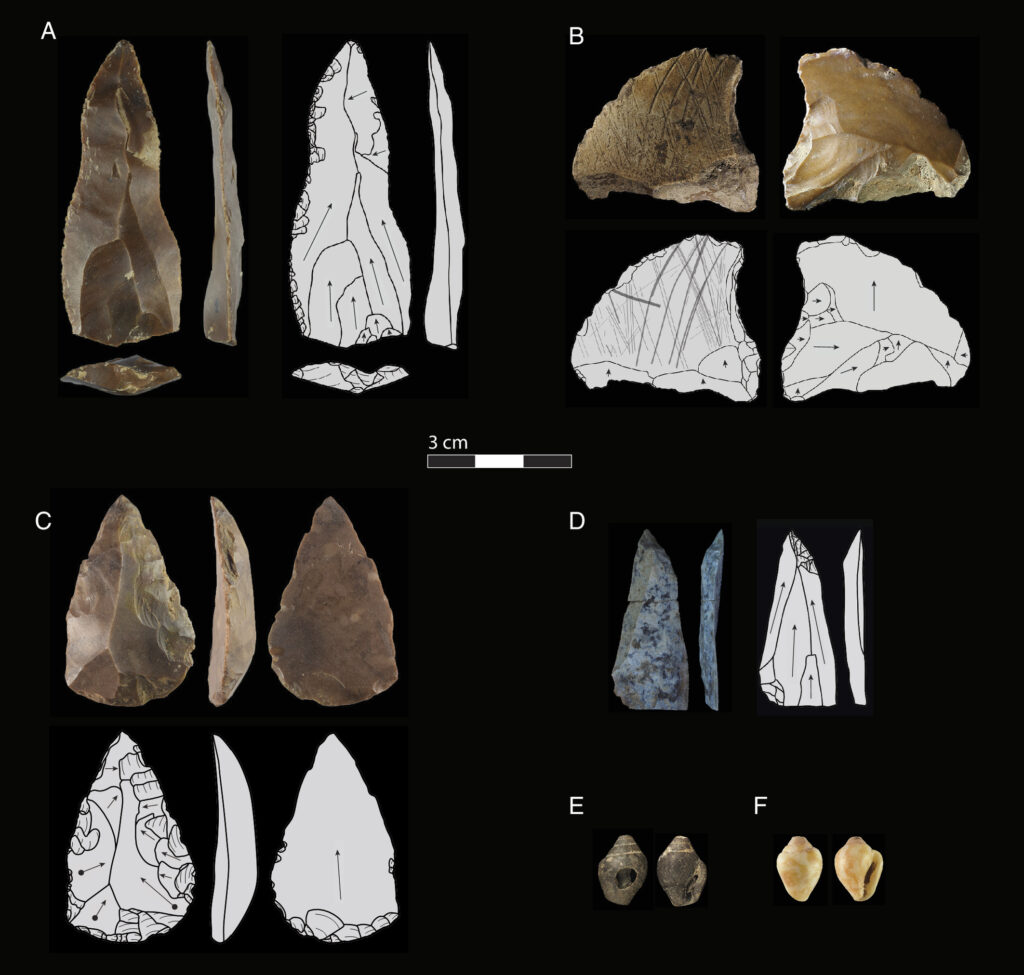
Researchers identified continuity in stone-tool production, animal exploitation, and the collection of marine shells. The shells are especially interesting because they were not gathered for food. Their presence may reflect shared traditions or culturally transmitted behaviors extending beyond purely practical activities.
The evidence does not prove that the two groups lived together in the cave at the same time. It also does not prove a single shared culture in the modern sense. But it does weaken the idea of a clean replacement, where one population disappeared and another arrived with an entirely different way of life.
A More Complicated Human Story
For a long time, the Neanderthal–modern human transition was often described as a sharp break. Üçağızlı II points to something more gradual and more complex.
At this cave, the archaeological sequence shifts from Neanderthal-associated layers to layers containing Homo sapiens remains while many cultural practices remain remarkably consistent. That makes the site one of the clearest places to examine whether early modern humans adopted local practices, whether Neanderthals and modern humans influenced one another, or whether both groups drew on similar traditions in the same landscape.
Cover Image Credit: Ankara University
Reference: Baykara, İ., D. Turan, E. Eren Kural, D. Silibolatlaz, M. K. Agras, E. Şahiner, S. Kavak, C. Zanolli, Y. Ishihara, W. Morita, and N. Morimoto. 2026. Long-term cultural continuity across the Neanderthal–modern human sequence at Üçağızlı II Cave, northern Levant. Proceedings of the National Academy of Sciences (PNAS). https://doi.org/10.1073/pnas.2609061123