
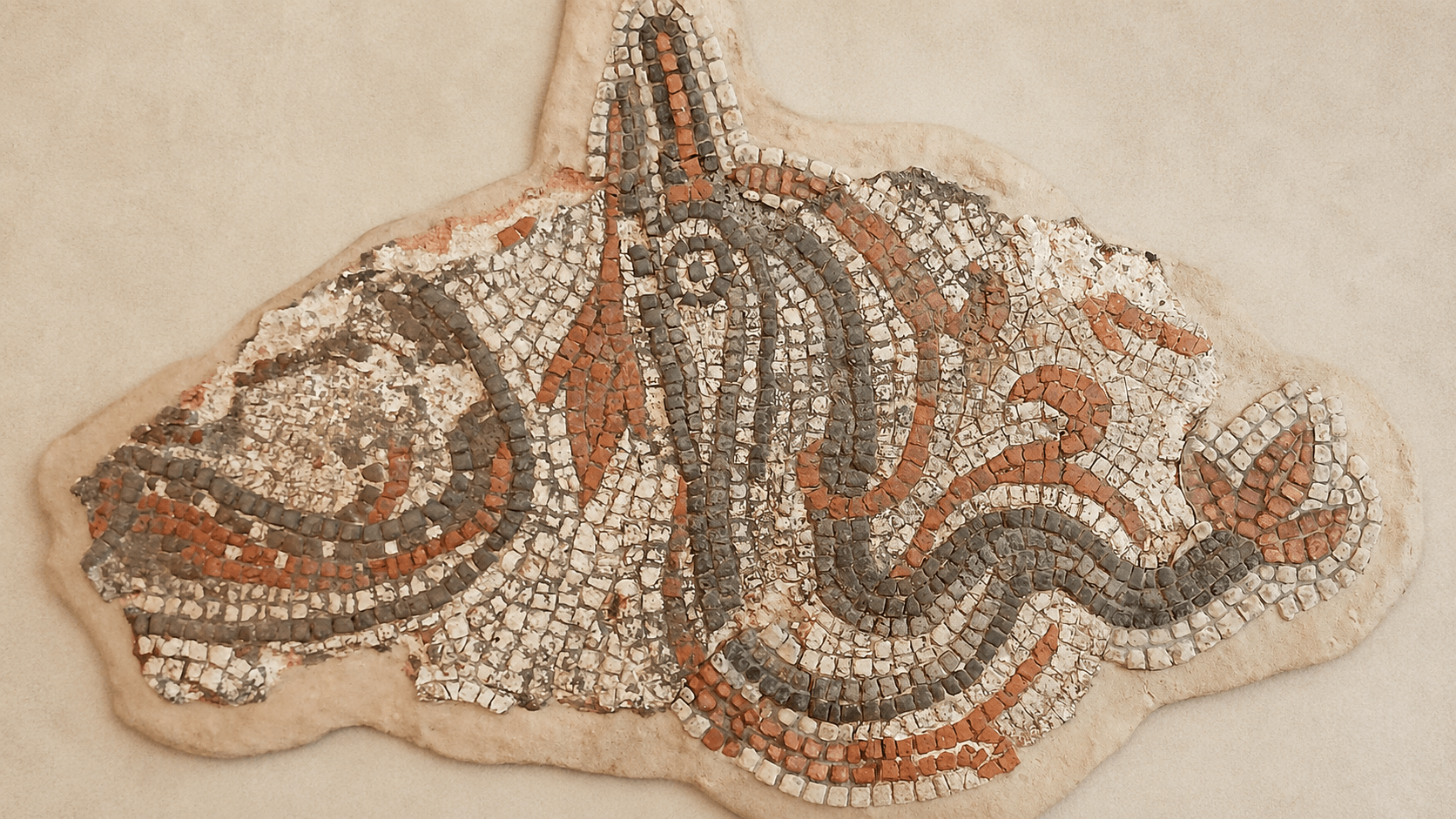
For more than two centuries, a Roman sea mosaic discovered beneath Cirencester survived largely as an image on paper. The pavement itself disappeared beneath the changing streets of the English town, but a single fragment rescued from beneath a house in the 1980s has now returned to the Corinium Museum.
The fragment does not represent a new archaeological discovery. Its return is instead the final stage in an unusual chain of preservation that began when the mosaic was first uncovered in 1783, continued through the meticulous work of early antiquarians, and depended ultimately on a small section being saved during modern construction.
Placed on a five-year loan by the Lamplough family, the fragment is expected to go on public display by the end of 2026. For the first time in roughly 45 years, specialists and visitors will be able to compare part of the original Roman floor with the historic drawings that preserved the appearance of the lost composition.
A Roman seascape beneath Dyer Street
The mosaic was discovered beneath what later became Gloucester House on Dyer Street in Cirencester, England. During the Roman period, the town was known as Corinium Dobunnorum and developed into one of the largest urban centers in Roman Britain.
Dating to the second century AD, the pavement transformed the floor of a wealthy town house into an imagined marine world. Fish, an eel, shellfish, a crab and a shrimp appeared beside swimming cupids and hybrid creatures including a sea horse and a sea leopard.
The surviving documentation suggests that these figures moved around a central mythological scene. It may have depicted Neptune in his chariot accompanied by a Nereid—possibly Salacia, the Roman goddess associated with the sea—riding a marine creature.
Such a composition would have done more than decorate the room. The owner had selected imagery connected to Classical mythology and the visual traditions of the wider Roman world, bringing an idealized Mediterranean seascape into a house in western Britain.
The drawing survived when the floor did not
Soon after its discovery, the pavement was recorded in detail by antiquarian Samuel Lysons with assistance from artist Richard Smirke. Their work preserved not simply the general arrangement but individual creatures and figures that would otherwise have disappeared from the archaeological record.
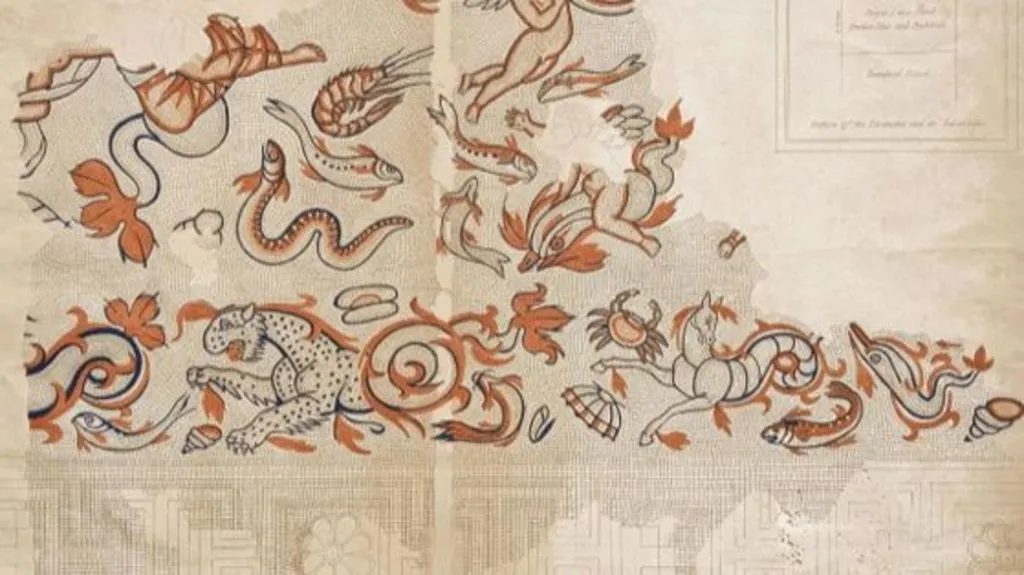
This distinction matters because archaeological illustration in the late 18th and early 19th centuries varied greatly in accuracy. Lysons, however, developed a reputation for carefully recording Roman buildings and mosaics, often using precisely colored illustrations created from direct observation.
The sea-life mosaic was subsequently reburied during the 19th century. Later building work damaged the pavement, and its location beneath an inhabited and repeatedly altered part of Cirencester made systematic preservation difficult.
Over time, the drawing became more complete than the surviving archaeology. Researchers could study the mosaic’s design, but the original tesserae—the small pieces of stone and other material used to construct the image—were effectively beyond reach.
A corner rescued from beneath a house
The story changed during work beneath Gloucester House in the early 1980s. Much of the floor had already been lost, but one surviving corner was identified and lifted by Stephen Clews, then assistant curator at the Corinium Museum, and conservator Marilee Parrott.
Nerina de Silva later conserved the section as part of her undergraduate research. It then passed into the care of the Lamplough family, the owners of Gloucester House, where it remained protected but outside public view for approximately 45 years.
The fragment was therefore not missing in the conventional sense. Museum staff knew that a section had survived, but the public story of the pavement continued to depend largely on the antiquarian record.
In 2026, Piers Lamplough contacted the Corinium Museum and invited its staff to examine the piece. The family subsequently agreed to lend it to the museum for five years.
“This fragment has travelled an incredible path through nearly two thousand years and quietly connected generations of people,” Lamplough said in the announcement issued by the Corinium Museum and Cotswold District Council. “We never truly own history. We simply become its custodians for a time.”
What one fragment can reveal
A single corner cannot reconstruct the entire pavement, but it can answer questions that even the most accomplished drawing cannot. The surviving tesserae preserve direct evidence of the colors, materials, scale and workmanship used by the mosaicists.
Comparison with the historic illustration may also show how faithfully Lysons and Smirke recorded what they saw in the 18th century. The fragment effectively provides a physical reference point for assessing one of the earliest detailed records of a Romano-British mosaic.
“We all thought the mosaic lost forever, so to have a fragment find its way back to us after all this time is incredibly exciting,” Corinium Museum Director Emma Stuart said.
Dr. Pat Witts of the Association for the Study and Preservation of Roman Mosaics has described the pavement as one of the best documented and most Classical in style among the mosaics of Roman Britain. Its importance rests not only on the sophistication of its marine imagery but also on the rare survival of both an early visual record and part of the original floor.
Reconstructing a vanished Roman house
The Corinium Museum already displays the Seasons Mosaic and the Hunting Dogs Mosaic, which are believed to have belonged to the same Roman town house. Together, the pavements suggest that the residence contained several rooms decorated with ambitious figurative designs rather than simple geometric patterns.
The newly returned section may help connect those surviving floors with the lost marine pavement. Even without the rest of the room, it offers a material glimpse of how the house’s owner used mythology, animals and color to shape the experience of the interior.
Most of the sea-life mosaic remains beneath the accumulated history of Dyer Street—or has been destroyed by later construction. What survives is divided between two very different forms of evidence: an 18th-century image that preserved the whole design and a small piece of Roman craftsmanship that retained its physical substance.
Neither record is complete. Together, however, they bring a floor lost beneath an English town closer to view than it has been for generations.