A 1,700-year-old Roman board game excavated at Vindolanda, one of the most important archaeological sites on Hadrian’s Wall, has been made playable again through 3D scanning and 3D printing. The replica allows visitors to handle and play a version of the game while the original stone board remains protected.
The project centers on a stone board found in 2019 and interpreted as a board for Ludus Latrunculorum, a Roman two-player strategy game associated with tactical play, soldiers, and civilian leisure across the empire. It was carried out through a collaboration between the Vindolanda Charitable Trust and Newcastle University.
The result is not the rediscovery of a lost Roman rulebook. The exact rules of Ludus Latrunculorum have not survived. Instead, the project shows how archaeology, engineering, and museum interpretation can work together to make a fragile object understandable without putting the original at risk.
A Game Board from Life Beyond the Fort
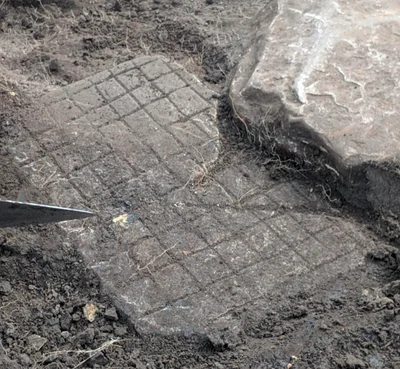
The board was discovered at Vindolanda between a bath-house drain and a workshop wall, beside a late third-century road. That location is important because it places the object outside the fort itself.
Ludus Latrunculorum is often linked with military life, partly because of its name and strategic character. But the Vindolanda board was found in a setting connected with the wider frontier community, not simply within a barrack block or military room. Newcastle University notes that this context suggests the game was not only a soldier’s pastime. It may also have been played by women, children, traders, enslaved people, and other civilians living around the frontier settlement.
Vindolanda, in modern Northumberland, was a Roman military and civilian community on the northern edge of the empire. At any one time, an estimated 1,500 to 5,000 people lived there. Its population was not exclusively military, and its finds show a place connected to long-distance supply networks, imported goods, and the daily routines of people who lived far from Rome but within the Roman world.
The board itself later had a second life. According to Newcastle University, it was reused as flagstones for a farm built on the same site, a common fate for Roman stone in later periods. It survived in five separate stone pieces, which together formed the complete game board.
A Roman Strategy Game with Missing Rules
Ludus Latrunculorum was one of the best-known board games of Roman Britain, but it remains only partly understood.
No complete ancient set of rules has been found. Researchers therefore reconstruct the game cautiously, using clues from ancient authors, archaeological boards, gaming pieces, dice, and the contexts in which such objects are discovered.
What can be said with more confidence is that it was a two-player strategy game played on a gridded board. Boards could be square or rectangular, often between seven and twelve squares across. Players used pieces, sometimes interpreted as “soldiers,” to trap opposing pieces. The aim may have been to immobilize the opponent or capture a special piece, sometimes described as a king.
The game is often compared with modern draughts or checkers, but that comparison should not be pushed too far. Ludus Latrunculorum belonged to a different social and cultural setting, and its exact rules remain uncertain.
From Excavated Stone to Digital Model
Before the original board was sent to Canada for display, the Vindolanda Charitable Trust contacted Newcastle University to see whether a realistic replica could be produced.
The board was taken to Newcastle University’s Stephenson Building by Sophie Westlake, Activity and Diversity Officer at the Vindolanda Trust, and Barbara Birley, the Trust’s Senior Curator. The university team included Paul Watson, Electrical and Electronic Team Leader, and Dr Jenny Olsen, Lecturer in Mechanical Engineering.
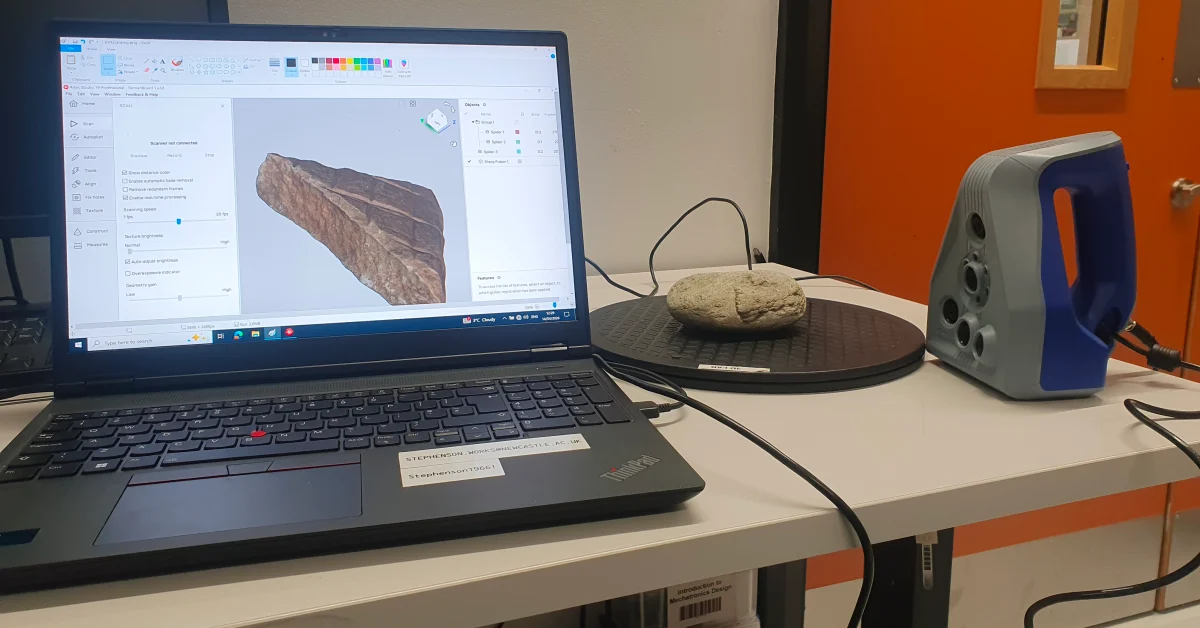
Each of the five stone pieces was scanned separately using the university’s handheld high-resolution Artec 3D Spider scanner. The process generated positional point data, which was used to create a detailed digital 3D model of the object.
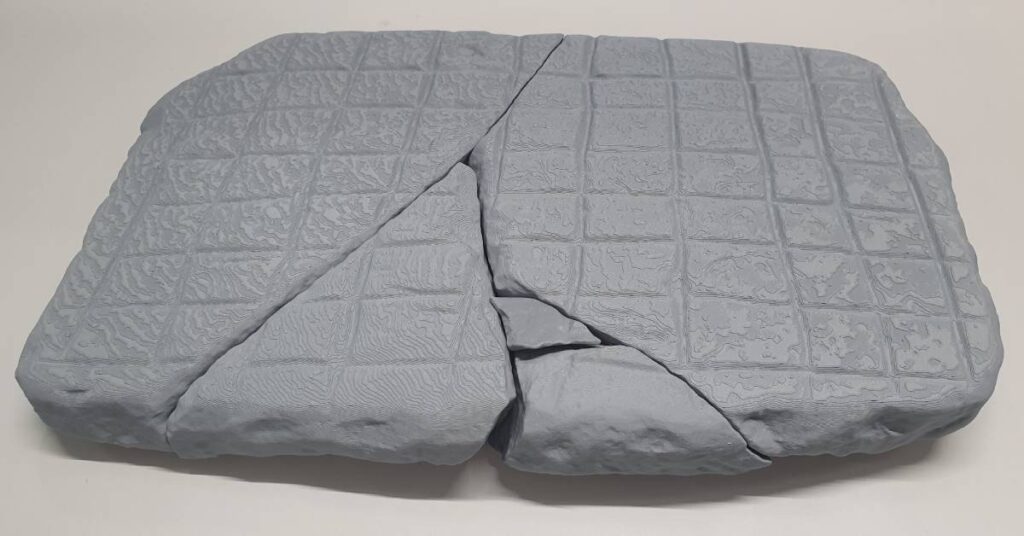
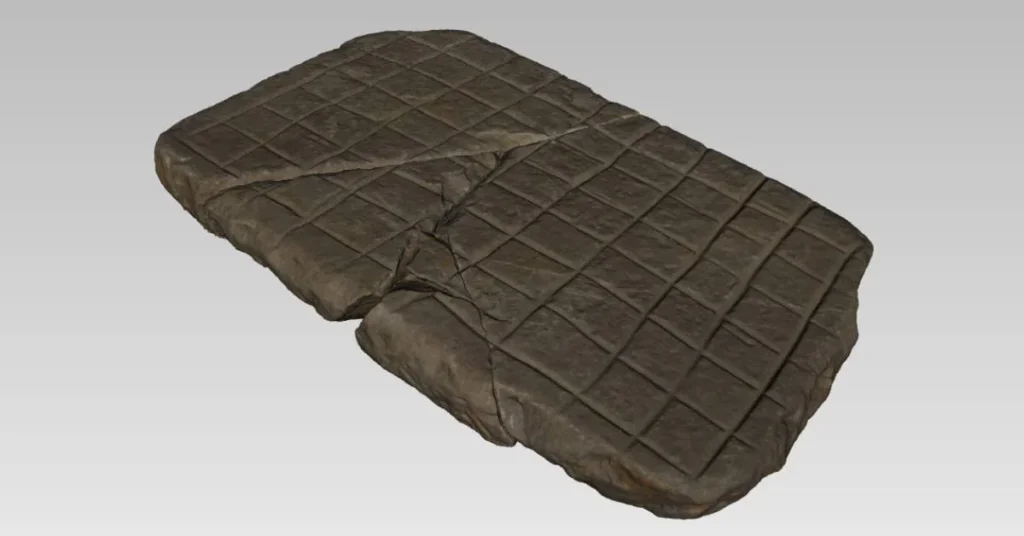
From that model, the team produced a physical replica using PLA, a biodegradable polylactic acid plastic commonly used in 3D printing. They also created an interactive digital model that allows users to rotate and examine the board on screen.
The original Roman board is currently on display at the Bata Shoe Museum in Toronto as part of the exhibition “Unearthing Vindolanda: Footwear from the Edge of the Roman Empire,” which runs through 2026 and 2027. The 3D printed replica has been handed to the Vindolanda Charitable Trust for use in public engagement at the Roman Army Museum.
Playing the Past Without Touching the Original
The point of the replica is not to replace the original artifact. It is to reduce the need to handle it while giving visitors a better sense of how the object may once have been used.
That matters because a gaming board is not only a carved surface. It was made for hands, pieces, pauses, mistakes, and competition. Looking at it behind glass can preserve the object, but it cannot fully convey the experience of playing on it.
Vindolanda is already known for finds that reveal unusually intimate details of life on Rome’s northern frontier: writing tablets, shoes, jewellery, weapons, armour, tools, and personal objects. Gaming boards belong to the same world. They show people not only marching, building, trading, or working, but also thinking tactically, competing, socializing, and passing time.
The site holds 16 gaming boards, around 15 percent of all such boards known from Roman Britain, making it the largest collection of its kind in the country. That does not mean every person at Vindolanda played the same game in the same way. But it does show that board games were a visible part of frontier life.
For archaeologists and museum visitors, the 3D printed board offers a controlled form of access. The original stone remains protected. The digital file preserves surface detail. The replica makes it possible to understand the object through use, not just observation.
For a Roman game whose exact rules remain partly lost, that may be the closest modern players can come to the table.