
A rare Iron Age skull found beneath a collapsed wall exposes how Augustus’ legions displayed the heads of defeated Cantabrian fighters
Forensic archaeology has delivered a stark window into the Cantabrian Wars: the fractured skull of a middle-aged defender from La Loma was recovered under a collapsed wall, confirming that Augustus’ legions had once mounted his severed head as a public warning. What survived was not a burial — it was a message.
The study, published in the Journal of Roman Archaeology, combines archaeological evidence, biological anthropology, radiocarbon dating, and ancient DNA to reconstruct the fate of a man who resisted Rome’s final push into northern Hispania.
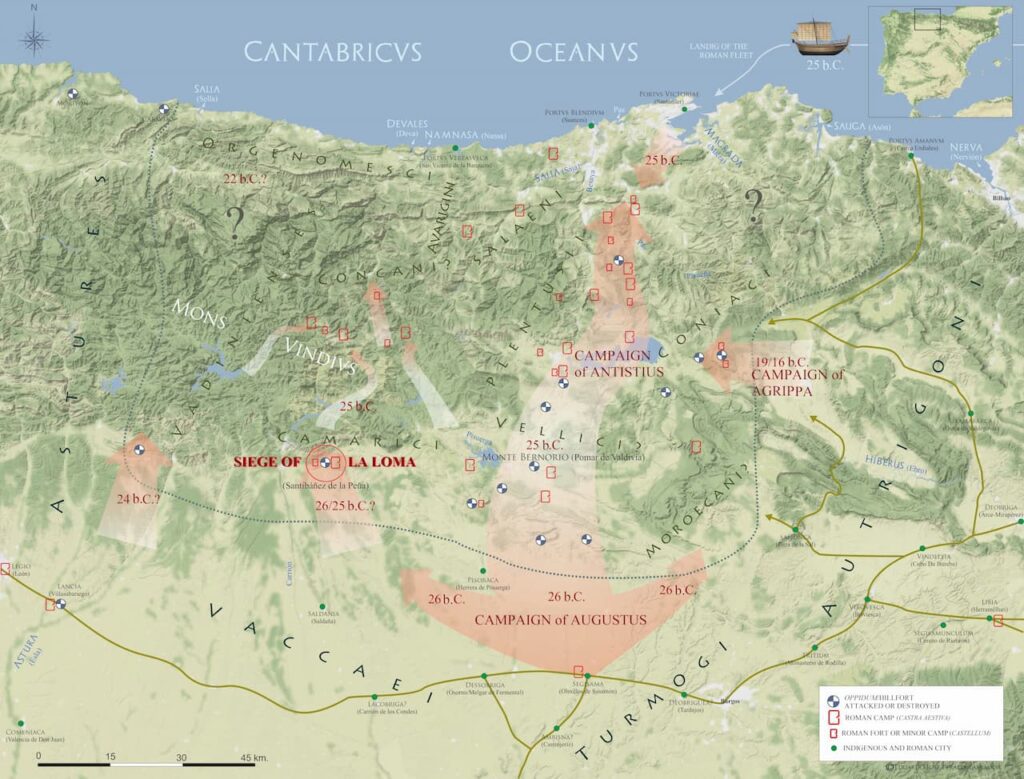
A hillfort under siege during Rome’s final northern campaign
La Loma belonged to the Cantabrian Camarici, one of the last communities to resist Roman rule during the Cantabrian Wars (29–16 BC) — a conflict that marked the final stage of Rome’s conquest of the Iberian Peninsula. After becoming the first emperor, Augustus deployed elite units to crush these northern hillforts.
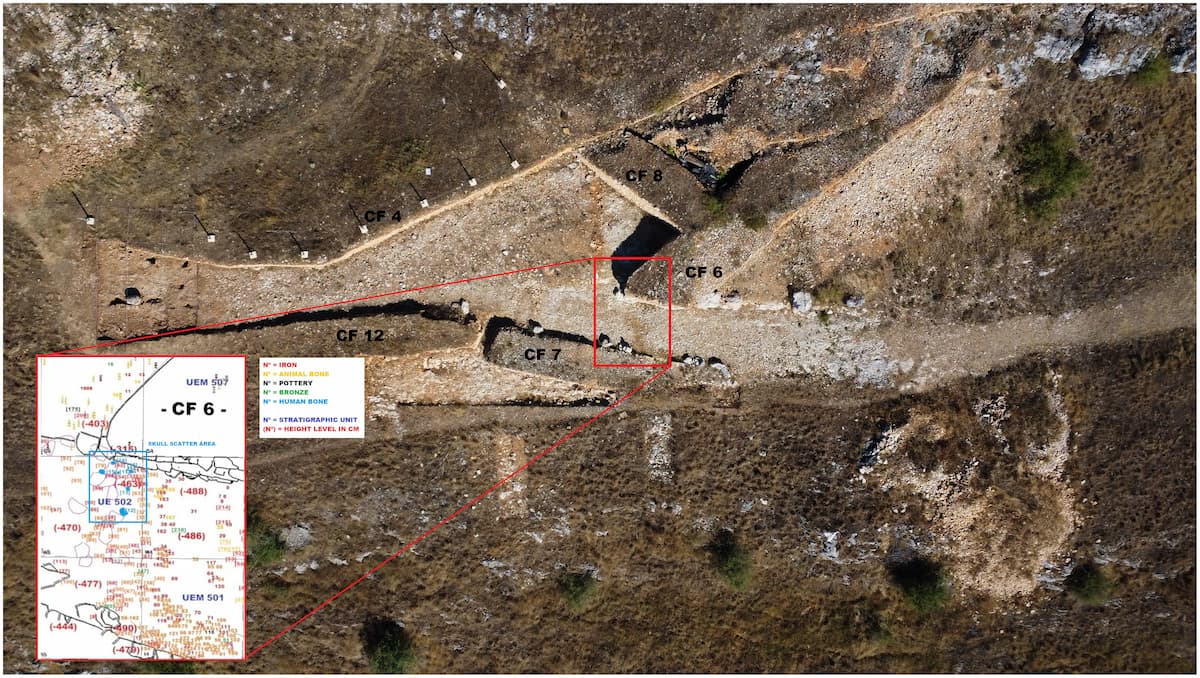
Excavations led by Eduardo Peralta, Jesús Francisco Torres-Martínez, and Santiago David Domínguez-Solera revealed a meticulously planned operation: the Romans built a network of camps, forts, and Roman siege lines encircling the hill.
Near the northeastern gate, archaeologists documented hundreds of arrowheads, fragments of caligae, buckles, and weapon debris — the physical residue of a violent assault that ended with the settlement burned and its fortifications demolished.
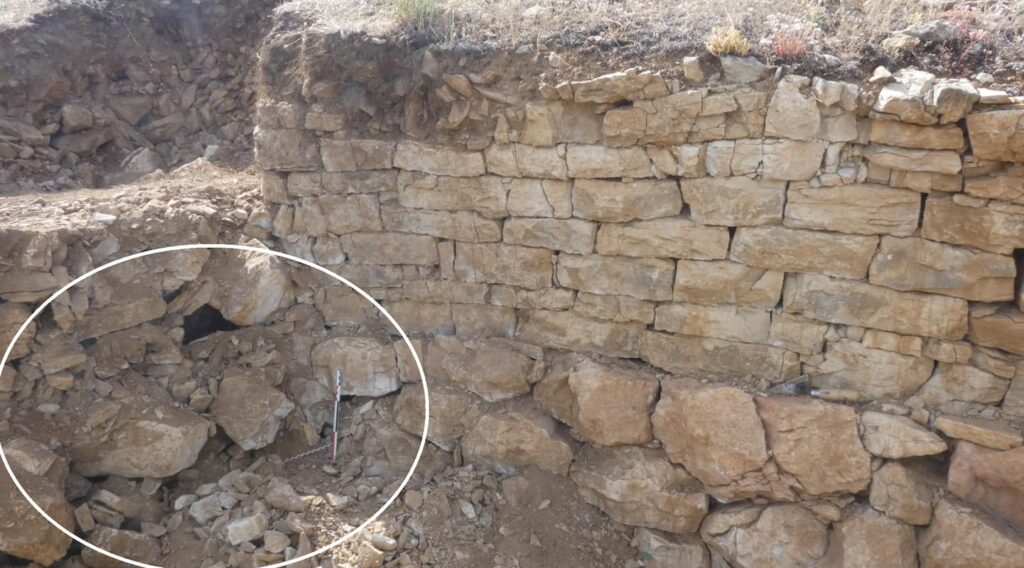
It was inside the debris of one of those intentionally collapsed walls that the skull surfaced in 2020.
A broken skull beneath the rubble
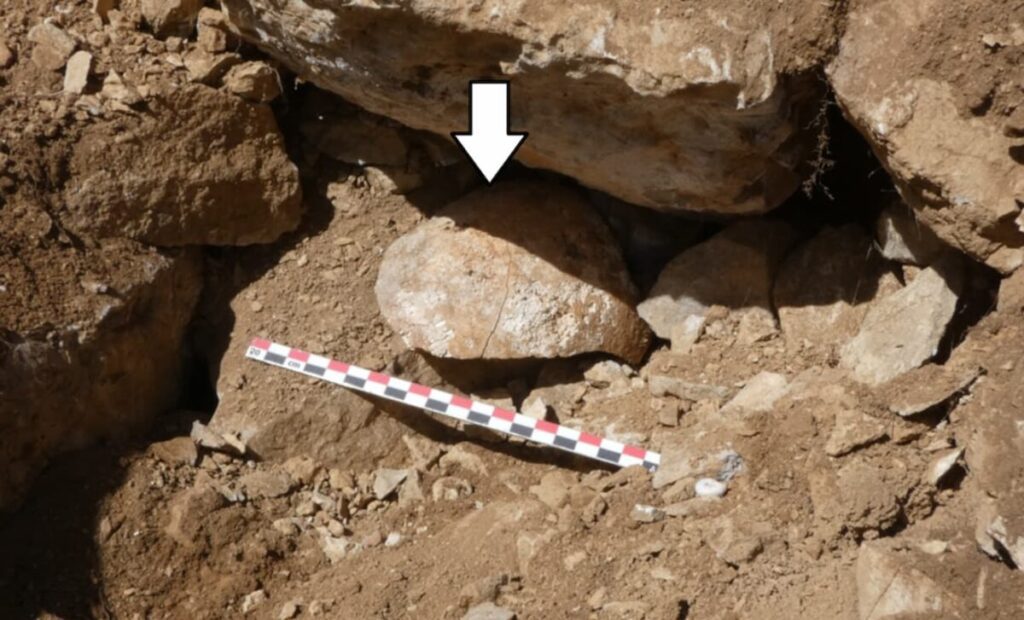
The remains were found scattered across a one-meter area, with no traces of the rest of the skeleton. The collapse layer was carefully sieved to retrieve every fragment. Radiocarbon dating placed the skull between 171 BC and AD 4 — fully consistent with the Cantabrian Wars.
Genetic and anthropological analysis revealed:
- Male, approximately 45 years old
- Local Iron Age ancestry, matching populations from Monte Bernorio and La Hoya
- Paternal haplogroup R1b-DF27, still dominant in Iberia today
- Maternal haplogroup V20, common in modern Spain
His mandible was missing, suggesting it had already detached by the time the head fell from its display point.
Evidence of exposure: a severed head mounted as a trophy
The skull told a clear story.
Its fractures were consistent with dry bone breakage, meaning the bones shattered when the wall fell — not at the moment of death.
But the surface showed something else:
- Erosion, whitening, and cracking, typical of long outdoor exposure
- Linear friction marks, created while the bone was still fresh
- No fire damage, confirming the head was not inside the burning settlement
Together, the evidence indicates the head was displayed on top of the fortification — just as Roman art shows on monuments like the Column of Trajan decapitation scenes, where legionaries parade the heads of defeated Dacians.
The authors conclude that the defender died during the fall of the oppidum, his head was mounted by the Romans, and when the legionaries finally dismantled their position, the skull fell and became trapped beneath the collapsing wall.
The fresh-bone friction marks suggest the Roman occupation was short-lived — perhaps only late summer to autumn.
Not ritual — pure military intimidation
The researchers dismiss the idea of a Celtic ritual. There was no burning, no ceremonial placement, no symbolic preparation.
This was not culture — it was conquest, a blunt form of psychological warfare designed to warn the survivors of northern Hispania.
Human remains from the Iron Age north are extremely scarce, making this skull a rare and powerful witness. It captures a frozen moment from the Roman conquest — not through texts, which are mostly lost, but through bone, rubble, and the violence etched into both.
As ongoing excavations at La Loma deepen the understanding of Rome’s northern campaigns in Iberia, the fate of this anonymous defender stands as the most direct physical testimony yet of resistance, defeat, and imperial display.
Domínguez-Solera SD, Torres-Martínez JF, Carnicero S, et al. The human skull from the siege of La Loma (Santibáñez de la Peña, Palencia, Spain). Journal of Roman Archaeology. Published online 2025:1-16. doi:10.1017/S1047759425100512
Cover Photo: Aerial view of the excavation sectors at La Loma, showing the collapsed fortification where the defender’s skull fragments were recovered. Inset: distribution map of finds in the collapse layer. Credit: Santiago David Domínguez-Solera and Miguel Osma