When a sewer trench was cut into a quiet street in northwestern Türkiye back in 2014, workers briefly exposed part of a Roman mosaic floor before authorities ordered the area sealed. It was too risky to investigate at the time, and too little was visible to understand what lay beneath.
Eleven years later, archaeologists from the Iznik Museum have reopened the site — and what is emerging from the soil is far more ambitious than anyone expected.
The First Face to Reappear: Askania, Lake Iznik’s Ancient Persona

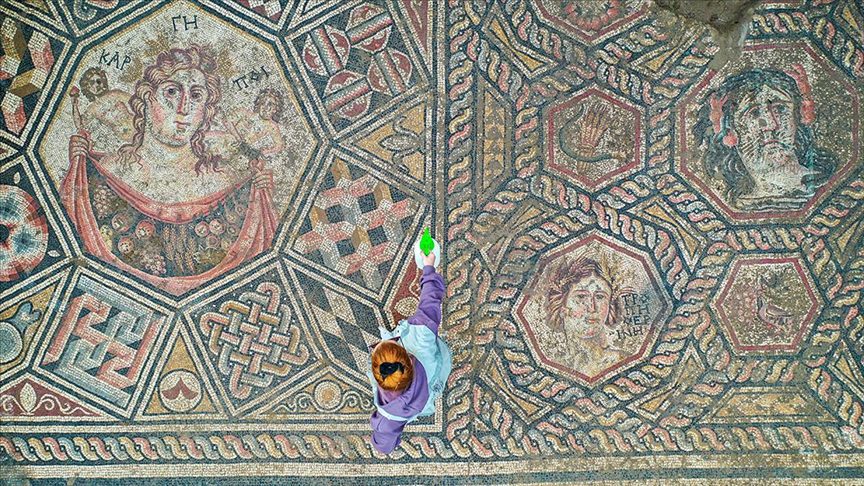
The most striking section to surface so far is the personification of Askania, the Roman-era name for Lake Iznik. The portrait shows a woman whose hair flows like waterweed, crowned with stylized crab claws, her neckline shaped like the contours of waves.
A small inscription beside her confirms the identification — a rare local personification seldom seen in the region’s existing mosaic corpus.
This single figure already places the mosaic among the more unusual artistic works of Roman Bithynia, hinting at a symbolic connection between the settlement and the lake that defined its landscape.
A Companion Panel Suggests Abundance and Seasonal Renewal
Nearby, another figure has begun to reappear: a woman holding a basket filled with fruits, flanked by two partially preserved mythic characters marked with abbreviated inscriptions. Archaeologists believe she may represent a goddess of agricultural abundance, though full epigraphic work is still underway.
Clues Point Toward a High-Status Roman Building
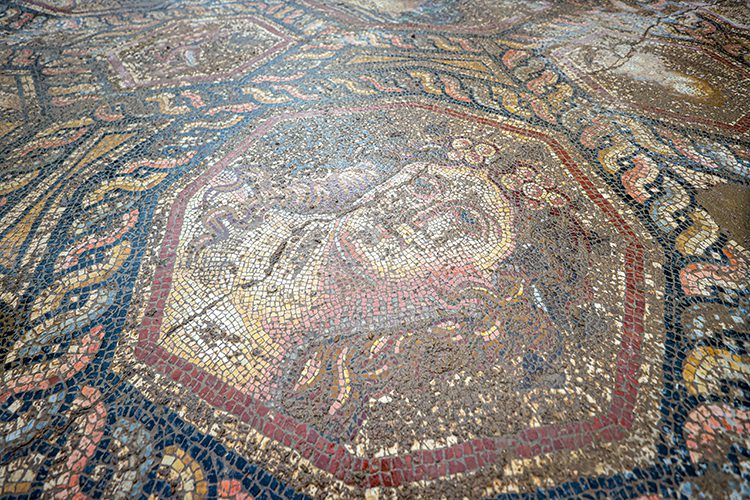
The quality of the artwork suggests that the mosaic belonged to a high-status Roman building, possibly a public hall or an elite residence within ancient Nicaea. Painted wall fragments, pieces of marble flooring, and the exceptional refinement of the tesserae reinforce this interpretation.
A threshold decorated with two pairs of sandal prints — arranged as if marking entry and exit — adds a ceremonial dimension to the room.
Borders of Braids, Labyrinths, Ivy, and Pomegranates
Around the main panels, the borders are alive with technical ambition:
braided bands with subtle color shifts, ivy spirals, pomegranate clusters, 3D geometric illusions, and knot motifs reminiscent of broader Anatolian traditions. Each color appears in several tonal variations, demonstrating deliberate shading techniques more typical of high-end workshop production.
A Layered Settlement That Changed Across Centuries
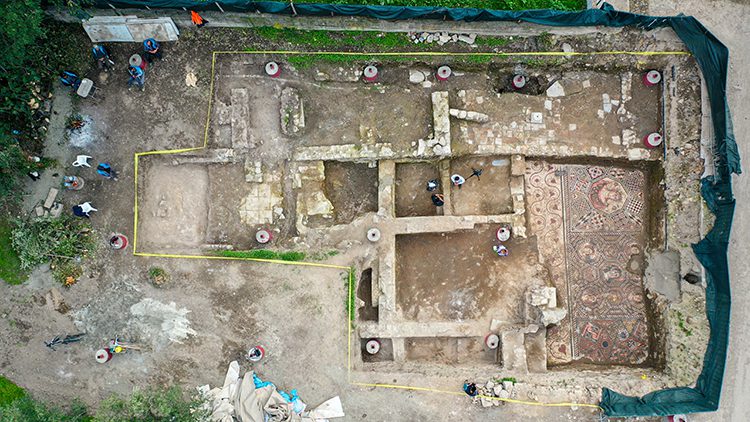
The building beneath the mosaic was damaged near the end of the 4th century, after which new construction phases were added in the 5th, 8th, 10th, and 11th centuries. Early Ottoman ceramics appear in the uppermost layers.
This sequence shows that the neighborhood remained occupied and repeatedly rebuilt for more than a millennium.
The Mosaic Extends Far Beyond the Current Trench
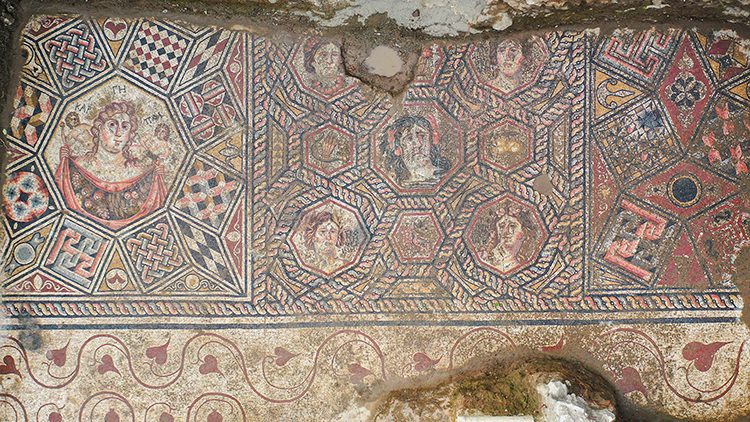
What has been exposed so far is only a fraction of the complete pavement.
Directional motifs and wall alignments indicate that the mosaic continues under the present-day road and neighboring parcels.
Future excavation seasons are expected to reveal a much larger design — one that may redefine how archaeologists understand the structure’s purpose and scale.
For now, Askania’s re-emergence after 11 years underground provides an arresting first glimpse into a forgotten artistic landscape beneath modern Iznik.
Cover Image: An archaeologist walks across the newly reopened Roman mosaic in northwestern Türkiye, where the Askania personification and surrounding mythic portraits have begun to re-emerge after 11 years underground. Credit: Mustafa Yılmaz/AA