
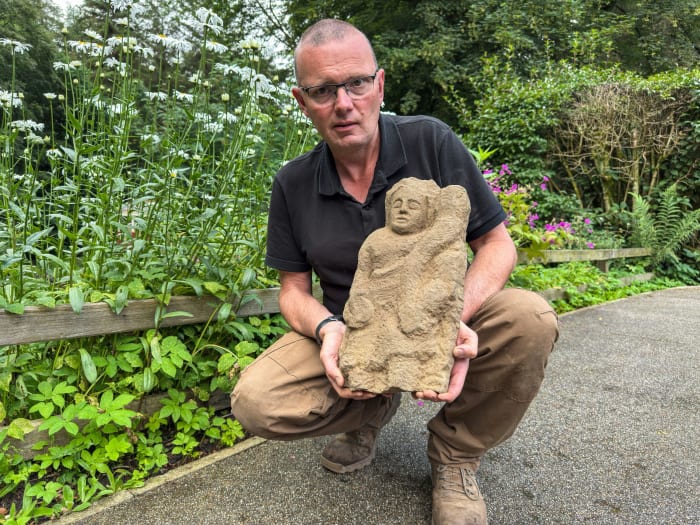
A carved Roman guardian spirit has been discovered face down beneath the floor of a fourth-century barrack at Vindolanda in northern England. The sandstone relief, probably once displayed in a small shrine, had later been reused as a paving stone, preserving its carved surface for more than 1,600 years.
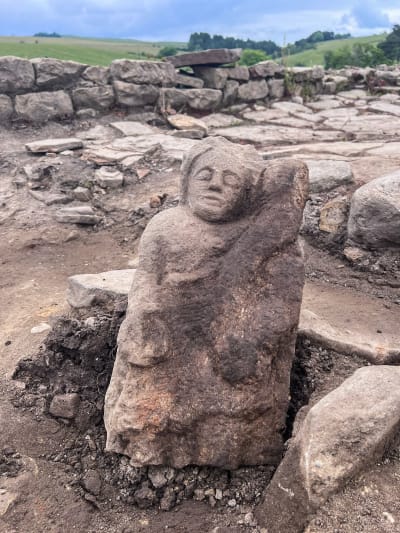
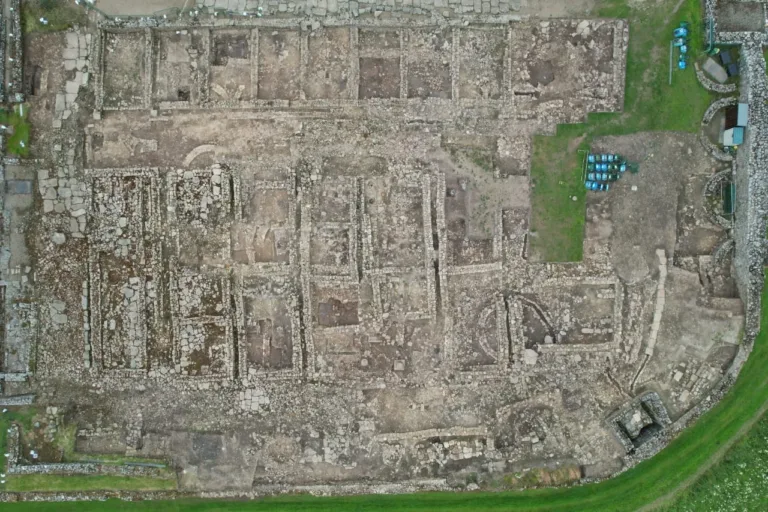
Dr Andrew Birley, director of excavations at Vindolanda, found the relief on June 16, 2026, while examining the barrack building. An unusually rounded flagstone caught his attention, and when he lifted it, the hidden side revealed the face and body of a Roman figure.
“My first thought was simply, ‘Who on earth am I looking at?’” Birley said.
Photographs were sent to Roman archaeology specialists Lindsay Allason-Jones, Fraser Hunter and Alex Rome-Griffin. They identified the figure as a Genius, a protective spirit associated in Roman religion with individuals, households, military communities and particular places.
A guardian holding symbols of abundance
The relief measures 44 centimetres high, 23 centimetres wide and eight centimetres deep. The figure carries a cornucopia in one hand and a patera in the other.
The cornucopia symbolised abundance and prosperity, while the patera was a shallow vessel used for pouring liquid offerings during religious ceremonies. Together, the objects helped archaeologists identify the figure as a Genius.
Worship of such spirits was widespread across the Roman world. A household might honour its own protective Genius, while military units, associations and settlements could invoke guardian spirits connected with their collective identity or location.
Inscriptions dedicated to a Genius are known from many parts of Roman Britain. Carved stone representations are less common, particularly examples recovered from a securely recorded archaeological setting.
The Vindolanda relief was found inside a dated fourth-century structure rather than as an isolated object with no known origin. Its position beneath the floor provides evidence for when the carving was reused, although it does not establish where it originally stood.
From a shrine to a barrack floor
Archaeologists believe the carving may have formed part of a domestic or local shrine before being removed from its original setting. At some point, the stone was turned face down and incorporated into the barrack floor.
Whether the placement carried any religious meaning is unknown. Roman builders routinely reused stone from older structures, and the relief may have been selected simply because its size and shape suited the new floor.
Its hidden position nevertheless protected the carving from centuries of weathering and foot traffic. The surface remained far better preserved than it would have been if left exposed.
The sandstone may have been worked at Vindolanda or produced within a regional carving tradition. Archaeologists have suggested that sculpture associated with the Roman fort at Lanchester in County Durham could offer useful comparisons, but further study will be required before the relief can be linked to a particular workshop.
Vindolanda before and after Hadrian’s Wall
Vindolanda stands in Northumberland, close to the Roman Stanegate road and just south of Hadrian’s Wall. The first fort at the site was established around AD 85, several decades before construction of the wall began under Emperor Hadrian in the 120s.
The early settlement formed part of Rome’s northern military network along the Stanegate, which connected important bases at Corbridge and Carlisle. Vindolanda continued to serve the frontier after Hadrian’s Wall was built and was repeatedly demolished, rebuilt and reorganised as military needs changed.
Successive forts housed different auxiliary units, while a civilian settlement developed outside the defensive walls. Soldiers, officers, craftspeople, traders, women and children all formed part of the wider community.
The barrack in which the Genius relief was found dates to the fourth century, during the later period of Roman occupation in Britain. The carving itself may be older, but no firm production date has yet been announced.
Vindolanda is best known for the wooden writing tablets recovered from its waterlogged deposits. Written in ink, the documents include military reports, supply records and private letters. They preserve ordinary concerns ranging from clothing and food to travel arrangements and social invitations.
Thousands of shoes, wooden objects, tools and fragments of textiles have also survived at the site, creating an unusually detailed record of daily life on Rome’s northern frontier. The Genius relief adds evidence for the rituals and protective beliefs practised within that community.
Three generations of excavation
The discovery has particular significance for the Birley family, whose archaeological work at Vindolanda spans three generations.
Andrew Birley’s grandfather, Eric Birley, began excavating at the site in the 1930s. His father, Robin Birley, later directed decades of research and played a central role in the investigations that brought the Vindolanda writing tablets to international attention.
Andrew Birley now leads the excavation programme, working alongside professional archaeologists and hundreds of volunteers who take part in fieldwork at the site.
The newly discovered relief is undergoing conservation and specialist examination. Once that work is complete, it is expected to go on display at the Vindolanda Museum.
The figure may once have stood in a shrine where Roman residents sought protection and prosperity. Later builders gave the stone a more practical role beneath a barrack floor. That reuse concealed the image but also preserved it, allowing the guardian to emerge again more than sixteen centuries later.
Cover Image Credit: The Vindolanda Trust